
Flickr Circles: Decoding Aesthetic DNA Through Multi-View Topic Modeling
9210_Flickr Circles Aesthetic Tendency Discovery by Multi-View Regularized Topic Modeling.
The paper introduces a framework for "Flickr Circles" discovery, which automatically categorizes social media users into groups based on shared aesthetic tendencies (e.g., architecture, portraiture). It utilizes a Multi-View Regularized Topic Model to fuse color, texture, and semantic features, followed by a manifold-guided Gaussian Mixture Model (GMM) to represent user interests.
TL;DR
Social media platforms like Flickr are goldmines of aesthetic data, yet manually curated groups are static and inefficient. This paper presents a system that automatically clusters users into "Aesthetic Circles" by analyzing their photo collections. By fusing multi-view features (Color, Texture, Semantics) and applying a manifold-regularized Gaussian Mixture Model (GMM), the researchers successfully mapped the "aesthetic fingerprint" of users, significantly improving automated tasks like photo cropping.
The Motivation: Why Aesthetic Discovery is Hard
In the realm of social media analysis, grouping users is usually done via social links (who follows whom) or simple text tags. However, Aesthetics—the "vibe" or visual style of a photographer—is much harder to quantify. The authors identified three primary bottlenecks:
- Feature Variability: Portrait photographers use different visual cues (like face landmarks) compared to landscape photographers (who might focus on horizon lines).
- The Scarcity Problem: In social networks, data follows a power-law distribution. Some users have 50,000 photos; many have fewer than 10. Standard models overfit heavily on those with sparse data.
- Cross-Channel Integration: Effectively merging low-level pixels (color) with high-level "concepts" (tags) without losing the underlying correlation.
Methodology: Fusing the Visual and the Semantic
1. The Multi-View Fusion Engine
Instead of just concatenating features, the authors treat Color, Texture, and Semantics as distinct "views."
- Color: RGB Color Moments.
- Texture: Histograms of Oriented Gradients (HOG) to capture geometric structures.
- Semantics: Latent Factor Analysis (LFA) applied to image tags to reduce noise and find latent topics (e.g., grouping "snow," "ice," and "white" into a single semantic axis).
These views are integrated using an Optimal Multi-view Learning framework, where weights for each channel are adjusted automatically based on their contribution to the manifold embedding.
2. Manifold-Guided Regularized GMM
This is the mathematical heart of the paper. To represent a user's interest, they use a Gaussian Mixture Model (GMM). To solve the "Scarcity Problem," they add a Manifold Regularizer (Laplace-Beltrami operator).
The Intuition: If two photos are visually similar on the manifold, the probability that they belong to the same "aesthetic topic" should be similar. This "smoothness" constraint prevents the model from diverging when a user has only provided a handful of images.
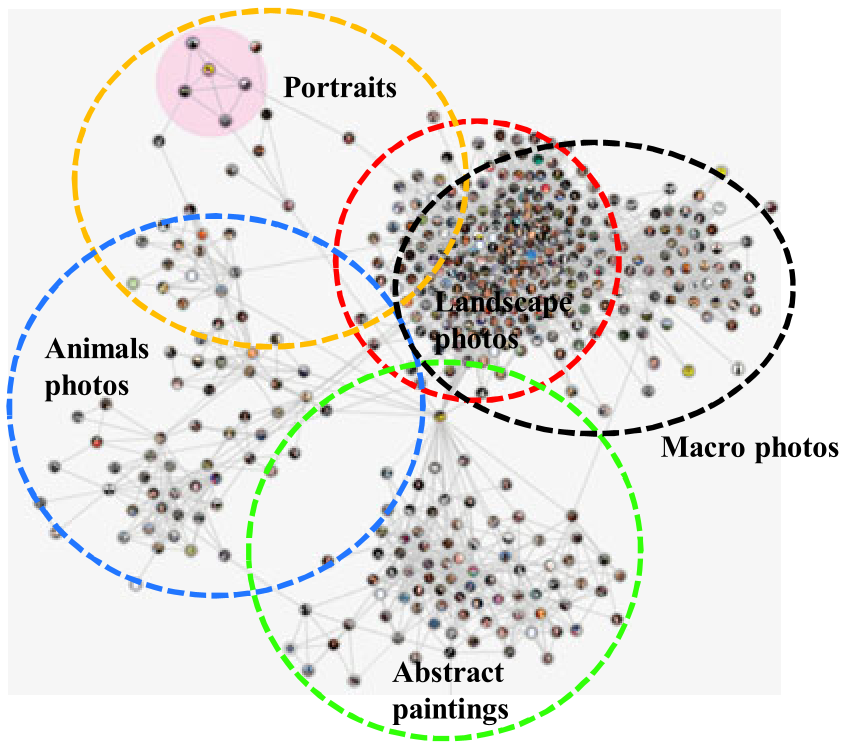 Figure 1: The overall workflow from multi-channel feature extraction to dense subgraph mining for circle discovery.
Experiments: Mining the Million-Scale Dataset
The authors crawled a massive dataset of 1 million photos from 35 Flickr groups. They compared their "Circles" against 7 state-of-the-art clustering algorithms.
Performance Highlights
- Semantic Accuracy: Across 35 distinct groups, the proposed method achieved the lowest Balanced Error Rate (BER) in 32 of them.
- Handling Sparse Data: The model showed a 15-20% gain in precision specifically for users with very few photos, proving the effectiveness of the manifold regularizer.
- Application - Smart Cropping: By using "Circle Knowledge," the system can "learn" how professional landscape photographers crop their photos and transfer that aesthetic to a novice's poorly framed photo.
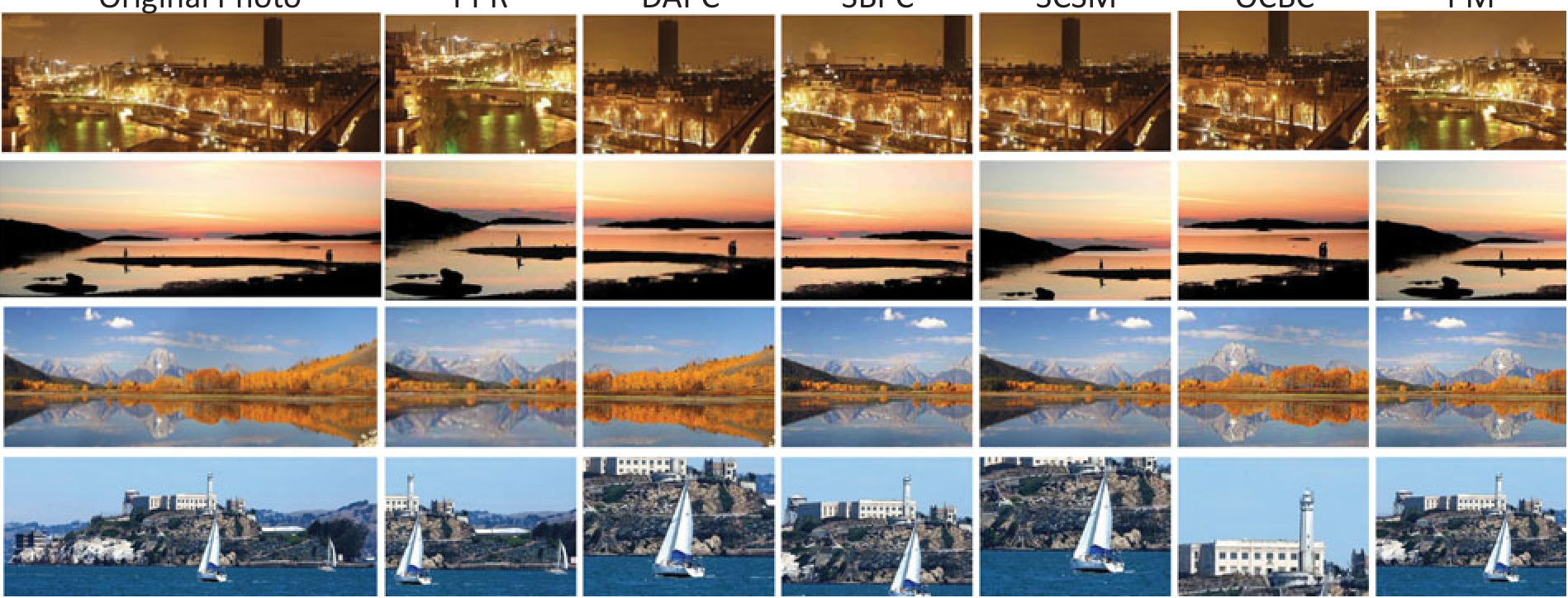 Figure 2: Examples of automated photo cropping. The system leverages the aesthetic 'style' of discovered circles to find the most pleasing sub-region.
Critical Analysis & Future Outlook
The "Flickr Circles" approach is a sophisticated bridge between low-level computer vision and high-level social network analysis. Its strength lies in its unsupervised nature—it doesn't need labeled data to find these circles.
Limitations: The authors admit the model struggles with "Abstract Aesthetics." While architecture and landscapes have clear geometric patterns, abstract art relies on conceptual triggers that current HOG and Color Moment features cannot fully capture.
Future Path: Incorporating Deep Learning (CNN/Vision Transformers) as the feature backbone would likely resolve the issues with abstract aesthetics. However, the Manifold-Regularized GMM remains a powerful tool for any social media task where data sparsity is an issue.
Conclusion
This work moves us closer to AI that "understands" style. By treating aesthetics as a distribution on a manifold, we can categorize the vast, messy world of social media photography into meaningful, actionable circles of interest.