
SOLVER: Architecting the Synergy Between Online and Vehicular Social Networks
9270_SOLVER A Framework for the Integration of Online Social Networks with Vehicular Social Networks.
This paper introduces SOLVER (Social OnLine and social VEhicular netwoRks), a hybrid framework that bridges centralized Online Social Networks (OSNs) with distributed Vehicular Social Networks (VSNs). By leveraging "virtual bridges" formed by users belonging to both domains, the framework achieves seamless data dissemination and maintains connectivity in highly dynamic vehicular environments.
TL;DR
The paper proposes SOLVER, a hybrid framework that integrates the centralized reliability of Online Social Networks (OSNs) with the opportunistic, distributed nature of Vehicular Social Networks (VSNs). By allowing data to "handover" between these two worlds, the system eliminates connectivity gaps in VSNs and reduces server congestion in OSNs, ultimately boosting connectivity probability and reducing latency.
Problem & Motivation: The Gap Between Cloud and Road
Vehicular networks are notoriously fickle. High speeds and varying traffic densities lead to what researchers call "connectivity holes"—moments where a vehicle has no neighbor to pass a message to. Traditional Vehicular Social Networks (VSNs) rely on opportunistic Peer-to-Peer (P2P) links that are often short-lived.
Conversely, Online Social Networks (OSNs) like Facebook or LinkedIn are rock-solid in terms of connectivity but suffer from the "centralization bottleneck." Every interaction must pass through a server, leading to high latency and massive infrastructure load.
The Insight: What if your vehicle's connection could "jump" to the cellular OSN cloud when the road is empty, or if Twitter could "offload" a popular local video to be shared directly between car-to-car (V2V) links in a traffic jam? This cross-platform synergy is the backbone of SOLVER.
Methodology: The Architecture of Integration
SOLVER is not just a protocol but a full-stack framework. It breaks down the integration into three distinct operational modes:
- Intra-VSN: When a vehicle in a VSN cluster (e.g., fans driving to a stadium) loses local V2V contact, the relevant content is cached in an OSN community to ensure it survives the "limited lifetime" of the physical link.
- Inter-VSN: Using "Virtual Bridges," two isolated groups of vehicles can communicate if members of both groups share common interests or tags on an OSN platform.
- OSN Extension into VSN: This is a load-balancing masterstroke. Instead of a server sending the same data to 50 cars individually, it sends it to one "Cluster Head," which then disseminates it via P2P V2V links.
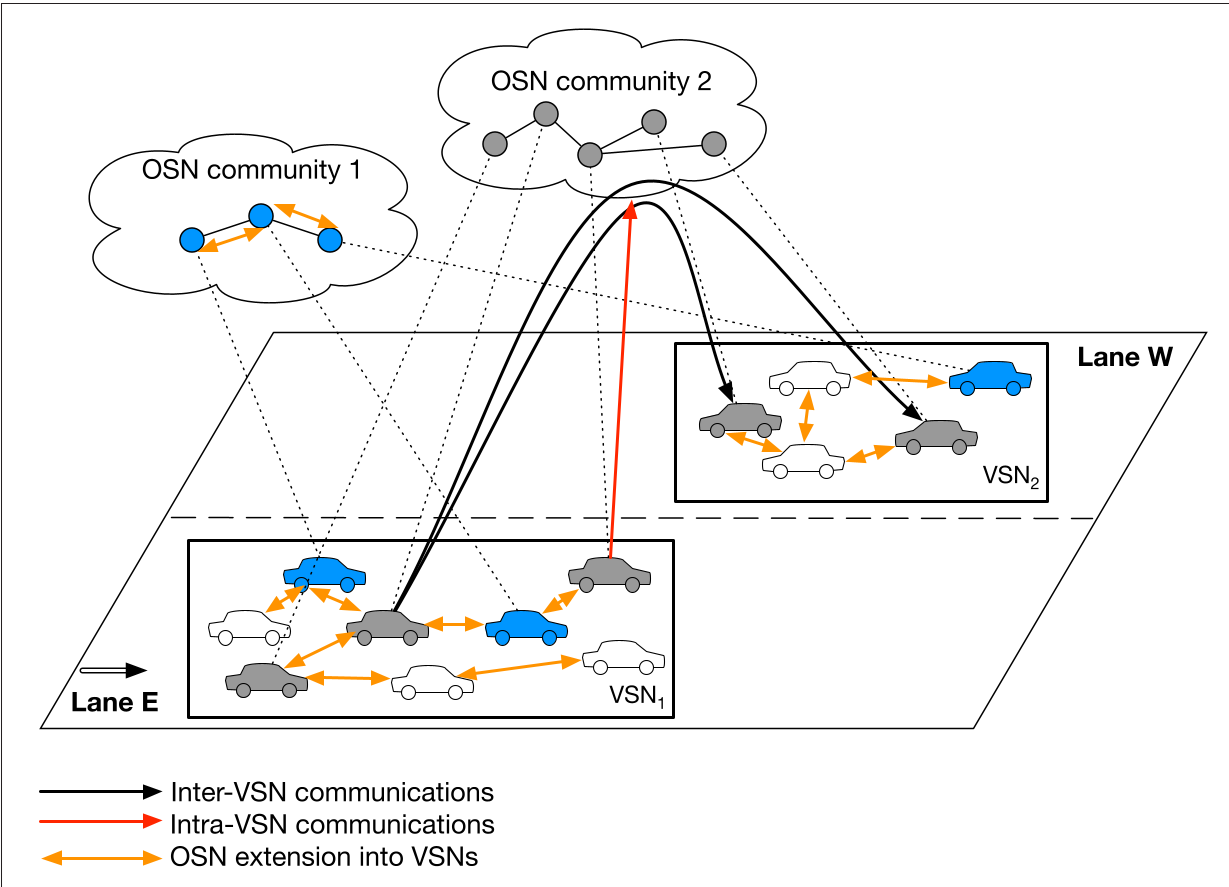 Figure 1: The hybrid architecture showing how OSN ties bridge isolated VSN clusters.
The Security Layer
Integration brings risk. SOLVER addresses this with an Honesty Factor. It matches VSN profiles with established OSN identities. A vehicle's trust is calculated based on:
- Historical mobility patterns (is the car where it says it is?).
- OSN-based trust (authentication through established social platforms).
Experiments & Results: Quantifying the Sync
The authors put SOLVER to the test using MATLAB simulations, focusing on two key metrics: Transmission Delay and Connectivity Probability.
- Delay Reduction: The hybrid mode (CS + P2P) consistently outperformed pure Client-Server (CS) architectures. As the number of "peers" (vehicles) increases, the system effectively offloads the server, keeping latency low even as the total user base grows.
- Connectivity Probability: In sparse environments where V2V links frequently fail, SOLVER acts as a safety net.
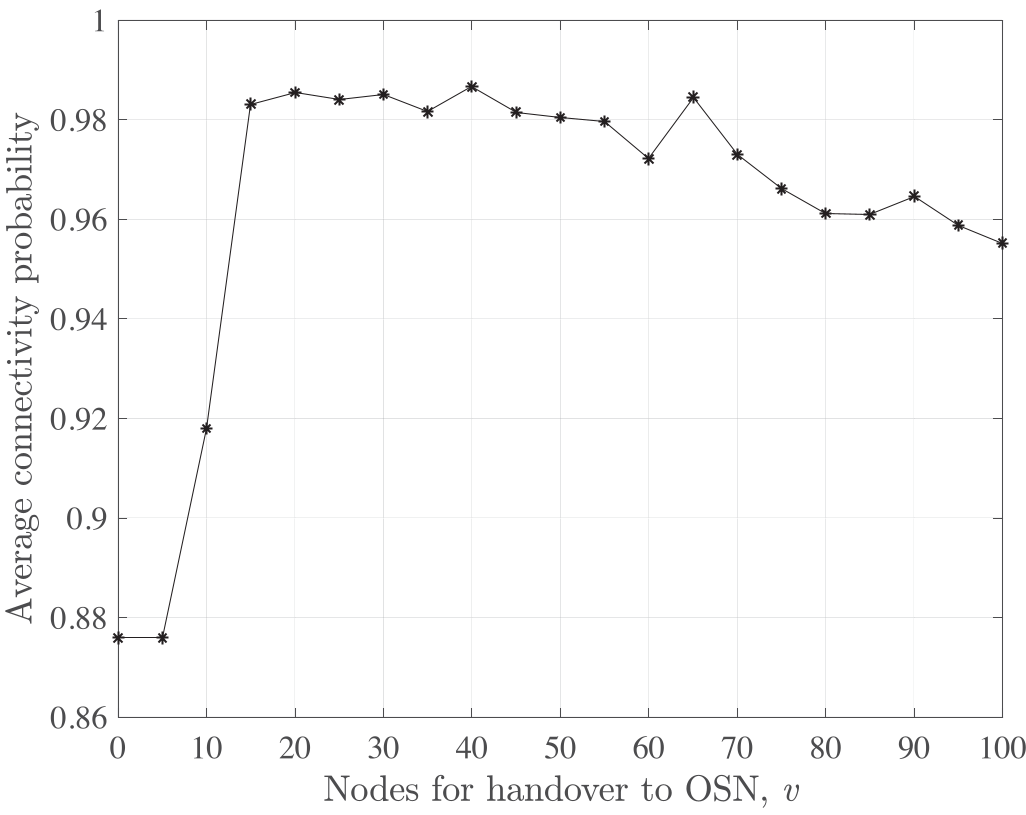 Figure 2: Average connectivity probability significantly increases as more nodes gain OSN-handover capabilities.
Critical Analysis & Conclusion
Takeaway
SOLVER successfully proves that the "Internet of Vehicles" (IoV) shouldn't just be about hardware sensors; it should be about Social Awareness. By treating social ties as "virtual wires," we can build a network that is more resilient than the sum of its parts.
Limitations
- Handover Overhead: The paper assumes seamless switching, but the signaling overhead of constantly checking OSN profiles while moving at 100 km/h could be taxing on cellular bandwidth.
- Privacy Concerns: While the multi-layer security approach is robust, the deep integration of personal social profiles with vehicle location data remains a sensitive regulatory hurdle.
Future Work
The next frontier for SOLVER would be integrating 5G Network Slicing to prioritize safety-critical social messages over infotainment data, further refining the "handover" logic based on real-time network congestion.