
AttriInfer: Scaling Attribute Inference in Social Networks via Markov Random Fields
9674_AttriInfer Inferring User Attributes in Online Social Networks Using Markov Random Fields.
AttriInfer is a privacy-focused attribute inference framework for Online Social Networks (OSNs) that utilizes a pairwise Markov Random Field (pMRF) to combine user behaviors and social graph structures. By optimizing Loopy Belief Propagation (LBP) into a linearized matrix form, it achieves a scalable and convergent solution for inferring private attributes like location or interests. In evaluations on a 5.7M user Google+ dataset, it outperformed the previous SOTA (VIAL) by 20% in accuracy while significantly reducing computational overhead.
TL;DR
AttriInfer is a highly efficient framework designed to unmask private user attributes (e.g., location, interests) by fusing social connectivity with behavioral data (like app reviews). By mathematically transforming the complex Loopy Belief Propagation (LBP) into a simple, convergent linear matrix operation, the authors achieved a 20% accuracy boost over previous methods while enabling simultaneous inference for millions of users at once.
The "Invisible" Data Problem
In modern Online Social Networks (OSNs), your privacy isn't just defined by what you hide, but by what your friends reveal and how you act. Current State-of-the-Art (SOTA) methods like VIAL pioneered the use of both social graphs and behaviors.
However, they hit a wall in two areas:
- Ignoring Negative Evidence: If we know User A doesn't live in New York, that information helps narrow down their true location. Previous methods couldn't encode this "negative" label.
- The Scalability Bottleneck: Methods based on Random Walks are "lazy"—they calculate attributes for one user at a time. In a network of 5.7 million users, this is computationally prohibitive.
Methodology: From Graphs to Matrices
The authors propose AttriInfer, which views the social network as a Pairwise Markov Random Field (pMRF).
1. Behavior-based Priors
The system starts by looking at user behaviors (e.g., Google Play ratings). Using Logistic Regression, it assigns each user a prior probability () of having a specific attribute.
2. Social Propagation (The Optimized LBP)
Standard LBP is powerful but notoriously unstable (it might not converge) and heavy (it stores messages on every single edge). AttriInfer’s genius lies in Linearization. The authors simplified the LBP equations to a residual matrix form: Where:
- is the vector of posterior probabilities we want to find.
- is the behavioral prior.
- is the adjacency matrix.
- is the homophily strength (the tendency of friends to be similar).
 Note: The framework leverages both the social graph and behavioral nodes to create a joint inference space.
Experiments and Results
The researchers tested AttriInfer on a massive Google+ dataset (5.7M users, 30M edges).
Performance vs. SOTA
AttriInfer demonstrated a significant lead over VIAL across all metrics. By leveraging negative training users, the model learns a much tighter boundary for attribute classification.
- Precision: +20.1% improvement over VIAL.
- F-Score: +17.8% improvement over VIAL.
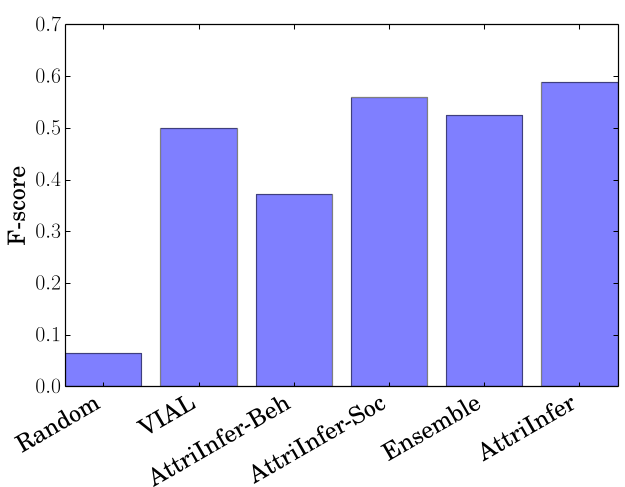 Figure: Precision/Recall/F-score comparison showing AttriInfer's dominance by combining social and behavioral signals.
Scalability and Convergence
Unlike previous methods that take longer as you add target users, AttriInfer's optimized version maintains a near-constant processing time for the entire graph. As shown below, it converges rapidly within roughly 10 iterations.
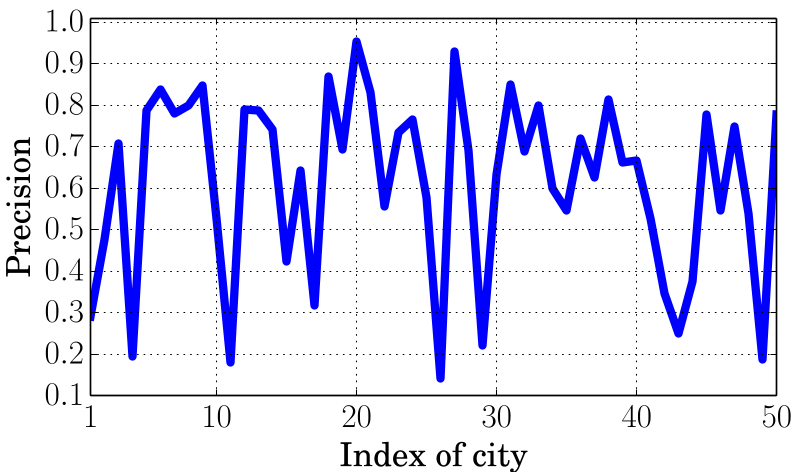 Figure: The relative error drops sharply and stabilizes, proving the reliability of the linearized approach.
Critical Insight: The International City Paradox
An interesting finding in the study was that international cities (like NYC or LA) are actually harder to predict. Why? Because their populations are highly diverse, breaking the "homophily" rule. People in these cities come from different backgrounds and display less uniform behavior compared to more homogeneous cities like Istanbul or Bangkok.
Conclusion
AttriInfer proves that you don't need computationally expensive random walks to perform high-accuracy inference. By formalizing the problem as a linearized pMRF, the authors provided a blueprint for how privacy-invading (or marketing-enhancing) algorithms can scale to the size of the modern web. The takeaway for researchers is clear: negative labels matter, and linearized LBP is a potent tool for large-scale graph inference.