
Mining the Social Web for Human Activity Priors: A Foursquare Approach
9689_ctivities from social data.
The paper introduces a novel framework for high-level Activity Recognition (AR) by mining crowd-generated data from Foursquare to establish location-specific prior knowledge. By extracting and categorizing geo-tagged "tips," the authors achieve a 67.4% testing accuracy in mapping activities to 10 distinct categories.
TL;DR
Activity Recognition (AR) is shifting from purely "watching" what a person does via sensors to "predicting" what they are likely to do based on where they are. This paper by ETH Zurich researchers mines 16,000+ Foursquare tips to build a prior-knowledge model. By combining text analysis with venue category metadata, they can predict activity types with 67.4% accuracy, providing a low-cost, scalable backbone for mobile AR systems.
The Motivation: Why Sensors Aren't Enough
Traditional AR relies heavily on accelerometers and gyroscopes. While great for distinguishing "walking" from "sitting," these sensors struggle with high-level semantics. Is a user at a cafe "working," "socializing," or "eating"? Physically, these might look identical to a wrist-worn sensor.
Prior work attempted to solve this using Time-Use Surveys, but these are:
- Expensive: Requiring massive government funding.
- Coarse: Lacking the specific GPS-level context of this specific corner shop versus that specific park.
The authors' insight was simple: Social media users have already labeled the world for us.
Methodology: From "Tips" to Prior Odds
The team crawled Foursquare data in San Francisco, capturing tip text, venue categories, and timestamps. The core challenge was turning noisy, unstructured text like "Best mocha in town!" into a structured prior probability distribution.
The Pipeline
- Filtering: Using a Linear SVM to separate noise from activity-relevant data (e.g., "fast service" is irrelevant; "great for a jog" is relevant).
- Categorization: Mapping the relevant tips to the American Time-Use Study (ATUS) taxonomy, covering 10 major categories like Sports, Eating & Drinking, and Work-Related.
- Feature Stacking: Combining three distinct signals:
- Text (N-grams): Looking for keywords like "drink," "run," or "study."
- Venue Semantics: The fixed category of the location (e.g., "Gym" limits the probability space).
- Temporal Cues: When the activity was reported.
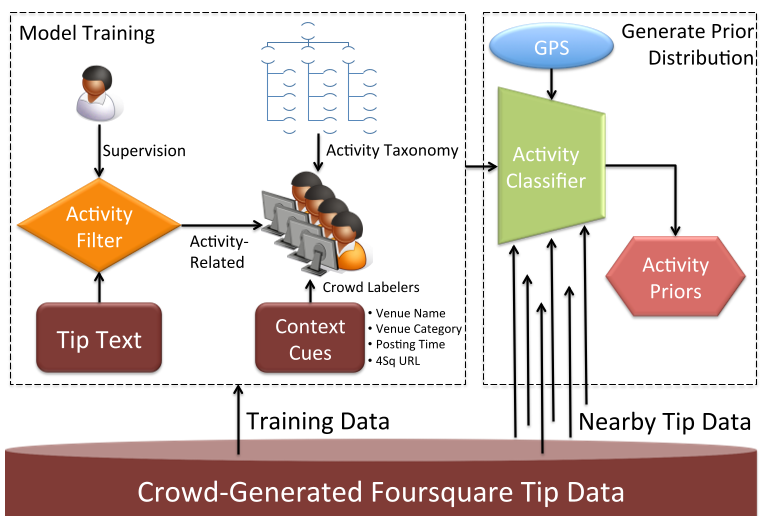 Figure 1: The system architecture showing how raw social data is distilled into a prior distribution of activities.
Experimental Results: Text vs. Location
The researchers tested different feature combinations using 10-fold cross-validation. The results reveal a clear hierarchy of information value:
| Feature Set | Accuracy |
|---|---|
| Posting Time | 32.6% (Near-random) |
| Tip Text Only | 59.2% |
| Venue Semantics Only | 61.1% |
| Text + Venue (Combined) | 67.4% |
Key Insight: The "Why"
Why does combining features work? Because locations are multi-functional. A "Park" (venue category) could host "Sports" or "Socializing." The text in Foursquare tips provides the "fine-grained adjustment" needed to distinguish between these possibilities. Interestingly, time was the weakest predictor, likely because a "tip" about a breakfast spot might be posted at dinner time, decoupling the report from the activity.
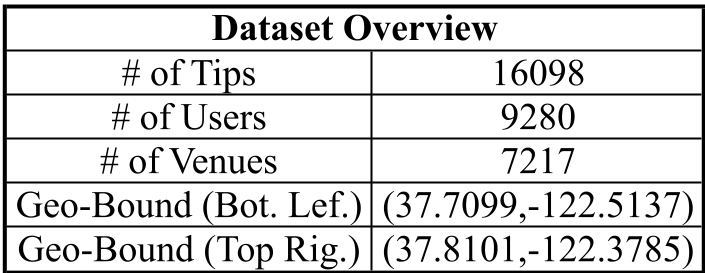 Table 1: Overview of the San Francisco dataset used for training and validation.
Critical Analysis & Future Outlook
This paper provides a brilliant "poor man's" approach to big data in ubiquitous computing. By leveraging existing social repositories, they bypass the need for expensive labeling campaigns.
Limitations:
- Demographic Bias: Foursquare users in 2013 were typically younger and more tech-savvy, biasing the data toward "Leisure" and "Eating" rather than "Household Care."
- Temporal Lag: As noted, people don't always tweet/post exactly when they are active.
Conclusion: This research paves the way for "Geo-aware" AR. Imagine a smartwatch that increases the sensitivity of its "Exercise" detection algorithms the moment you step into a zone where Foursquare users frequently mention "sprinting" or "yoga." It’s an elegant marriage of social data mining and physical sensing.