
Unifying the Wisdom of Crowds: A New Framework for Collective Intelligence
9775_Frameworks for Collective Intelligence A Systematic Literature Review.
This paper presents a systematic literature review (SLR) of Collective Intelligence (CI) frameworks, analyzing 12 core models identified from over 9,000 articles. The authors synthesize these findings into a novel, unified CI framework that meticulously defines the "Who, Why, What, and How" of CI systems while mapping 24 unique technical attributes.
TL;DR
Collective Intelligence (CI) has moved beyond simple "crowdsourcing." This paper conducts a massive systematic review to synthesize a fragmented field into a Unified CI Framework. By breaking down systems into 24 distinct attributes across components of Staff, Process, Goal, and Motivation, the authors provide a rigorous engineering blueprint for building the next generation of collaborative platforms.
Problem & Motivation: The "Intuition Gap"
For years, CI systems like Wikipedia, Linux, and InnoCentive succeeded largely through the brilliance of their initial designs and domain-specific intuitions. However, the academic landscape was a mess of "siloed" models. Some researchers viewed CI through the lens of organizational psychology, others through swarm intelligence or software architecture.
The authors identified a critical "reproducibility crisis": without a unified model, we cannot systematically design new CI systems for novel challenges—we are simply guessing what might work.
Methodology: The Unified Framework
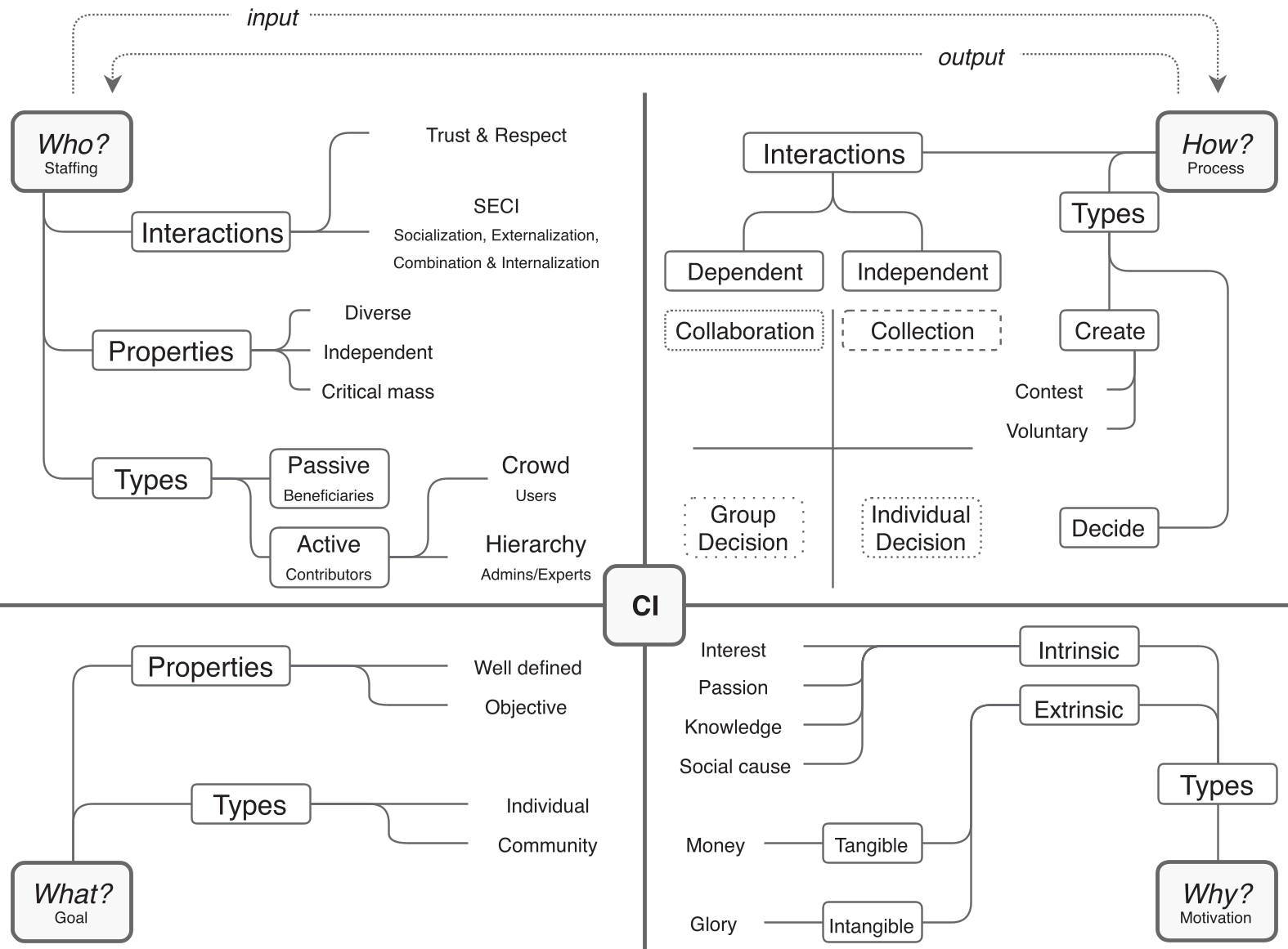
The core contribution of this work is the synthesis of 12 major CI models into a single, granular architecture. The authors shift the focus from "What is being done" to "What is being accomplished," providing a more goal-oriented view.
The Generic Model Architecture
The proposed model rests on four pillars:
- Who (Staff): Distinguished between Active Contributors (the Crowd and the Hierarchy) and Passive Beneficiaries.
- Why (Motivation): A dual-track system of Intrinsic (Self-fulfillment, Social Cause) and Extrinsic (Money, Glory, Reputation) factors.
- What (Goal): Aligning individual objectives with community missions.
- How (Process): Interactions categorized as Collection (independent) vs. Collaboration (dependent), and Decide vs. Create.
CI as a Complex Adaptive System (CAS)
Unlike static software, CI systems are "alive." The authors argue that a true CI framework must account for:
- Self-Organization: Systems organizing without external control.
- Emergence: Patterns where "the whole is greater than the sum of parts."
- Adaptivity: The capability to evolve based on environmental feedback.
Deep Insight: Beyond Malone’s Genome
While Thomas Malone’s "Genome of Collective Intelligence" is the gold standard, this paper argues it lacks granularity. The authors introduce Interactions (Trust, Respect, and the SECI knowledge model) as essential properties of the "Who" and "How." For instance, they note that "Independence" is not just a preference but a technical requirement to prevent Information Cascades, where peer pressure leads to biased, irrational collective decisions.
Experiments & Results
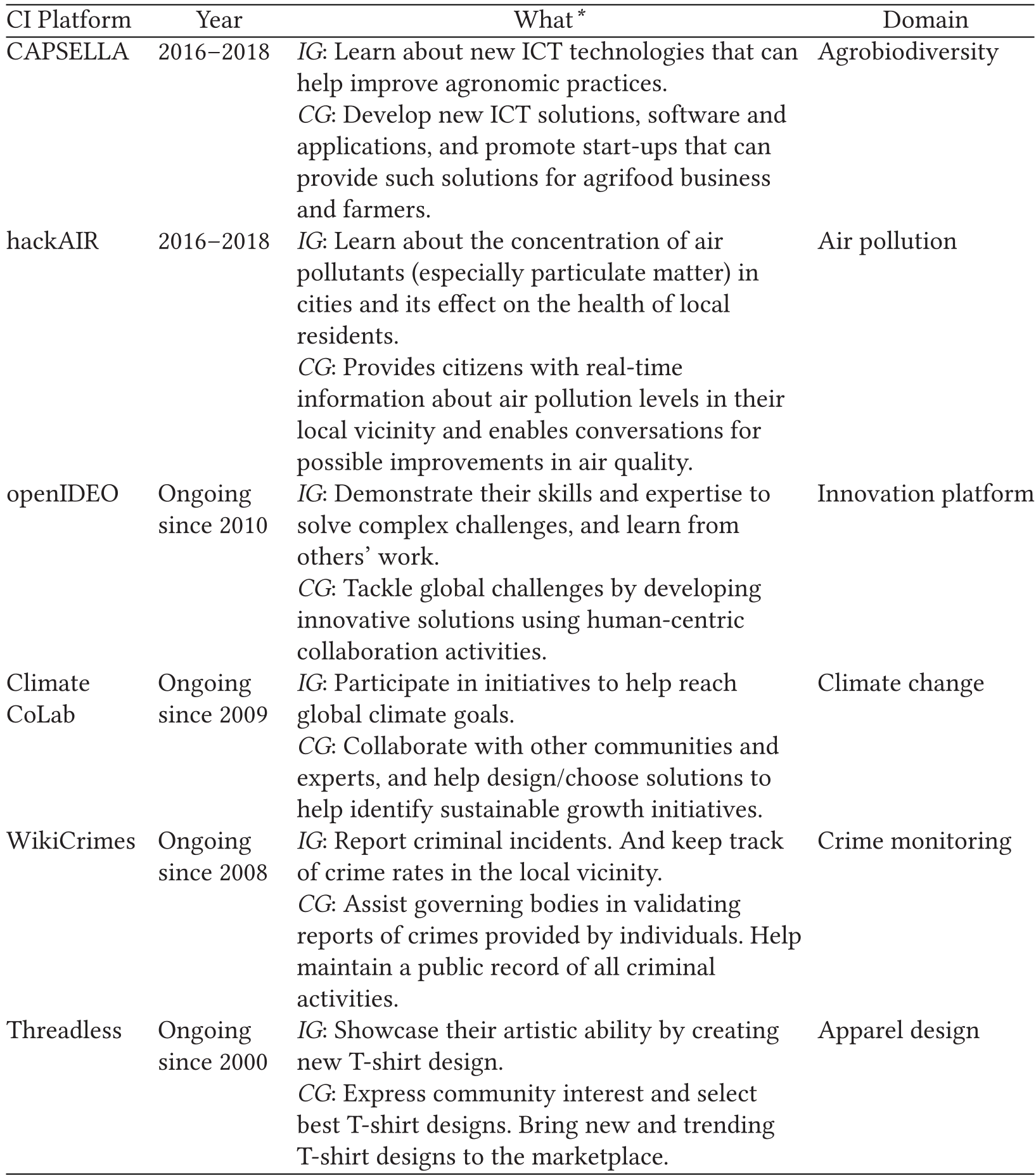
The authors validated their framework by applying it to six diverse, ongoing CI initiatives. This mapping proved that the 24-attribute framework could describe systems as different as WikiCrimes (crime monitoring) and Threadless (apparel design).
Key Findings from Case Studies:
- Motivation Dependency: "Decide" activities are mostly intrinsic, while "Contest-based Create" activities require extrinsic rewards (Money/Glory).
- The Power of Hierarchy: Even "flat" crowd systems (like WikiCrimes) utilize hierarchical "Agents" to maintain reputation and data integrity.
Critical Analysis & Conclusion
This paper is a significant "map-making" effort. Its strength lies in its ability to bridge the gap between sociology and computer science.
Takeaway: If you are building a CI platform, don't just "let the crowd decide." You must architect the specific aggregation mechanisms and independence guards required for intelligence to actually emerge.
Limitations: While the framework is comprehensive, the "Critical Mass" (minimum users needed) remains an elusive metric that varies wildly by domain. Future work should focus on quantifying these "tipping points" for system stability.