
WalkON Suit: Engineering a Bronze Medalist for the Paraplegic "Cybathlon"
9776_WalkON Suit A Medalist in the Powered Exoskeleton Race of Cybathlon 2016.
The paper presents the development of the "WalkON Suit," a powered exoskeleton that won a bronze medal at Cybathlon 2016. It focuses on assistive technologies for paraplegics, integrating a hybrid actuation mechanism and a novel "Forward-Inflection Walking" (FIW) control strategy to handle complex terrains like stairs, ramps, and uneven stones.
TL;DR
The WalkON Suit is a high-performance powered exoskeleton designed to help paraplegics navigate real-world obstacles. By combining a unique biarticular transmission, a multi-motor synchronous drive, and a novel Forward-Inflection Walking (FIW) algorithm, the system successfully conquered stairs, ramps, and slalom courses at Cybathlon 2016, proving that specialized control logic can overcome the physical limitations of long-term paralysis.
Problem & Motivation: Beyond Straight-Line Walking
Most commercial exoskeletons excel at walking on flat gym floors but fail when faced with a sofa, a flight of stairs, or a tilted path. For individuals with Spinal Cord Injury (SCI), two major problems arise:
- Safety & Balance: Paraplegics often have muscle atrophy in the lower limbs, shifting their Center of Gravity (CoG) high into the torso, making them prone to falling.
- Physical Constraints: Long-term wheelchair use leads to joint contractures (stiffness), meaning their legs cannot fully straighten or bend like a healthy person's, rendering standard "normal" gait trajectories useless.
The authors' insight was to move away from mimicking "normal" human walking and instead design a "quasi-static" movement pattern that prioritizes stability and body-weight distribution.
Methodology: The Core of WalkON
1. Hardware Architecture
The WalkON Suit utilizes a hybrid actuation system. To generate the massive torque required for a 75kg pilot to stand up (estimated at >120 Nm), the team used a Synchronous Actuation Module. This involves using four BLDC motors per joint. This not only provides the necessary power but acts as a fail-safe: if one motor fails, the others can maintain the pilot's safety.
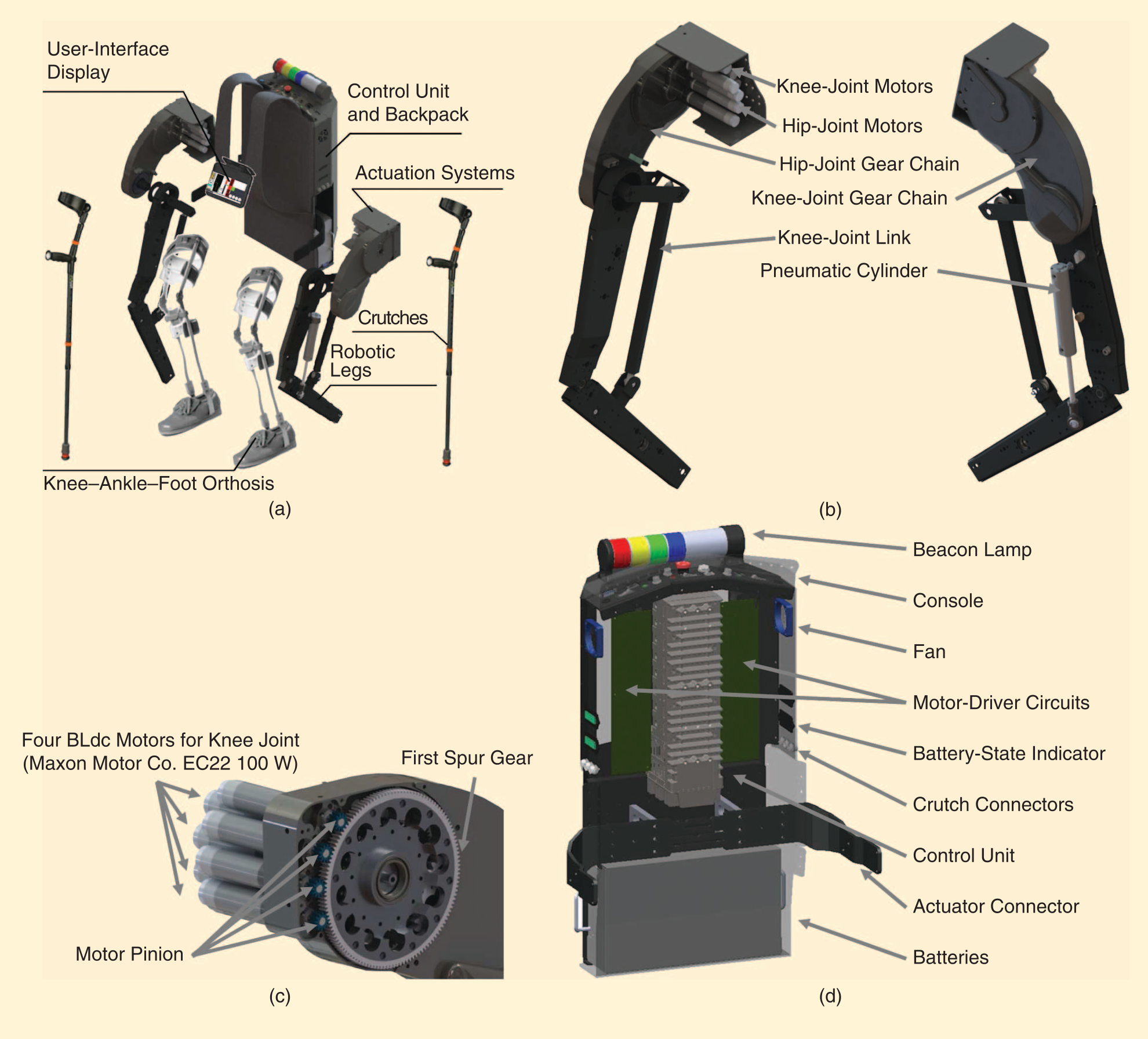 Figure: The hardware decomposition showing the backpack control unit and the 4-motor joint synchronization.
2. Forward-Inflection Walking (FIW)
The most critical innovation is the FIW algorithm. In a normal gait, the knee is fully extended at the start of a step. However, for a paraplegic, this keeps the CoG too far back. FIW mandates a specific joint constraint: This forces the knee to flex slightly, tilting the upper body forward so the CoG is always over the "leading leg" (the stance phase), drastically reducing the risk of tipping over even without heavy reliance on crutches.
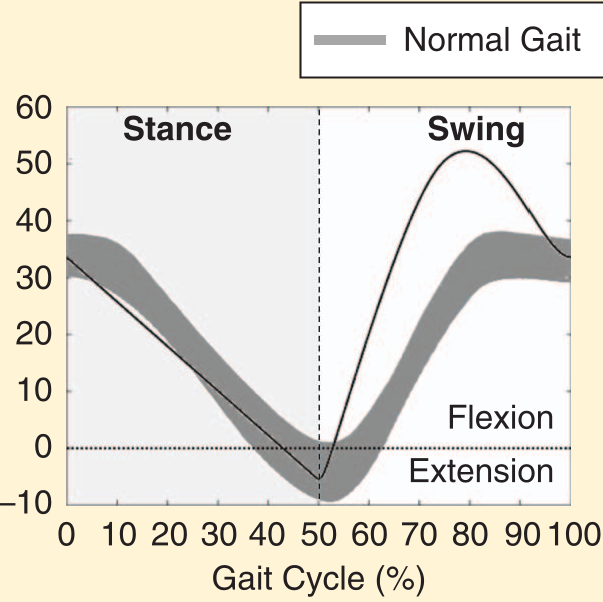 Figure: Comparison between (a) the proposed FIW method and (b) normal walking, highlighting the CoG placement.
Experiments & Results: The Road to the Podium
The pilot, who had been wheelchair-bound for 20 years, underwent a rigorous 6-month training program.
- Metabolic Efficiency: Initially, the pilot's "Oxygen Cost" (energy spent per meter) was 30x higher than a healthy person. This was reduced by 75% through joint optimization and training.
- Task Performance: At Cybathlon 2016, the suit cleared the Sofa, Slalom, Ramp/Door, and Stones tasks within competitive timeframes.
- Benchmarking: Compared to giants like ReWalk, the WalkON Suit displayed superior stability on uneven "Stones" tasks, although its quasi-static FIW method resulted in a slightly slower top speed (1.1 km/h vs 2.6 km/h).
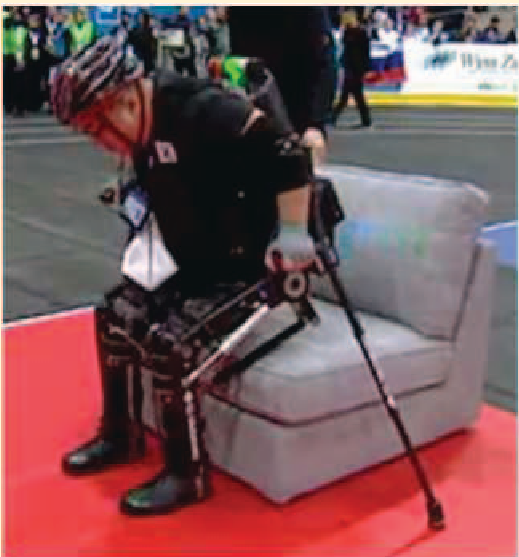 Figure: The pilot successfully navigating the Slalom and Ramp tasks during the competition.
Critical Analysis & Conclusion
The WalkON Suit represents a shift from "human-mimicry" to "human-centered engineering."
Takeaways:
- Stability > Speed: In medical robotics, the psychological and physical safety provided by a stable CoG (via FIW) is more valuable than high-speed walking.
- Redundancy is Key: The use of distributed batteries and multi-motor clusters ensures that a single component failure isn't catastrophic for a disabled user.
Limitations: The quasi-static nature of the current control prevents the use of natural limb dynamics, limiting efficiency at higher speeds. Future iterations aim to integrate more dynamic motions as pilots become more comfortable and "tuned" to the robotic assistance.