
KDLC: Bridging Bayesian Clustering and Inductive Rules for Precision Agriculture
A ~e~~odology and Life Cycle Model for and Knowledge Discovery in Precision
This paper introduces KDLC (Knowledge Discovery Life Cycle), a multistrategy methodology for data mining in large, heterogeneous databases. It integrates unsupervised Bayesian classification (AutoClass) with supervised inductive rule learning (AQ15c) through a constructive induction mechanism to achieve high-quality knowledge discovery.
TL;DR
The paper presents the Knowledge Discovery Life Cycle (KDLC), a robust framework designed to extract meaningful patterns from complex, heterogeneous datasets. By combining AutoClass (unsupervised Bayesian classification) and AQ15c (supervised rule learning), the authors demonstrate a "multistrategy" approach that transforms raw sensor and soil data into geographical insights for precision farming.
Problem & Motivation: The Heterogeneity Gap
In fields like precision agriculture, researchers deal with massive, distributed datasets including chemical soil samples, elevation data, and sensor readings. The core difficulty is twofold:
- Lack of Labels: High-level target concepts (like "why this area yields more") are often not pre-labeled in raw data.
- Explainability: Purely statistical methods provide clusters but don't explain why a cluster exists in a way a farmer can act upon.
The authors argue that a single learning strategy is insufficient. One needs a methodology that can both find hidden structures (unsupervised) and describe them with logical rules (supervised).
Methodology: The Power of Multistrategy Learning
The heart of the paper is the integration of diverse learning strategies through a process called Constructive Induction.
1. The KDLC Model
The KDLC is a six-stage closed-loop process:
- Plan for Learning: Experiment formulation and data cleansing.
- Generate/Test Hypothesis: Exploratory analysis.
- Discover Knowledge: The algorithm execution phase.
- Determine Relevancy: Using visualization (GIS) and validation.
- Evolve Knowledge: Updating repositories.
- Panel of Experts Critique: Human-in-the-loop verification.
2. Bayesian Oracle meets Symbolic Logic
The technical workflow follows a specific pipeline:
- AutoClass: Uses Bayesian theory to find the "maximum posterior probability" classification. It acts as an oracle, creating new taxonomic classes from unlabeled data.
- Constructive Induction: These new class labels are injected back into the dataset as new attributes.
- AQ15c: A supervised learner that performs a heuristic search for logical expressions (STAR method). Because it now has the "hint" from the Bayesian clusters, it can find much more precise and discriminant rules.
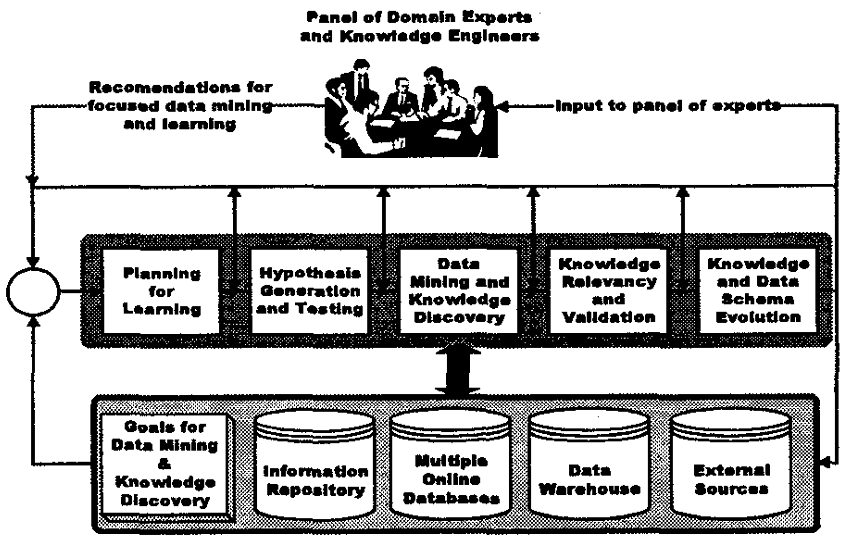 Figure 1: The six stages of the Knowledge Discovery Life Cycle.
Case Study: Precision Agriculture in Idaho
The authors applied KDLC to a dataset of 500 soil samples with 62 attributes (Calcium, Nitrogen, pH, etc.).
Experimental Workflow
- Clustering: AutoClass discovered 10 distinct "soil quality" classes.
- Rule Induction: AQ15c generated rules such as:
Class 1 if [CEC-10 is between 8.26..10.09] AND [N-4 is 6.85..12.39]...
- Visualization: Using ArcView GIS, they mapped these symbolic rules back to the physical farm.
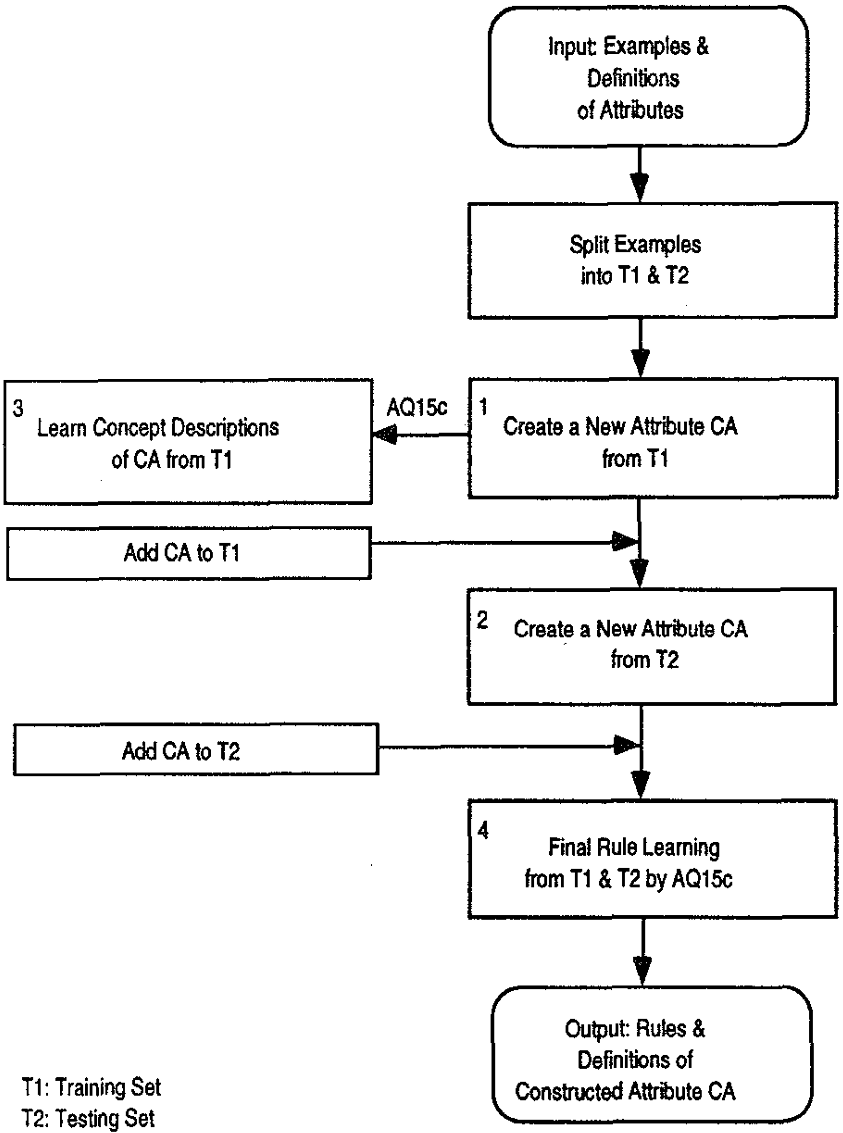 Figure 2: How new attributes are created for training and testing via AutoClass.
Results & Insights
The experiment proved that the clusters weren't just mathematical noise—they corresponded to contiguous geographic regions.
- Class 0, 1, and 2 formed distinct blocks on the map, characterized by specific nutrient ranges (e.g., specific concentrations of Calcium and Nitrogen at different times of the year).
- Yield Prediction: By using the discovered classes as variables, the system could explain "High Yield" regions (Yield Class 6) as being primarily associated with soil Classes 0 through 5, while excluding Classes 7 and 8.
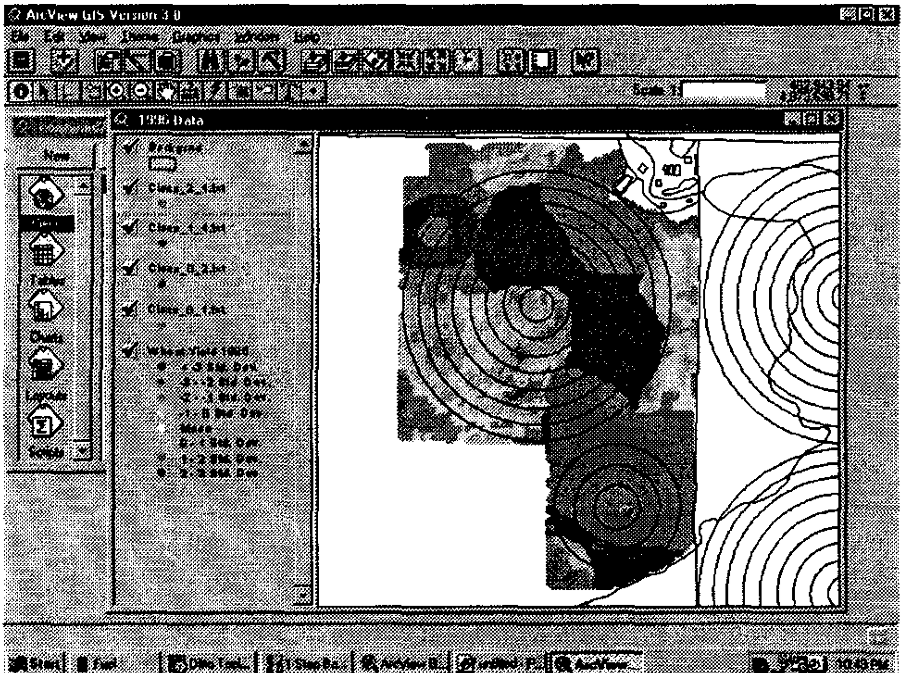 Figure 3: GIS visualization showing the spatial contiguity of discovered clusters.
Critical Analysis & Conclusion
Takeaway
KDLC proves that multistrategy learning is superior to isolated algorithms. By allowing an unsupervised learner to "expand" the representation space, the supervised learner gains the inductive bias necessary to extract human-readable rules from complex data.
Limitations & Future Work
The authors acknowledge that current methods need tighter coupling with advanced database technology to handle even larger sets. Furthermore, they emphasize the necessity of the "Panel of Experts"—reminding us that in precision agriculture, AI is a decision-support tool, not a replacement for domain expertise.
Future Outlook: The shift toward "Intelligent Agents" for automated feature retrieval and the use of the KDLC for evolving knowledge bases represents an early precursor to modern automated machine learning (AutoML) and MLOPs workflows.