
High-Throughput Discovery of Quantum Frustration: Mapping the Kagome and Triangular Landscapes
Ab initio screening of quantum frustrated materials with kagome and triangular geometries
This paper presents a high-throughput ab initio screening workflow to discover quantum frustrated magnetic materials. By analyzing ~150,000 compounds, the authors identified six novel candidates for kagome and triangular lattices (KMgNiIO6, Li4Fe3WO8, etc.) and predicted a new magnetic phase called "cuboc-3."
Executive Summary
TL;DR: Researchers from KAIST have developed a multi-step computational pipeline that sifts through 150,000 materials to find those with high "geometrical frustration." The study moves beyond simple structural screening to extract complex magnetic exchange values (), predicting six entirely new materials and a previously unknown magnetic phase dubbed cuboc-3.
Background: Geometrical frustration is the holy grail for realizing Quantum Spin Liquids (QSLs)—states where spins never settle into a pattern even at absolute zero. This paper transitions from retrospective analysis (explaining known materials) to prospective discovery (predicting new ones).
The Frustration Bottleneck: Why is Discovery Hard?
Traditional material science relies on "informed trial and error." While we know kagome and triangular lattices are prone to frustration, simply having the right lattice isn't enough. The real magic happens in the competition between nearest-neighbor () and further-neighbor () interactions.
If is too dominant, the system enters a standard 120° order. If the out-of-plane coupling () is too strong, the 2D quantum nature is lost. Quantifying these tiny energy differences across thousands of potential compounds is computationally expensive and theoretically daunting.
Methodology: The Six-Gate Workflow
The authors designed a rigorous six-step filtering process:
- Geometric Filtering: Ensuring the lattice is perfectly triangular or kagome within tight tolerances.
- Valence Configuration: Targeting partially filled transition metals.
- DFT+U Stability: Ensuring magnetic solutions converge.
- Magnetic Force Theory (MFT): This is the "secret sauce." Instead of massive supercell calculations, MFT uses linear response theory to extract exchange constants () efficiently.
- Hamiltonian Analysis: Filtering for "Active Competition" (e.g., for triangular lattices).
- Validity Checks: Final stress-testing with different functionals to ensure the results aren't artifacts.
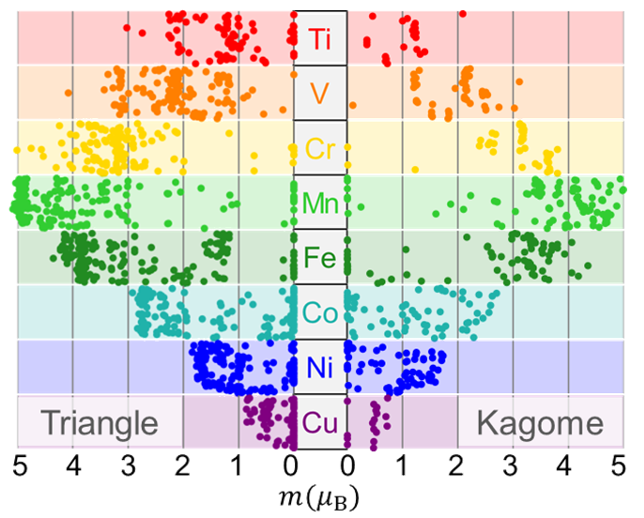 Figure 1: The screening funnel, from 150k candidates to 6 specific targets.
Key Discoveries: New Materials and the "Cuboc-3" Phase
The screening identified six high-priority materials that have not yet been synthesized.
The Kagome Superstars
- : This material is unique due to an "across-hexagon" interaction (). The ions at the center of the hexagons mediate a massive coupling, 45% as strong as . This stabilizes the cuboc-1 phase—a non-coplanar state where spins point toward the vertices of a cuboctahedron.
- : The most complex of the group. It features competing and (along-bond) interactions. This competition gives birth to the cuboc-3 phase, a 4x4 magnetic superstructure that allows for both chiral and non-chiral configurations.
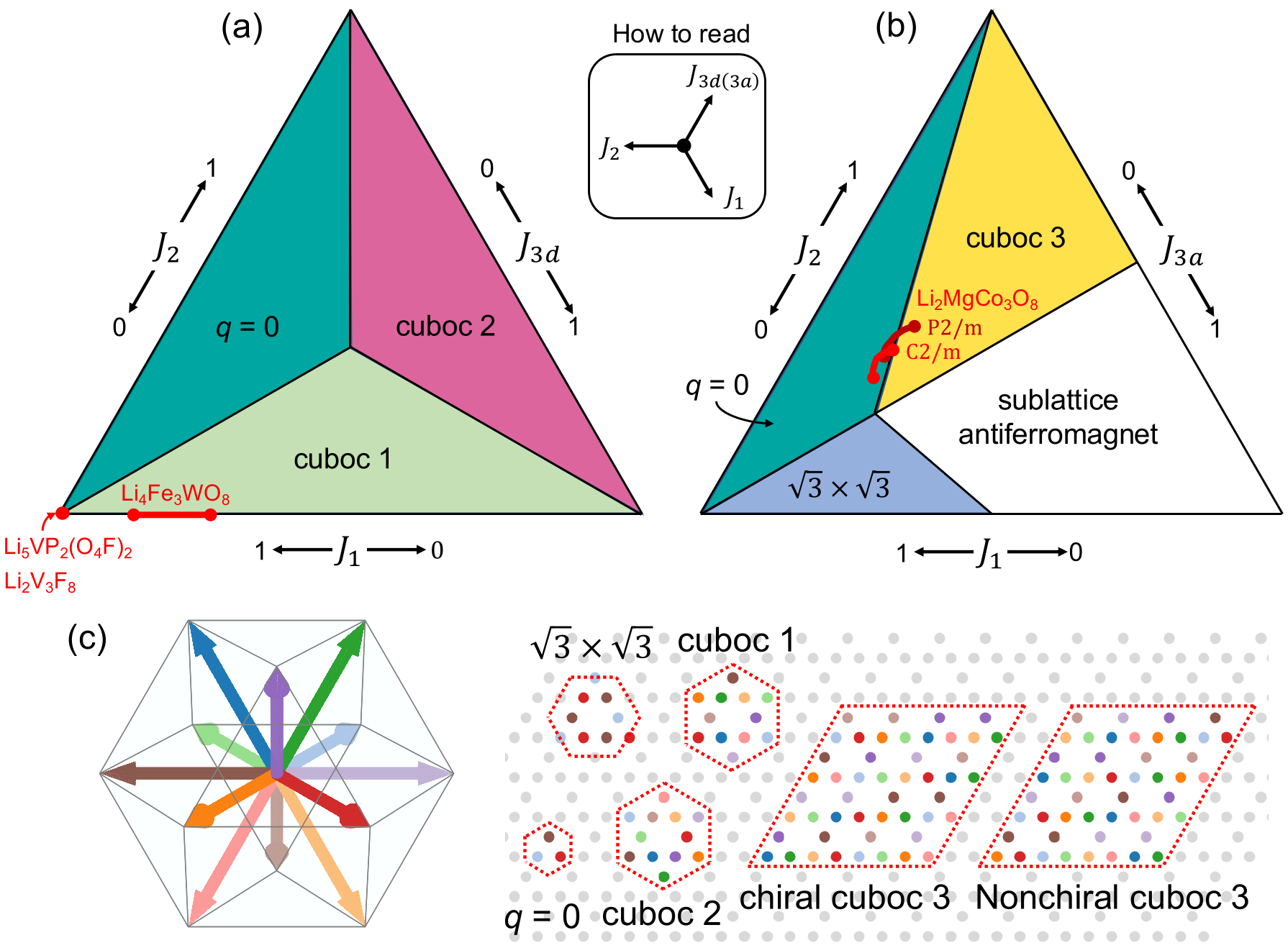 Figure 2: Comprehensive phase diagrams for kagome lattices showing the stability regions for q=0, cuboc-1, and the newly found cuboc-3 phase.
The Triangular Lone Wolf
- : While most triangular candidates settle into standard 120° order, this compound sits precariously on the phase boundary, potentially hosting "stripy" magnetic order due to its specific ratio.
Critical Analysis & Future Outlook
Takeaway: This work proves that we can now "order" materials with specific frustration profiles. By providing the exact values for and others, the authors have given experimentalists a precise map for what to look for in neutron scattering experiments.
Limitations:
- Sub-meV Sensitivity: Some exchange constants are extremely small (<0.1 meV). At these scales, Dzyaloshinskii–Moriya (DM) interactions or structural distortions (magnetoelastic coupling) could overturn the predicted ground states.
- Synthesis: Identifying a "stable" database entry doesn't always translate to easy synthesis in a lab, especially for complex oxides with volatile ions like Lithium.
Conclusion: This paper marks a milestone in the "Materials Genome" approach for quantum magnetism. It moves us closer to a future where we design Quantum Spin Liquids from the bottom up, rather than stumbling upon them by luck.