
ABnews: Reclaiming Privacy via ABE and the "Old School" Usenet Protocol
ABnews: A Fast Private Social Messaging System Using Untrusted Storage and Attribute-Based Encryption
ABnews is a decentralized social messaging system that leverages Ciphertext-Policy Attribute-Based Encryption (CP-ABE) and untrusted cloud storage (e.g., Google Drive). It achieves SOTA-level efficiency by decoupling heavy ABE computations from interactive user access, allowing the use of unmodified legacy Usenet newsreaders.
TL;DR
ABnews is a fast, decentralized social networking system that uses Attribute-Based Encryption (ABE) to secure data on untrusted cloud storage like Google Drive. By reviving the classic Usenet (NNTP) protocol, it allows users to use modern, high-quality newsreaders while keeping their private data encrypted and under their own control.
Positioning: This work represents a pragmatic bridge between advanced cryptographic access control and user-friendly legacy software, proving that privacy-first SNS doesn't have to mean a slow, clunky UI.
Problem & Motivation: The Slow Death of Privacy
In the modern era, Big Tech "walled gardens" force a trade-off: convenience for privacy. Decentralized Social Networks (DOSNs) like Diaspora or Mastodon attempt to fix this, but they often lack fine-grained access control.
While Attribute-Based Encryption (ABE)—where access is determined by properties like "Company=X" or "Group=Friend"—is the "Holy Grail" of access control, it has a reputation for being computationally "heavy." Previous attempts like Persona or Priv.io required custom browser extensions or new, often buggy, application stacks. The authors of ABnews asked: Why reinvent the wheel when we can use a protocol that already perfected distributed messaging decades ago?
Methodology: High-Tech Security Meets 1980s Stability
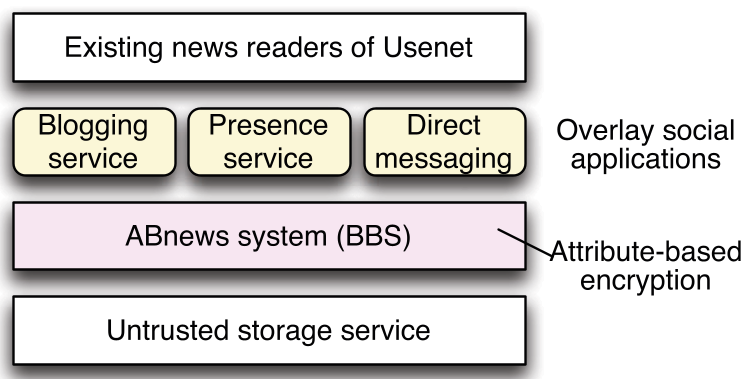
The core "Aha!" moment of ABnews is its Layered Architecture. By mapping modern social features onto the Usenet BBS structure, they inherited 40 years of software stability.
1. The Architecture
The system runs a local NNTP Daemon (NNTPD) on the user's PC. This acts as a gateway between the rich newsreader (like Thunderbird or mobile apps) and the encrypted cloud storage.
2. Eliminating ABE Latency
The primary innovation is the Local Spool. When a user reads a message:
- Traditional ABE Apps: The app fetches encrypted data Decrypts Displays. (Slow!)
- ABnews: A background process (Downloader) fetches data from Google Drive, decrypts it, and stores it as plaintext in a restricted local spool. The user's newsreader then accesses the local spool instantly.
3. Overlay Applications
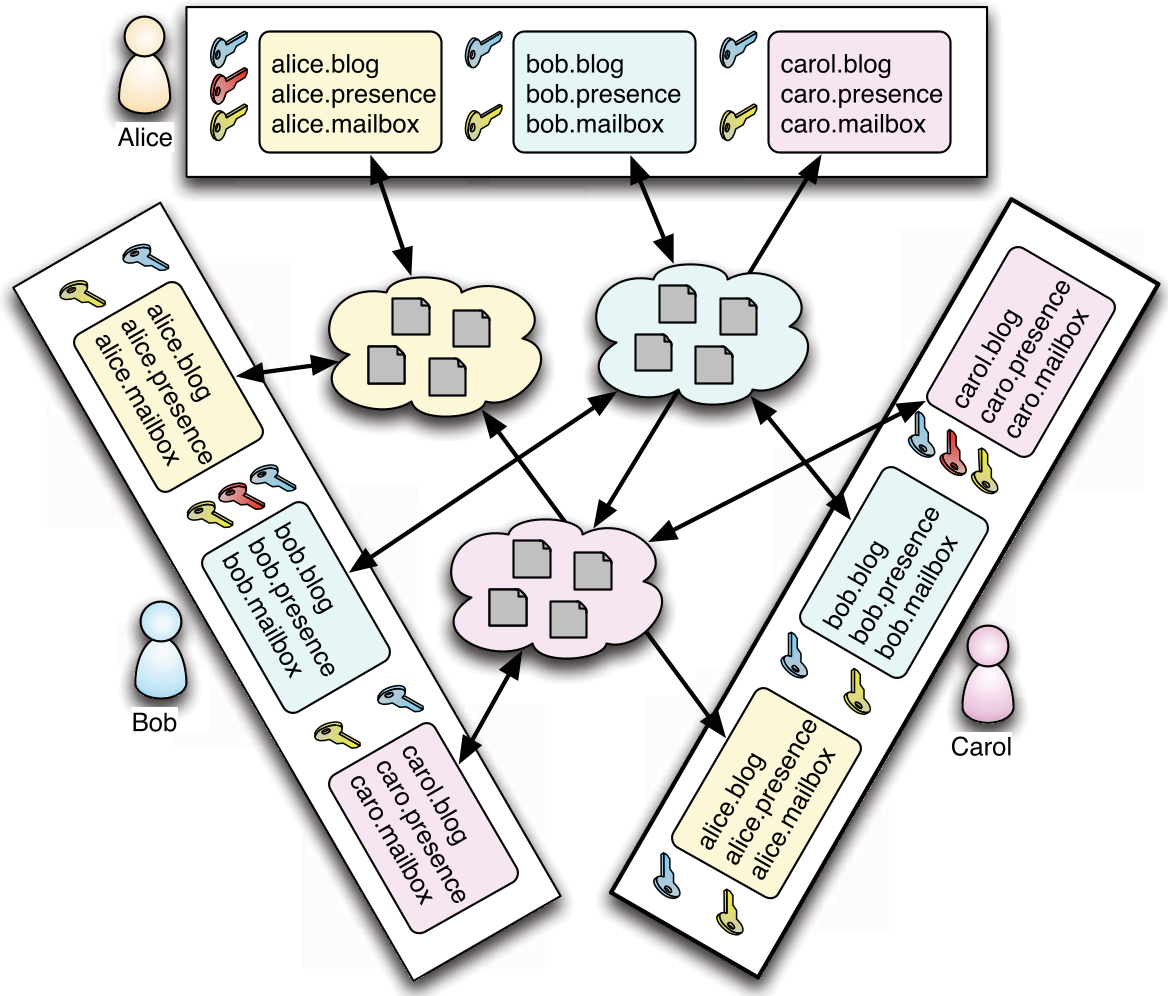
The authors cleverly mapped complex SNS functions to simple newsgroups:
- Blogs/Timeline: Each user has an
alice.blognewsgroup. Friends follow and reply. - Direct Messaging: A special
mailboxnewsgroup where only the recipient's ABE key can "unlock" the message. - Presence: Real-time IP updates are pushed as small news articles.
Experiments & Results: Is it Actually Fast?
Performance testing on an Intel i7 machine showed that the cryptographic overhead is negligible.
- Post & Upload: ~2.4 seconds (mostly network latency).
- Download & Decrypt: ~1.6 seconds.
- Batch Processing: When syncing 10 articles at once, the time per article drops significantly (~0.9s), allowing for "seamless" background updates.
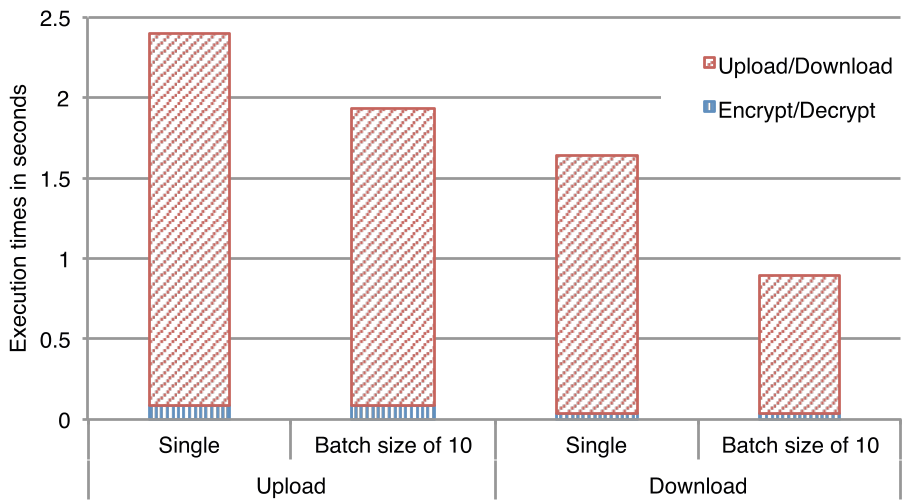
Because the newsreaders interact only with the local spool, the user perceives zero lag during reading—a massive SOTA improvement over Web-based ABE systems.
Critical Analysis & Conclusion
The Good: ABnews proves that "good enough" encryption (CP-ABE) paired with "tried and true" protocols (NNTP) is a viable path for private SNS. It bypasses the "UI hurdle" by letting users keep their favorite apps.
The Limitations:
- Metadata Leakage: While content is hidden, Google Drive still knows who is talking to whom by looking at file access patterns.
- Storage Waste: Users must download all encrypted files in a group even if they can't decrypt them, which could be an issue for users with metered data.
Final Takeaway: This work reminds us that sometimes the best way to move forward in privacy tech is to look backward at robust, decentralized protocols that worked before the era of centralized data silos.