
Mining the Ivory Tower: The Evolution and Challenges of Academic Social Networks
Reviewing academic social network mining applications
This paper provides a comprehensive review of academic social network mining applications, focusing on the evolution from traditional bibliometrics to web-based Social Networking Services (SNS). It evaluates key systems like Referral Web, Flink, and ArnetMiner, while proposing AcaSoNet as a solution for more reliable researcher data integration.
TL;DR
In the professional world, general social networks like Facebook fall short. This paper reviews the specialized systems designed to map the "hidden web" of academic collaborations. It explores how researchers move from simple web co-occurrence counts to sophisticated semantic integration of publication data, aiming to solve the persistent issues of name ambiguity and data unreliability.
The Motivation: Why Link Researchers?
In academia, who you know—and who you work with—is more than just social; it is the currency of professional trust and authority. While general SNS platforms emerged in the early 2000s, they lacked the structure for professional collaborative activities.
The author identifies several critical needs that general social networks cannot fulfill:
- Expert Finding: Calculating centralities in a citation/publication network to find true authorities.
- Trust Calculation: Measuring the strength of collaboration through "knows" and "co-author" relations.
- Conflict of Interest (COI) Detection: Vital for peer review processes to ensure objectivity.
The Technical Landscape: From Referral Web to ArnetMiner
The paper meticulously charts the genealogy of academic mining systems.
1. The Progenitors (Referral Web & Flink)
Early systems like Referral Web (1997) relied on a simple but ingenious intuition: if names X and Y appear together on a page frequently, they likely share a professional link. Flink (2005) evolved this by adding Semantic Web technology (FOAF - Friend of a Friend) to aggregate knowledge from emails and publications.
2. Semantic and Probabilistic Refinement
Systems like POLYPHONET improved disambiguation by appending affiliation data to search queries (e.g., "Scholar Name AND University Name"). ArnetMiner (2008) took this further by using Conditional Random Fields (CRF) to extract profiles and generative probabilistic models to map the topical expertise of authors.
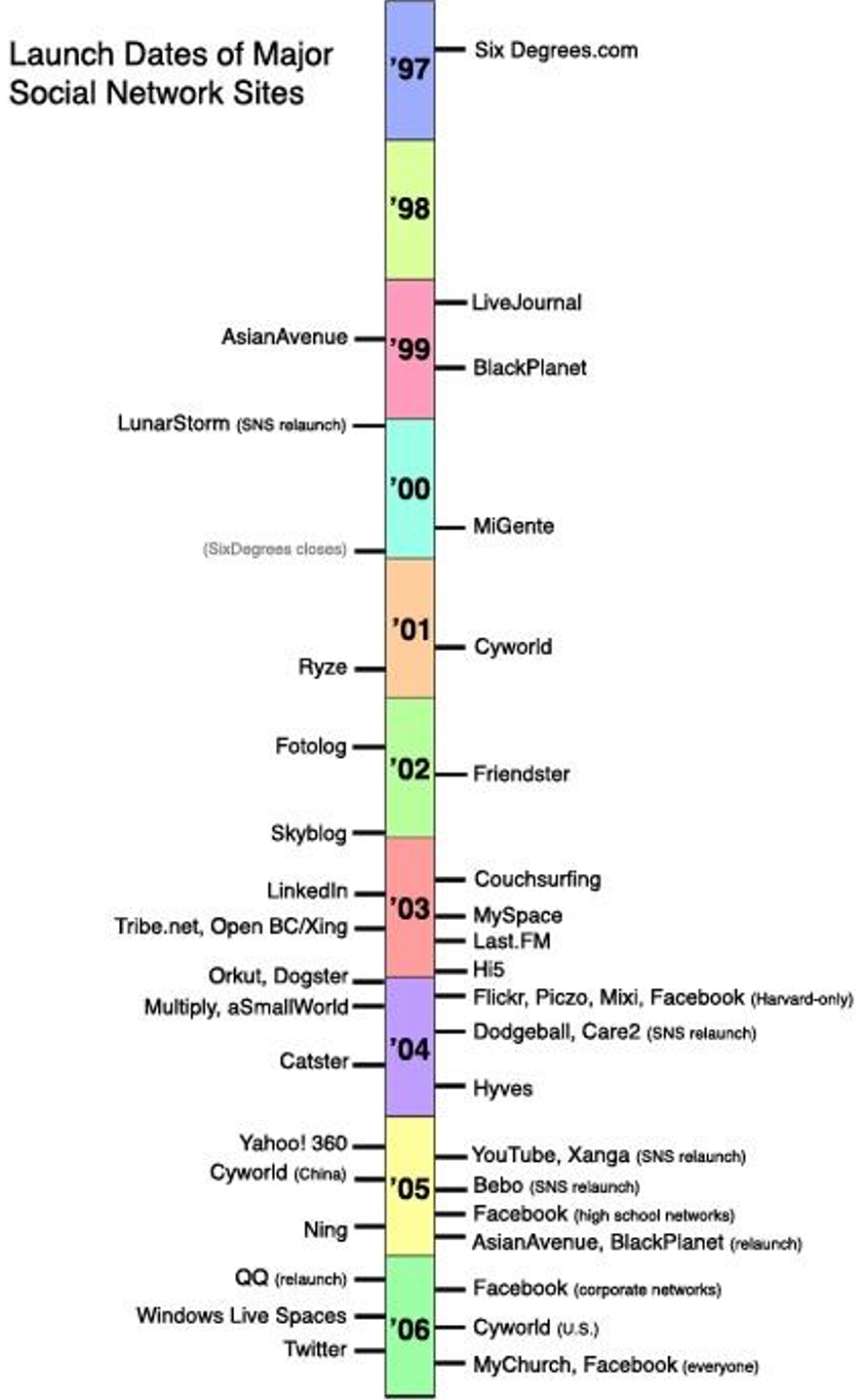 Figure 1: The growth of SNS platforms, showing the environment in which academic networks began to evolve.
Methods Comparison
The paper provides a breakdown of methodologies used across the decade:
| System | Primary Methodology | Key Contribution |
|---|---|---|
| Referral Web | Search engine co-occurrence | Automation of referrals |
| Flink | FOAF + Semantic Web | Community visualization |
| ArnetMiner | CRF extraction + Topic modeling | Unified mining from DLs |
| AcaSoNet | Hybrid IR + User Verification | Reliable performance metrics |
The Core Problem: The Scalability and Reliability Wall
Despite the advancements, the author highlights a "Query Explosion" problem. To detect relationships among just 500 people, some systems require over 124,000 queries to search engines. This is not only inefficient but also risks being blocked by search providers.
Furthermore, Name Ambiguity remains a "hard" problem. Common names and names shared with locations (e.g., "York") create noise that automated scrapers struggle to filter without deep contextual knowledge.
The AcaSoNet Vision: Data Sovereignty for Researchers
The paper concludes by advocating for the AcaSoNet approach. The core insight is that automatic detection is not precise enough. By allowing researchers to verify their own mined publication lists, the system gains three major advantages:
- Reliability: The data is "ground truth" verified by the author.
- Rich Metrics: Facilitates accurate calculation of h-index and g-index.
- Scalability: Reduces the reliance on brute-force web queries by focusing on structured library data.
Final Perspective
The mining of academic social networks is shifting from "scrubbing the web" to "curating the graph." The future lies in tools that assist researchers in managing their digital identity while providing the industry with a reliable map of human expertise. As we move toward more open research data, the ability to integrate verified social ties with publication output will be the benchmark of a successful academic system.