
Deciphering the DNA of Science: A Deep Dive into Academic Social Networks
Academic social networks: Modeling, analysis, mining and applications
This paper provides a comprehensive survey of Academic Social Networks (ASNs), conceptualizing them within the framework of Scholarly Big Data (SBD). It systematically explores ASNs through four core dimensions: structural modeling, network analysis metrics, advanced mining technologies, and diverse academic applications including expert finding and trend prediction.
TL;DR
The landscape of scientific research is no longer just a collection of PDFs; it is a massive, evolving "Scholarly Big Data" (SBD) ecosystem. This paper provides the first comprehensive roadmap for Academic Social Networks (ASNs), detailing how we can model, analyze, and mine the relationships between scholars, papers, and institutions to predict the next "Rising Star" or scientific breakthrough.
Background: Beyond the Static Citation
In the era of Web 2.0, science has become a complex, self-organizing network. We are moving away from seeing a paper as an isolated unit of knowledge and towards seeing it as a node in a high-dimensional graph. The pain point is clear: Information Overload. With millions of papers published annually, how do we find experts, identify emerging trends, or even disambiguate two authors with the same name? The answer lies in the structural topology of ASNs.
Methodology: The Architecture of Academic Knowledge
The authors categorize ASNs into two primary structural types:
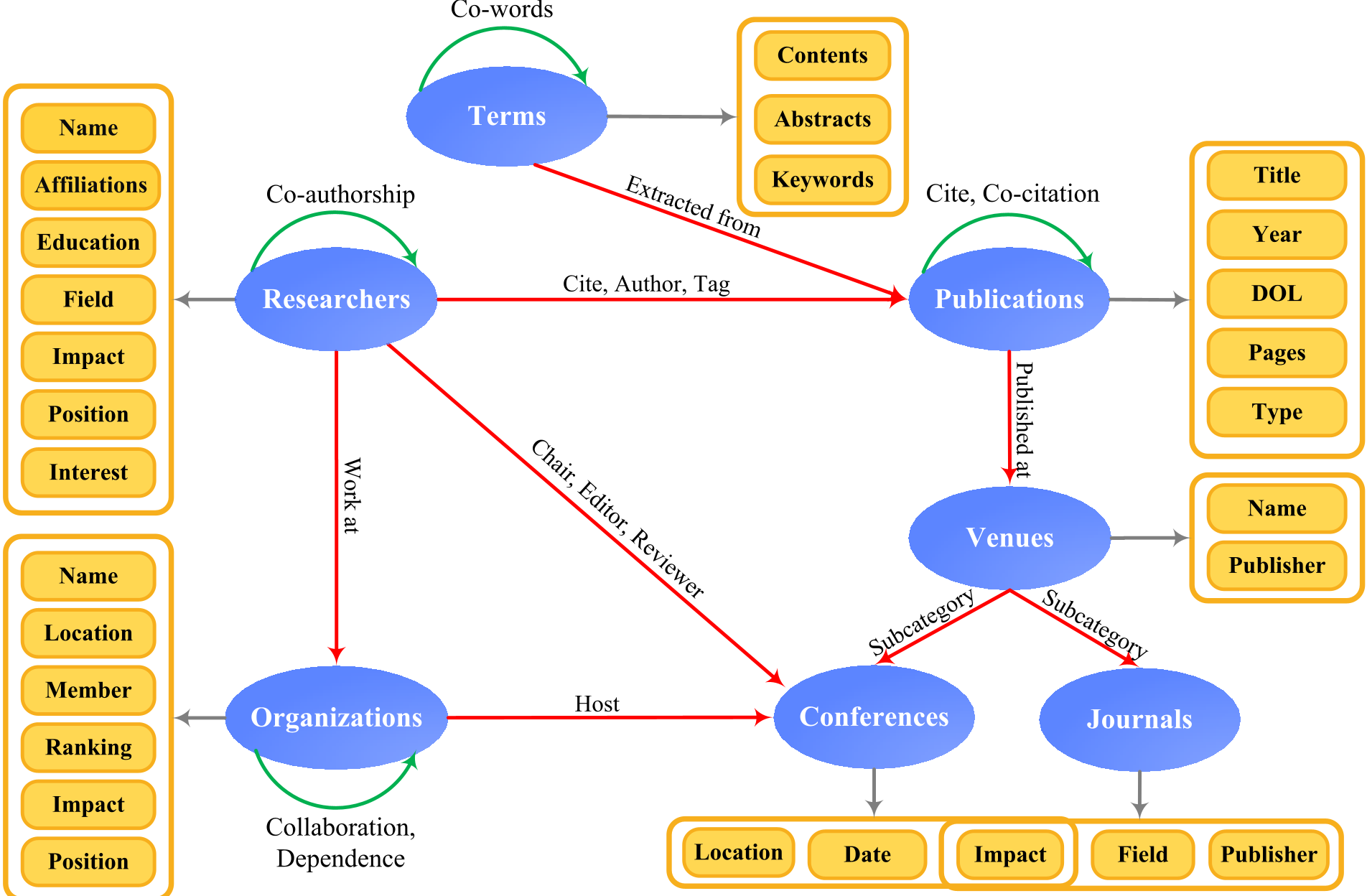
- Homogeneous Networks: Single-entity graphs. This includes the classic Co-authorship networks (who works with whom) and Co-citation networks (which papers are cited together).
- Heterogeneous Networks: This is where the real complexity lives. These graphs connect different types of entities—authors to papers, papers to venues (journals/conferences), and institutions to fields.
The Core Framework
To make sense of these networks, the paper establishes a four-tier analysis framework: Modeling, Analysis, Mining, and Applications.
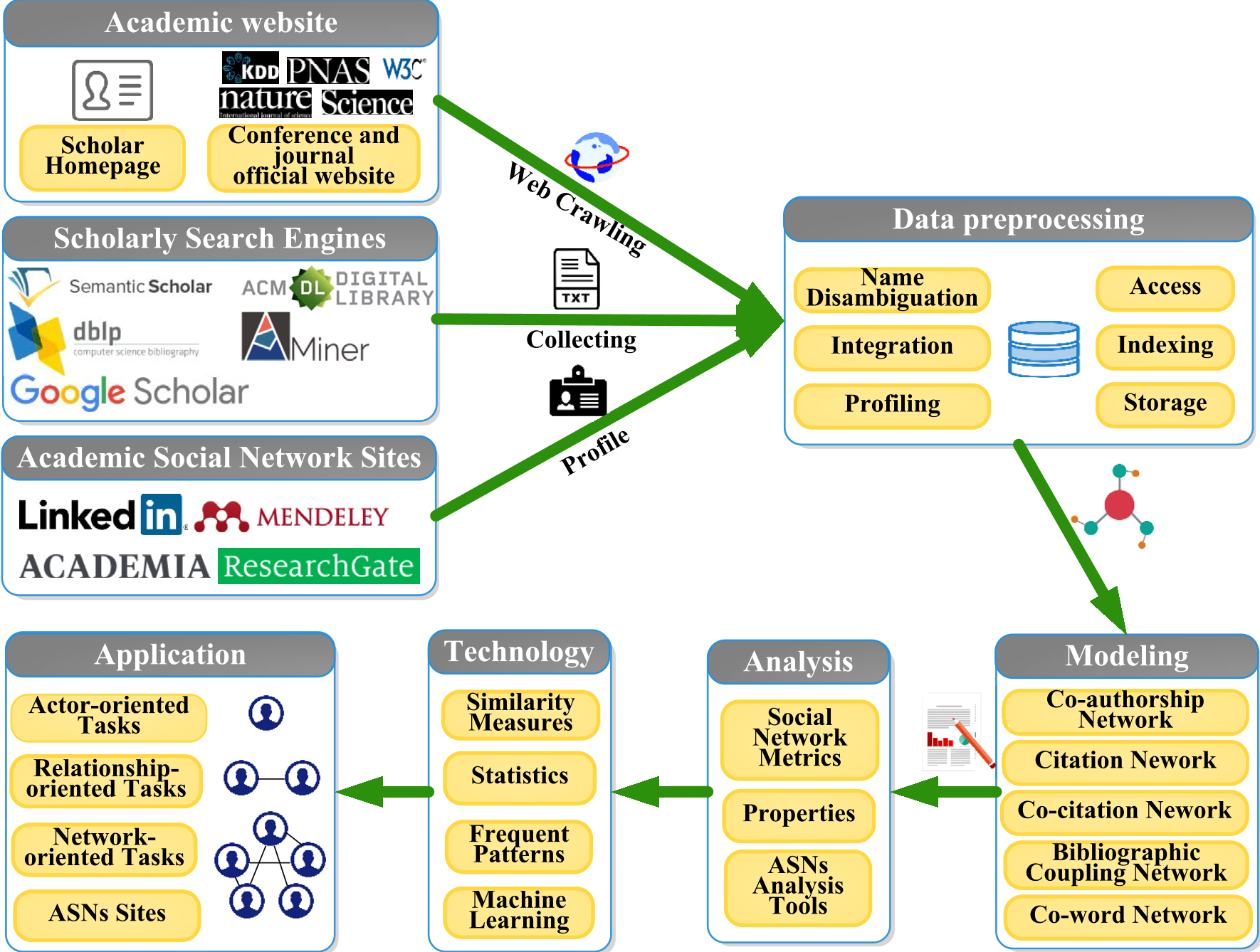
The methodology leverages Graph Theory (Node Degree, Centrality, Small-world properties) and Machine Learning (XGBoost, Deep Learning, and Clustering) to extract value from the noise of SBD.
Key Mining Insights: Finding the "Rising Stars"
One of the most compelling aspects of the paper is its focus on Actor-oriented applications. Traditional metrics like the H-index are "lagging indicators"—they tell you who was famous yesterday.
The survey explores advanced mining techniques like CocaRank and StarRank. These algorithms look at "Collaboration Caliber" and dynamic publication rankings to identify young researchers who are situated in pivotal network positions, effectively predicting future prestige before it reflects in citation counts.
Experiments & Real-World Platforms
The paper doesn't just stay in the theoretical realm; it reviews the "Big Three" of academic data:
- AMiner: Focuses on semantic-based profiles and heterogeneous networks.
- Microsoft Academic Graph (MAG): Provides multidisciplinary data on a massive scale (167 million articles).
- Google Scholar: The gold standard for citation tracking, despite its lack of standardization.
The "Experiments" in this field are often validated through tasks like Link Prediction (predicting future collaborations) and Community Detection (finding hidden research clusters). The paper highlights that modularity-based approaches (like the BGLL algorithm) are essential for uncovering the hierarchical structure of scientific disciplines.
Critical Insight & Future Outlook
While the paper provides a masterclass in current ASNs, it also points to a significant hurdle: Data Silos. Much of our academic data is locked behind institutional or disciplinary walls (e.g., Computer Science is better mapped than Humanities).
The Takeaway: The future of ASNs lies in Multiplex Diffusion Networks. We need to understand not just that Author A cited Author B, but how an idea flows through emails, social media mentions, and finally into a formal publication.
As we move toward 2026, the integration of Deep Learning with Graph Mining will allow us to move from simply observing the science of science to engineering better environments for innovation.
Limitations to Consider
- Name Disambiguation: Still a "hard" problem that skews network metrics.
- Dynamic Modeling: Real networks are temporal; many current models still treat them as static snapshots.
- Privacy & Intellectual Property: Sharing underlying SBD datasets remains a legal minefield.