
Accelerated Distributed Gradient: Solving Economic Dispatch for 1,000+ Generators
An Accelerated Distributed Gradient-Based Algorithm for Constrained Optimization With Application to Economic Dispatch in a Large-Scale Power System
This paper proposes an accelerated distributed gradient-based algorithm for constrained convex optimization, specifically targeting Large-Scale Power Systems. The method incorporates a momentum-based acceleration gain to enhance the convergence speed of traditional distributed gradient methods, achieving significantly faster results in Economic Dispatch (ED) tasks across systems up to 1000 generators.
TL;DR
Balancing the generation of thousands of electricity units at minimum cost (Economic Dispatch) is a massive optimization challenge. This paper presents a new accelerated distributed gradient algorithm that uses local "momentum" to speed up convergence while strictly respecting generator limits and global demand. By rethinking the estimate vector as a local scalar rather than a global status, the researchers achieved significant speedups in large-scale power systems.
Background: Why Distributed Optimization?
As power grids evolve into "Smart Grids," the number of controllable agents (thermal plants, wind farms, storage) grows exponentially. Centralized control suffers from single points of failure and massive data bottlenecks. Distributed optimization offers:
- Privacy: Agents only share minimal estimates, not their internal cost functions.
- Reliability: No single master controller is required.
- Scalability: Local computations are performed in parallel.
However, the "Achilles' heel" of distributed gradient methods has always been convergence speed. They are notoriously slow compared to centralized Newton-type methods.
The Problem: The High-Dimensional Bottleneck
Previous distributed approaches required every generator to maintain a "global estimate vector." If you have 1,000 generators, every agent must communicate and store a 1,000-dimensional vector. This leads to communication explosion. Furthermore, existing "fast" methods often ignore the complex inequality constraints (min/max power limits) inherent in power systems.
The Core Insight: Momentum + Virtual Agents
The authors propose two major breakthroughs:
1. The Momentum-Based Acceleration
Inspired by physics, they add a momentum term to the update law:
abla f_i(v^k) + \beta_k (v^k - v^{k-1}) ]$$ Here, $\beta_k$ is the **acceleration gain**. The key innovation is proving that for the algorithm to remain stable while being fast, $\beta_k$ must be **diminishing and summable**. ### 2. Hierarchical Decentralized Architecture To solve the dimensionality problem, they use a **virtual agent** strategy. Instead of estimating the whole grid's state, each generator only estimates its *own* output. A central coordinator acts as a lightweight "virtual agent" to ensure the total power matches the demand, without needing to know the cost functions of individual plants.  *Figure: The core update law incorporating the momentum term $\beta_k (v^k - v^{k-1})$.* ## Experimental Validation The researchers tested the algorithm on IEEE 30-bus, 118-bus, and a massive **1000-generator** system. - **Speedup**: The proposed method converged significantly faster than the baseline decentralized algorithm from [33]. - **Ramp Limits**: The algorithm successfully handled dynamic load profiles where generators have limits on how fast they can increase/decrease output (Up/Down-ramp limits). - **Scalability**: In the 1000-generator test, the method proved that distributed optimization can compete with centralized solvers when executed in parallel, with only a marginal increase in total iteration count. 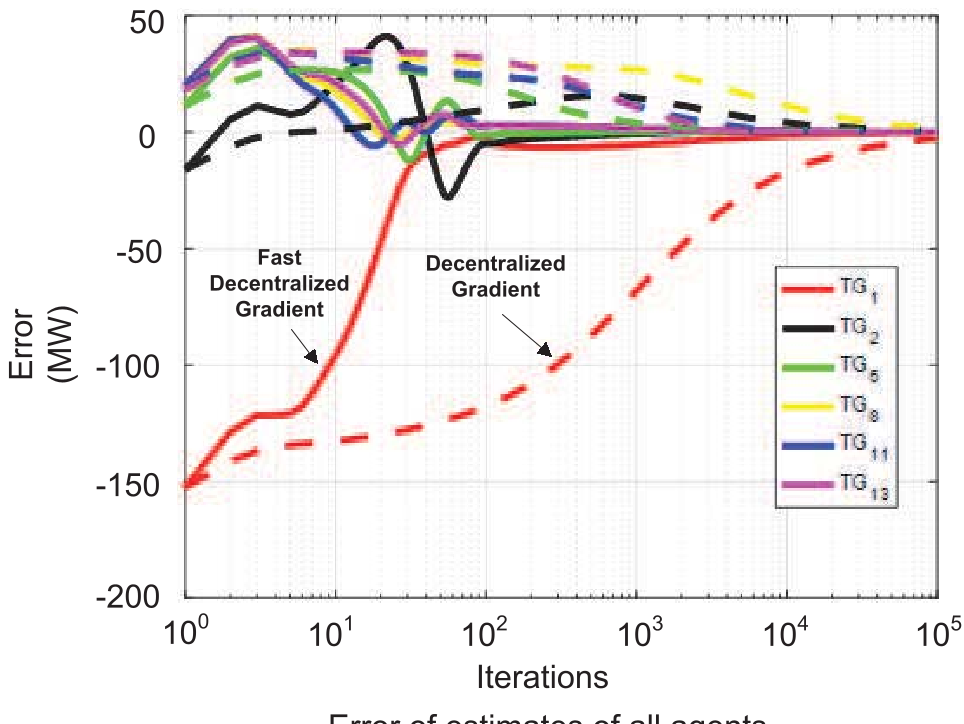 *Figure: Convergence comparison showing the accelerated method (solid line) reaching the optimal cost significantly faster than the traditional method (dashed line).* ## Critical Insight & Conclusion The true value of this work lies in the **Convergence Analysis (Theorem 1 and 2)**. Proving stability for an accelerated method under both local inequality and global equality constraints is mathematically non-trivial. By showing that the decentralized version is equivalent to a virtual-agent-augmented distributed system, the authors bridge the gap between theoretical optimization and practical power engineering. **Limitations**: While the momentum term speeds up local convergence, the synchronization with the coordinator still requires a global clock/timestamp. Future work could look into *asynchronous* updates to further reduce the dependency on network timing.