
Scaling the Unscalable: How Crowdsourcing Can Modernize Qualitative Coding
Accelerating Deductive Coding of Qualitative Data: An Experimental Study on the Applicability of Crowdsourcing
The paper introduces an interactive coding system designed to accelerate deductive qualitative data analysis by leveraging non-expert crowdworkers on Amazon Mechanical Turk. The system employs a task-splitting strategy and incentive mechanisms, achieving a substantial intercoder agreement (up to 91%) with expert coders on semi-structured interview data.
TL;DR
Qualitative research provides deep insights but is often bottlenecked by the "coding" process—a manual, labor-intensive task of labeling text. This paper presents an interactive system that allows non-expert crowdworkers to perform deductive coding on semi-structured interviews. By splitting complex tasks and using consensus-based rewards, the system achieves expert-level reliability for concrete data, offering a scalable path for large-scale qualitative analysis.
The "Strenuous" Bottleneck of Qualitative Research
In the world of Human-Computer Interaction (HCI) and Social Sciences, qualitative data is gold. However, mining that gold requires coding: the process of assigning labels to text to find patterns. Traditionally, this requires PhD-level experts to spend hundreds of hours reading transcripts.
While AI (Machine Learning and NLP) has been proposed as a solution, the "black box" nature of AI often clashes with the interpretive requirements of qualitative work. Researchers simply don't trust machines to understand the "why" behind a human's answer. This paper asks a provocative question: Can we replace one expert with dozens of non-experts (the "Crowd") without losing quality?
Methodology: The "Divide and Conquer" Approach
The core insight of this paper is that task complexity is the enemy of the crowd. To enable non-experts to code complex interviews (specifically "laddering interviews" which connect product attributes to human values), the authors built a specialized UI and workflow.
1. The Multi-Stage Workflow
Instead of giving a worker a list of 20+ codes, the task is split into:
- Step 1: Identify the primary category (e.g., Is this about a product Attribute, a Consequence, or a Value?).
- Step 2: Based on the Step 1 result, assign a specific code from a smaller sub-set.
2. Contextual UI Design
The system shows multiple interview segments at once. This allows workers to see the "flow" of a conversation, which is critical for understanding the context of an answer.
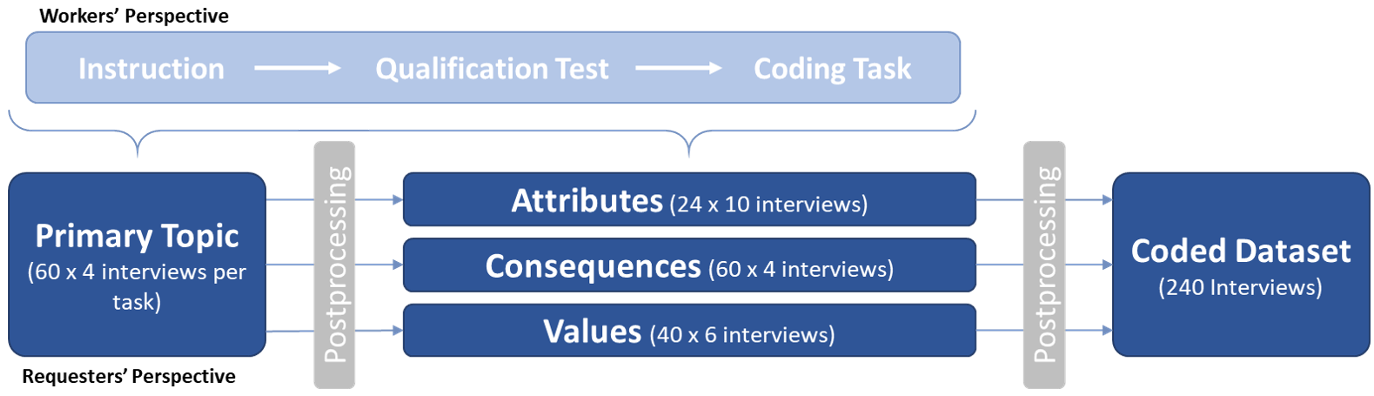 Figure 1: The two-step crowdsourcing process designed to reduce cognitive load.
Experiments: Expert vs. Crowd
The authors tested the system on 240 interviews using Amazon Mechanical Turk. They measured two things:
- Consistency: Do the workers agree with each other?
- Accuracy: Do the workers agree with the "Gold Standard" set by expert researchers?
Key Findings:
- Attributes (Concrete) are easy: The crowd achieved an almost perfect agreement () when coding concrete things like "WhatsApp" or "Battery Life."
- Values (Abstract) are hard: When coding abstract concepts like "Self-Esteem" or "Security," agreement dropped. This suggests that the more interpretative a task is, the more the coder's personal background influences the result.
 Table 1: Comparison of consistency between the Crowd and Experts across different code types.
Critical Insight: Disagreement is a Feature, Not a Bug
One of the paper's most sophisticated arguments is that we shouldn't always aim for 100% agreement. In qualitative research, "diverse perspectives" are valuable.
If four crowdworkers give three different labels, it might not mean they are "wrong"—it might mean the text is ambiguous or the codebook is unclear. The authors suggest using the crowd as a "proxy" to test how intuitive a researcher's codebook actually is before finalizing it.
Future Outlook and Limitations
While the system succeeded for "hard-laddering" (highly structured) interviews, the authors admit that verbose, unstructured narratives might still be too difficult for a general crowd. Furthermore, the lack of demographic data on workers remains a limitation; we don't yet know how much a worker's own culture biases their coding of another person's values.
Conclusion
This study bridges the gap between the rigor of qualitative methods and the scale of the digital age. It proves that by using interactive system design and smart task decomposition, we can accelerate the analysis of peoples' minds without completely removing the "human" element that AI often lacks.