
Scaling Intent: How Crowdsourcing Accelerates Goal-Based Robotic Imitation
Accelerating imitation learning through crowdsourcing
This paper introduces a framework for Goal-Based Imitation Learning that leverages crowdsourcing to overcome data scarcity in robotics. By collecting 2D object model demonstrations from Amazon Mechanical Turk (AMT), a robot can learn generative graphical models that generalize across diverse human intentions and hardware constraints.
TL;DR
Robots often struggle to learn from humans because high-quality demonstrations are expensive and scarce. This paper proposes a paradigm shift: instead of training a robot on a few local demonstrations, why not use crowdsourcing to gather thousands of examples? By focusing on Goal-Based Imitation—imitating the result rather than the movement—the authors demonstrate a robot that uses online "wisdom of the crowd" to build 2D models, infer intentions, and even predict missing parts.
Background: Trajectories vs. Goals
In classic imitation learning, a robot typically tries to mimic the exact path (trajectory) of a human hand. This is problematic: a bulky industrial arm cannot move like a lithe human wrist. Goal-based imitation sidesteps this by asking what the human is trying to achieve, allowing the robot to find its own way to reach that state. However, learning "intent" requires a massive variety of examples to understand the underlying patterns of a concept like a "House" or a "Tree."
The Core Insight: Crowdsourcing the "What"
The authors utilize Amazon Mechanical Turk (AMT) to scale up their data. They developed a web interface where workers build 2D block models. This serves two purposes:
- Volume: Thousands of workers provide a diverse dataset that a single local teacher cannot.
- Scoring: The crowd also provides "satisfaction ratings," teaching the robot which designs are "good" or "recognizable," effectively providing a human-centric reward function.
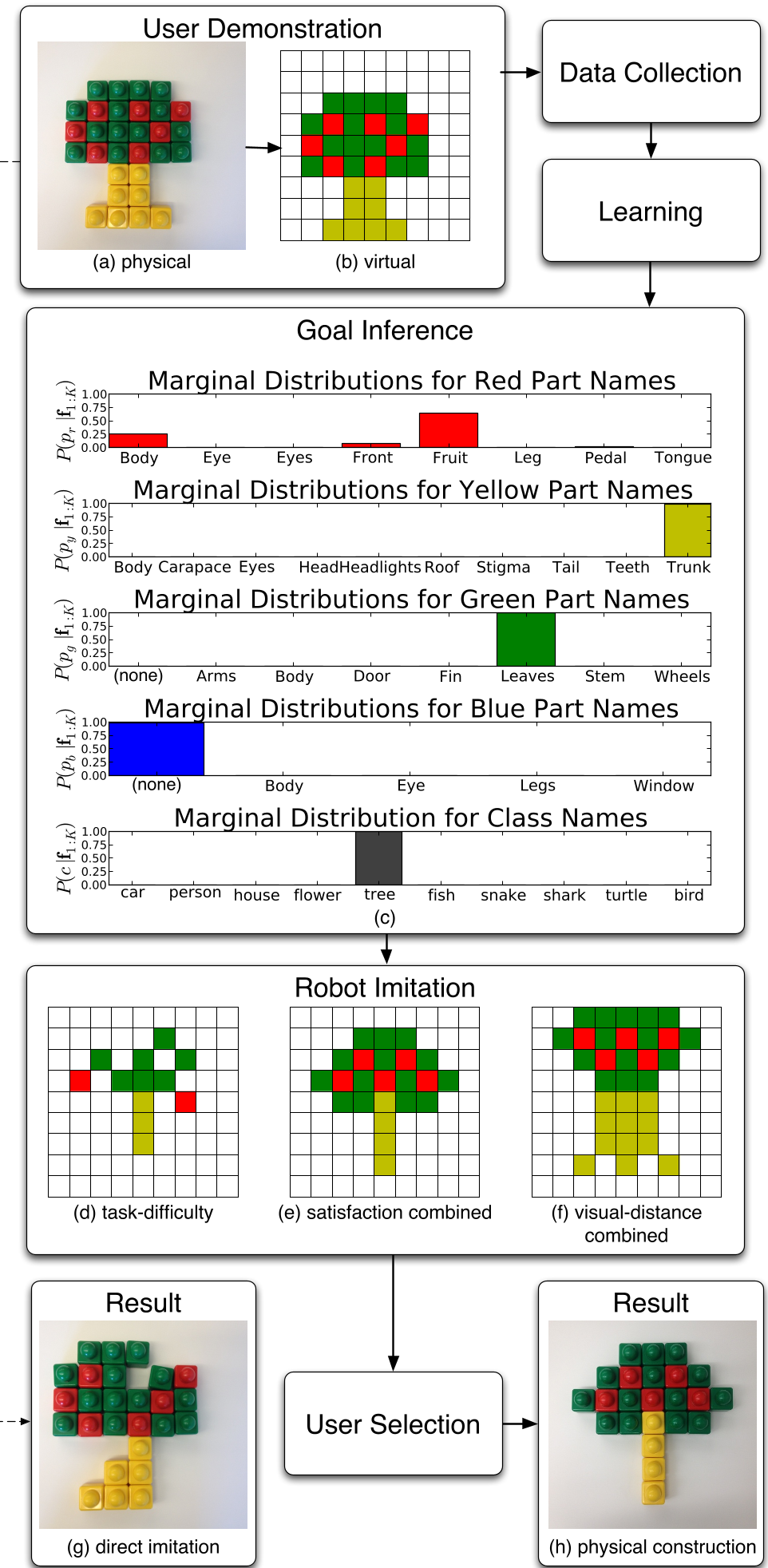 Figure 1: The flow from user demonstration (a) to sensing (b), crowd-based goal inference (c), and final robotic execution (h).
Methodology: The Generative Graphical Model
To process this data, the authors use a generative graphical model (see below). It breaks down an object into its name (), its parts (), and its features ().
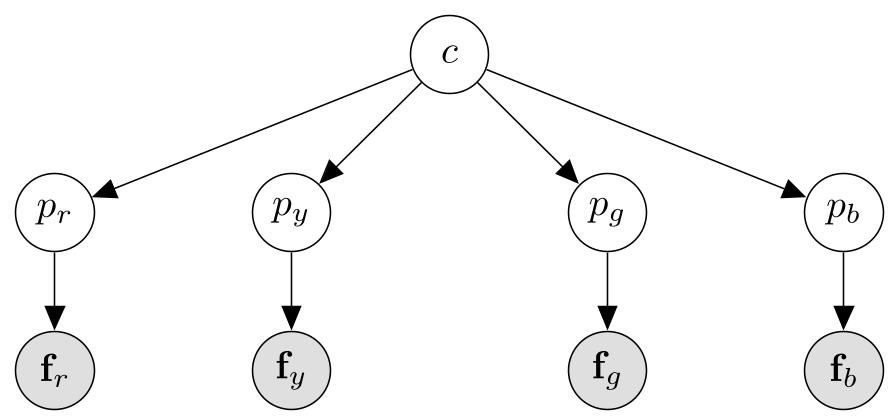 Figure 2: The tree-structured model allows for efficient belief propagation to compute marginals of what the user is actually building.
Imitation as a Search Problem
Once the robot understands the goal (e.g., "The user wants a Tree"), it doesn't just copy the user's exact (and potentially physically difficult) model. Instead, it searches the crowdsourced database for the optimal version to build, balancing:
- Task Difficulty: Can I actually place these blocks without knocking others over?
- Crowd Satisfaction: Does the crowd think this is a "good" tree?
- Visual Similarity: Is it close to what the user showed me?
Experimental Wins
The team tested the Gambit robot on 16 different model tasks. Key findings included:
- The Power of Scale: Identification accuracy for objects and parts only began to plateau after roughly 800 crowdsourced examples, proving that local "small data" approaches are insufficient for generalizable knowledge.
- Missing Part Prediction: Because the model is generative, the robot can "fill in the blanks." If a user builds a house without a roof, the robot can infer the missing pieces based on its learned distribution of "Houseness."
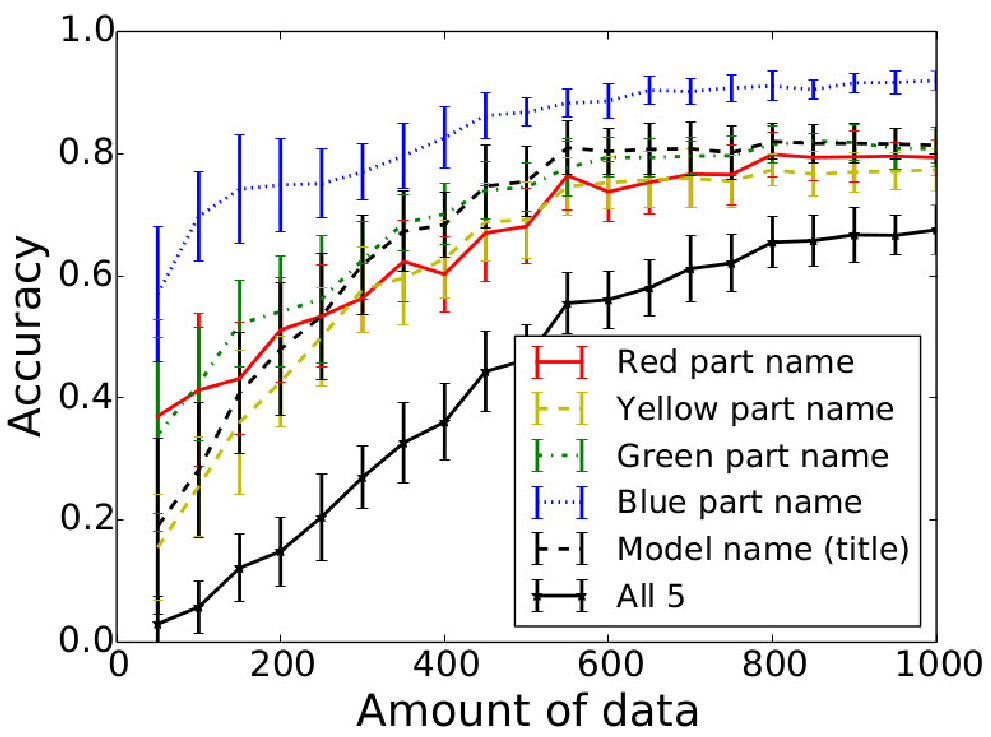 Figure 3: Accuracy vs. Data Volume. Notice how performance scales significantly as the crowd-provided dataset grows.
Critical Analysis & Real-World Limitations
While highly effective, the authors admit to the "wild west" nature of crowdsourcing. Quality control is the primary hurdle; spammers and "lazy" workers can pollute the dataset with noise. Furthermore, translating these 2D grid-based tasks into complex, high-degree-of-freedom 3D assembly remains a significant leap.
Conclusion
This work highlights a future where robots aren't just trained in labs by PhDs, but are constantly "polling" the collective human experience via the web. By decoupling the intent of a task from the physics of the execution, the researchers have provided a scalable roadmap for robots to acquire human-like common sense in task performance.