
Socializing the Swarm: How Social Networks Can Supercharge P2P File Sharing
Accelerating Peer-to-Peer File Sharing with Social Relations
This paper investigates the acceleration of BitTorrent (BT) file sharing by leveraging social relations, specifically Twitter-triggered swarms. The authors propose a "Social Index" based on Hadamard Transform to identify socially active peers and a modified choking protocol that prioritizes social friends, achieving significantly faster download times.
TL;DR
BitTorrent (BT) has long been a game of anonymous "Tit-for-Tat." This paper reveals that in typical swarms, peers almost never meet again, making long-term cooperation impossible. However, by tapping into Twitter-triggered swarms, where community interests lead to 7x higher peer encounter rates, the authors introduce a Hadamard Transform-based Social Index and a modified choking protocol that slashes download times by over 80%.
The "Meet-Again" Problem in P2P
The fundamental incentive in BitTorrent is Tit-for-Tat (TFT): "I give to you only if you give to me." While effective against free-riders, it is notoriously inefficient for altruistic cooperation. Previous researchers hoped that peers would form long-term relationships, but this paper’s massive 80-day trace measurement provides a cold reality check: less than 5% of peers in normal swarms encounter each other a second time.
Without repeated interactions, there is no "shadow of the future," and thus no incentive for peers to help each other beyond the immediate swap.
The Twitter Catalyst
The rise of social media has changed the landscape. When a torrent link is tweeted, followers often click and join the swarm simultaneously. This creates temporal locality.
- Normal Swarms: Sparse encounters, random online patterns.
- Twitter Swarms: Dense "communities" where over 35% of peers meet again, often overlapping for more than 15 hours.
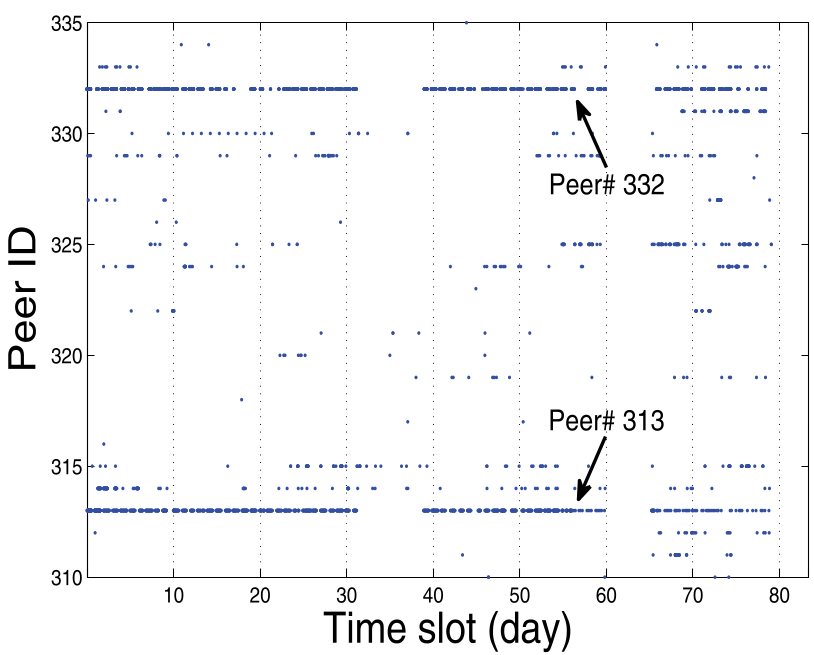 Fig 1: Comparison of peer relationships. Twitter swarms (right) show much denser community clustering compared to normal swarms (left).
Methodology: Identifying the "Socially Active"
How do we find these valuable, socially active peers among millions of users without massive computational overhead? The authors look at the randomness of online behavior.
They utilize the Hadamard Transform (a relative of the Fourier Transform) to analyze binary online/offline sequences.
- Random Behavior: Peers who join/leave sporadically have high "randomness" (like Poisson data).
- Social Behavior: Peers with regular, community-driven patterns show persistent amplitudes in the transform domain.
By calculating a Social Index based on this randomness, trackers can group "friends" together. The proposed protocol then allows leechers to act like seeders for their social friends—prioritizing uploads to them based on social ties rather than just immediate reciprocal download rates.
Experimental Results: A Speed Revolution
The impact of this social awareness is staggering. In PlanetLab testing, the authors compared a standard BT swarm with a "Social" swarm.
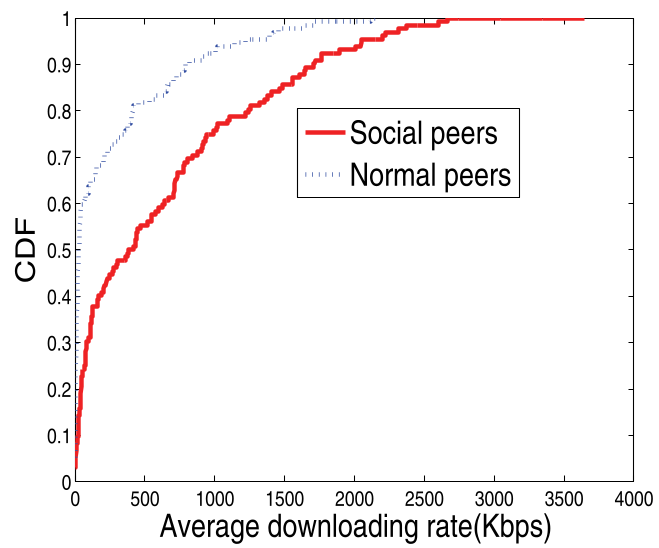 Fig 2: Completion time comparison. Social-enhanced swarms reach 70% completion while normal swarms are still under 10%.
Key Findings:
- Speed: Social peers finished in a fraction of the time. The 90th percentile of social peers got their first piece of data within 60 seconds, whereas 40% of normal peers were still waiting.
- Hybrid Success: Even in a "Hybrid" swarm (where only some peers are social), the social group still benefits immensely without negatively impacting the "normal" peers. In fact, clustering social peers can improve the overall health of the swarm by increasing "seeding" duration within those sub-communities.
Critical Insight & Future Outlook
This work shifts the P2P paradigm from Calculated Selfishness (TFT) to Social Altruism. The core insight is that social networks provide the "context" that raw IP addresses lack.
Limitations: The study assumes we can easily map Twitter identities to BT peers, which raises privacy concerns. Furthermore, it doesn't solve the "Free Rider" problem if a user is a friend but still refuses to upload.
The Future: As we move toward Web3 and decentralized storage (like IPFS), the "Social Index" logic could be integrated into DHTs (Distributed Hash Tables) to ensure that content is not just distributed, but distributed among those most likely to be online at the same time.