
Socially-Aware BitTorrent: Leveraging Twitter Relations to Break the Tit-for-Tat Speed Barrier
Accelerating Peer-to-Peer File Sharing with Social Relations
This paper explores accelerating P2P file sharing (specifically BitTorrent) by leveraging Twitter-based social relationships. It introduces a "Social Index" based on the Hadamard Transform to identify socially active peers and proposes a modified choking protocol that prioritizes uploading to social friends, significantly reducing download times.
TL;DR
While BitTorrent (BT) has long relied on the "Tit-for-Tat" (TFT) mechanism to ensure fairness, this "stranger-to-stranger" logic often limits the speed of cooperative peers. This paper proves that "Twitter-triggered" swarms provide a unique opportunity for acceleration. By introducing a Hadamard Transform-based Social Index, the authors identify "socially active" peers and implement a protocol that prioritizes sharing among friends, resulting in a staggering 5x improvement in download completion times.
The "Lone Wolf" Problem in P2P
Since its inception, BitTorrent has been a solitary pursuit. You swap bits with anonymous IP addresses, and once the file is done, you usually disappear. Previous research attempted to boost efficiency by assuming "long-term relationships" between peers, but this paper’s 80-day trace of 100,000 swarms delivers a reality check: less than 5% of peers ever meet each other again.
However, the rise of social media (Twitter) changed the landscape. Torrent links shared in communities create swarms where peers have common interests and—crucially—overlapping online patterns. In these Twitter swarms, the encounter rate jumps from 5% to 35%.
Methodology: Detecting Social Patterns via Hadamard Transform
The core challenge is identifying who is "socially active" without the massive overhead of comparing every peer's history. The authors provide a brilliant insight: Socially active peers have regular, non-random online patterns.
Using the Hadamard Transform (a generalized Fourier Transform), the authors analyze the binary sequence of a peer's availability (online vs. offline).
- Random/Poisson behavior (normal peers) results in high entropy/randomness in the transform domain.
- Regular behavior (socially active peers) shows specific independent amplitudes, leading to a high "Social Index."
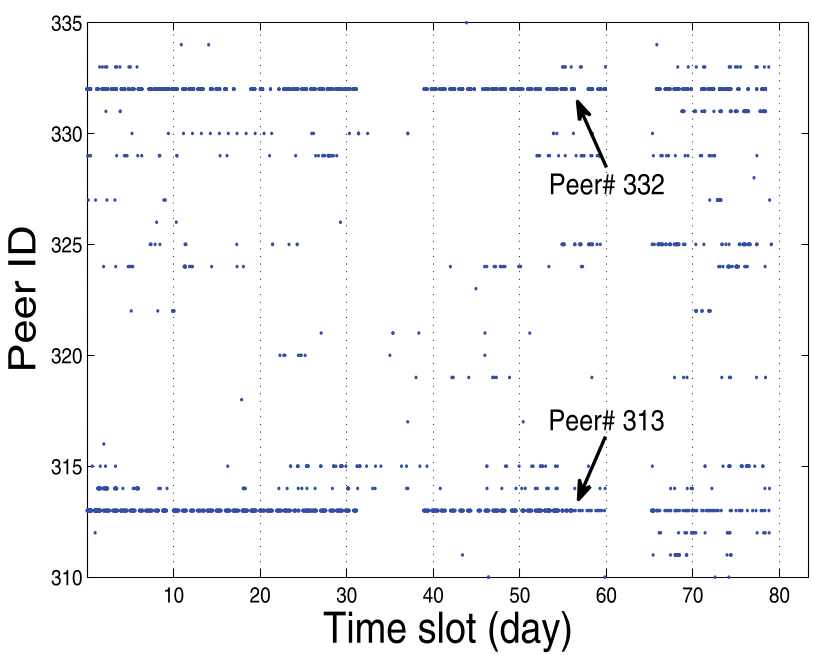 Fig 1: Visualization of common interests in normal swarms (left) vs. Twitter swarms (right), showing denser social clusters in the latter.
The Protocol: Friends with Benefits
The authors modified the standard BT choking algorithm. In the standard version, a leecher unchokes the 4 peers providing the best download rate (reciprocity). In the Socialized Protocol:
- The tracker identifies social friends via the Social Index.
- Leechers treat social friends like "seeders"—they unchoke friends based on their own uploading rate to those friends.
- This fosters a "altruistic" cluster within the swarm that moves data much faster than the TFT-constrained masses.
Experimental Results: A Performance Leap
The results from PlanetLab experiments are nothing short of transformative.
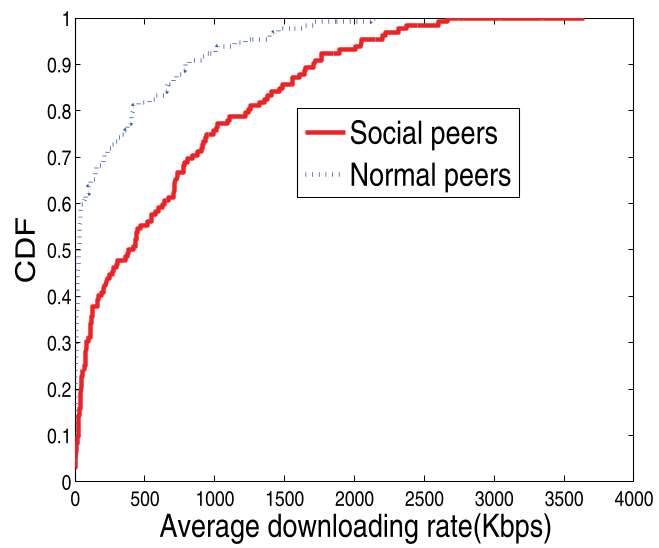 Fig 2: Comparison of download completion times. The social-enhanced swarm (S-social) finishes significantly earlier than the standard swarm (S-normal).
- Download Speed: 70% of social peers finished in <800s, while 60% of normal peers were still downloading at 4000s.
- Startup Delay: Social peers received their first piece within 1 minute, compared to a much slower ramp-up for traditional peers.
- Hybrid Robustness: Even when only 30% of the swarm was "socially active," those peers still saw massive gains without slowing down the rest of the network.
Critical Insight & Conclusion
The genius of this work lies in moving P2P from a purely mathematical game-theory problem to a socio-technical one. By recognizing that social networks (Twitter) act as an external "trust and timing" signal, the authors found a way to bypass the inherent friction of the Tit-for-Tat mechanism.
Limitations: The study primarily focuses on Twitter; however, the "Social Index" is technically platform-agnostic, as it only measures the periodicity of online behavior. The true hurdle remains privacy—trackers would need access to social graphs or behavior logs, which might raise concerns in the decentralized P2P community.
In a world moving toward decentralized social networks (Web3), this "Social Index" approach could be the key to building the next generation of high-speed, community-driven content delivery systems.