
Harmonizing Light and Logic: Accelerating Distributed ML with Pattern-Aware Optical Switching
Acceleration and Efficiency Warranty for Distributed Machine Learning Jobs over Data Center Network with Optical Circuit Switching
This paper introduces a Pattern-Aware Scheduling (PAS) and Fast Convergence (FastConv) strategy for Distributed Machine Learning (DML) jobs in hybrid Data Center Networks (DCN) utilizing Optical Circuit Switching (OCS). By dynamically reconfiguring lightpaths to match MPI communication patterns (e.g., Ring AllReduce), the system significantly reduces job completion time and accelerates model convergence.
TL;DR
Distributed Machine Learning (DML) performance is often throttled by the network, not the GPU. This paper proposes a hybrid architecture that uses Optical Circuit Switching (OCS) to physically rewire the data center on-the-fly to match the specific "communication shapes" of ML jobs, alongside a FastConv strategy that prioritizes bandwidth for jobs that haven't yet reached accuracy targets.
The Bottleneck: When Topology Mismatches Traffic
In modern DML, models are synchronized via collective operations like AllReduce. These operations generate massive "elephant flows." In standard Electronic Packet Switching (EPS) networks, these flows often collide, leading to:
- Queueing delays: Packets wait at switches because the physical path doesn't align with the logical ring or tree pattern of the ML framework.
- Bandwidth Stragglers: Overlapping jobs compete for the same links, slowing down the entire synchronization step (the "tail latency" problem).
While some researchers suggest allowing packet loss to speed things up, this paper argues we shouldn't sacrifice accuracy for speed. Instead, we should change the network itself.
Methodology: PAS and FastConv
The authors introduce a dual-layered strategy to tackle efficiency from both a structural and a performance perspective.
1. Pattern-Aware Scheduling (PAS)
Instead of forcing MPI traffic through a static tree topology, PAS reconfigures the Optical Cross Connect (OXC). If a job uses a Ring AllReduce pattern, the network becomes a physical ring. If it uses Recursive-Doubling, the OXC changes the lightpaths dynamically to match each step of the algorithm.
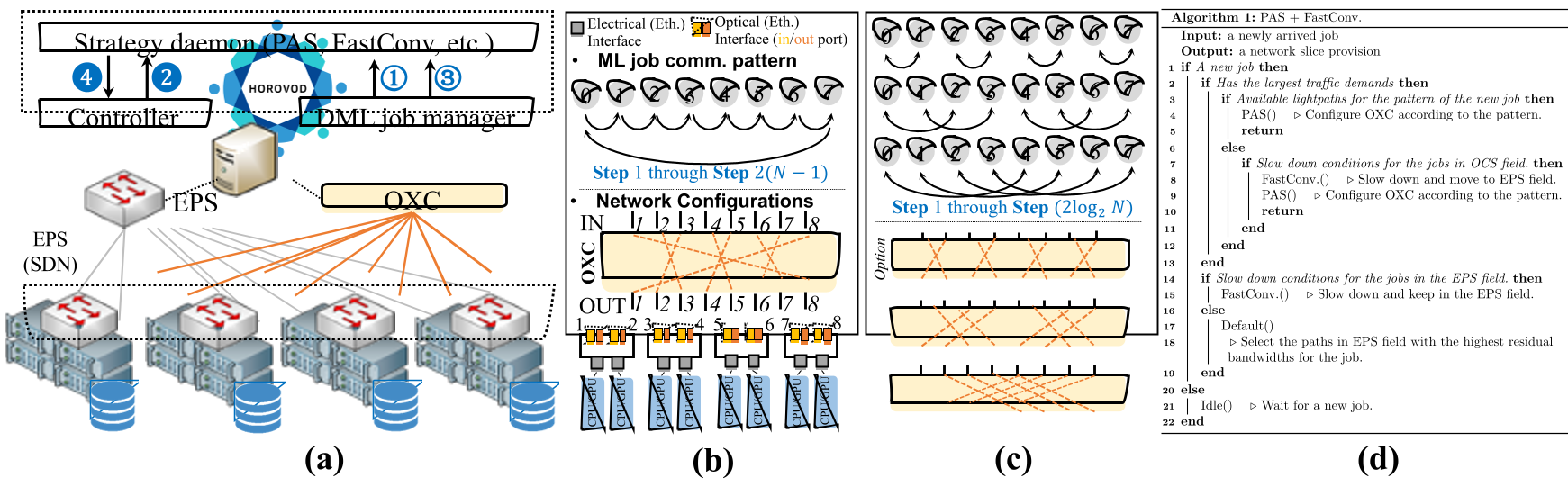 Fig 1. The architecture integrates a Strategy Daemon that coordinates between the DML Job Manager and the SDN/Optical controllers.
2. Fast Convergence (FastConv)
The "FastConv" strategy adds a layer of intelligence. It monitors the actual Learning Performance (e.g., Accuracy). If a job is already near its convergence threshold, the system throttles its bandwidth (moving it to the EPS domain) and reallocates the high-speed OCS paths to new jobs that need to "warm up" or converge quickly.
Experimental Insights
The researchers tested their approach using the PCAM dataset and CNN benchmarks across multiple job densities.
The "Small Job" Paradox
Interestingly, PAS provided the highest acceleration ratios for jobs with smaller input data sizes when density was high (Fig 2a). This is because small jobs are the most vulnerable to being "crushed" by bandwidth-hungry large jobs in a traditional shared network. PAS gives them a dedicated "express lane."
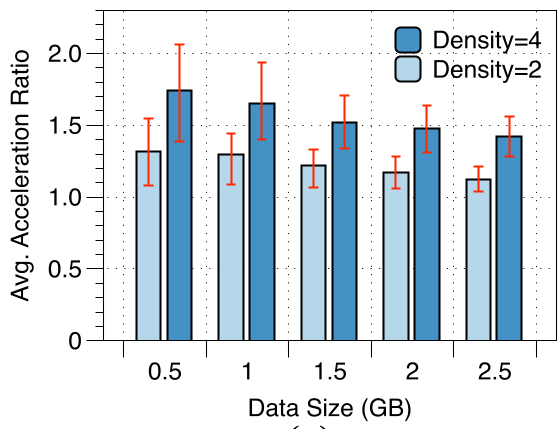 Fig 2. Acceleration ratios for varied data sizes and MPI patterns. Note how Ring AllReduce benefits significantly from PAS due to its high node-connection demands.
Efficiency Gains
By combining PAS and FastConv, the team observed that jobs reached 90% of their peak accuracy significantly faster. This demonstrates that network scheduling shouldn't just be "load-aware"—it must be "convergence-aware."
Critical Analysis & Conclusion
This work represents a vital shift toward Application-Aware Networking. By using OCS to provide tailored topologies, we eliminate the mismatch between the software's logical communication and the hardware's physical paths.
Limitations:
- Reconfiguration Overhead: The paper focuses on the gains but OCS hardware typically has a millisecond-level switching latency. For very short-lived MPI steps, this might become a bottleneck.
- Scalability: The experiment was conducted with 4 nodes per job. Scaling this to thousands of GPUs (as seen in LLM training) would require a hierarchical OXC management strategy.
Future Outlook: As we move toward massive scale training (GPT-5 and beyond), the "one-size-fits-all" Fat-Tree topology may become obsolete. Solutions like PAS point toward a future where the network is as programmable and dynamic as the code running on the GPUs.
Takeaway: In the era of Distributed ML, the network is no longer just a pipe; it is a dynamic component of the training algorithm itself.