
The Cultural Moat: Why "Standard" Social Networks Rule Their Local Markets
Acceptance and Quality Perception of Social Network Standard and Non-standard Services in Different Cultures
This study evaluates the acceptance and quality perception of "standard" versus "non-standard" social network services (SNS) across two distinct cultures, Russia and Germany. Utilizing the Information Service Evaluation (ISE) model, it identifies Vkontakte (Russia) and Facebook (Germany) as regional standards and analyzes how network effects influence user behavior and perception.
TL;DR
Why is Facebook a "ghost town" for many Russian users while Vkontakte dominates? This study investigates the friction between "Standard" and "Non-Standard" Social Network Services (SNS) in Germany and Russia. It reveals that once a platform achieves "Standard" status, it benefits from a massive "quality perception" boost that makes competitors feel clunky, untrustworthy, and boring by comparison—regardless of their actual features.
Background Positioning
Unlike traditional software, SNS value is dictated by network effects. This paper moves beyond simple TAM (Technology Acceptance Model) applications by introducing the concept of a "National Standard" service. It positions itself as a cross-cultural comparative study that explains why globalization hasn't resulted in a single global SNS hegemony.
The Problem: The Standard vs. Non-Standard Gap
The researchers identify a critical oversight in existing social computing literature: they often ignore the "status" of a service. A Russian user doesn't just evaluate Facebook on its buttons and speed; they evaluate it as a "non-standard" service—one where their friends aren't present and the cultural "vibe" feels off.
The study highlights that even if a service is "known," it is rarely "used" if it isn't the regional standard. The central question is: How does the perception of quality (is it fun? is it easy?) change when a service is the national incumbent versus a foreign intruder?
Methodology: The ISE Framework
The authors utilize the Information Service Evaluation (ISE) model, which breaks down the user experience into eight distinct indicators:
- Perceived Quality: Ease of Use, Usefulness, Trust, and Fun.
- Acceptance: Adoption, Use, Impact, and Diffusion.
The study compared two groups:
- Russia: Vkontakte (Standard) vs. Facebook (Non-Standard).
- Germany: Facebook (Standard) vs. Vkontakte (Non-Standard).
Deep Dive into the Results
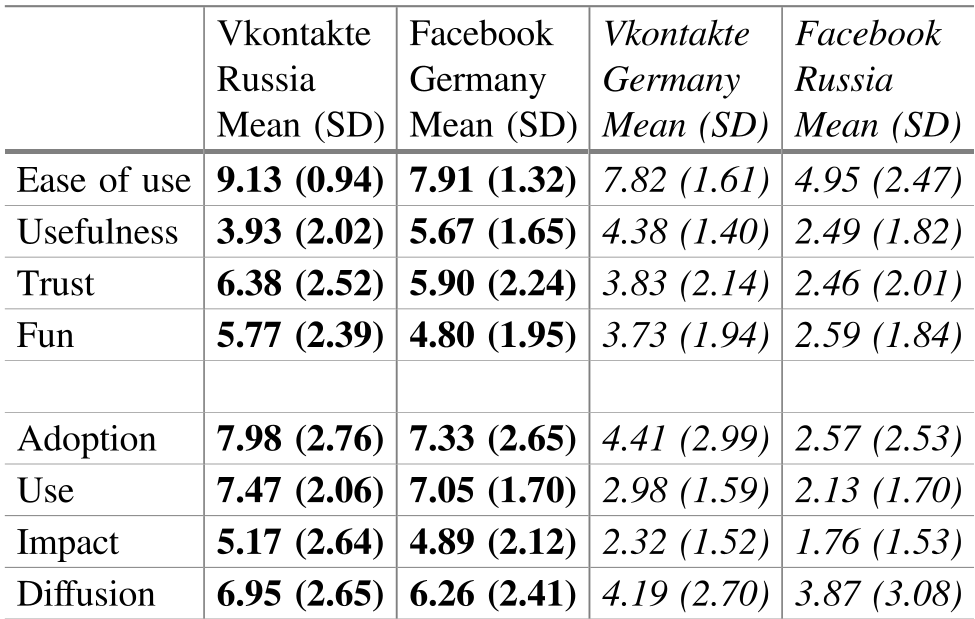
The data reveals a staggering divide. In Russia, the "Ease of Use" for the local standard (Vkontakte) was rated at 9.13, while Facebook—a platform used by billions—was rated at a meager 4.95 by the same demographic.
Key Insights from Correlational Data:
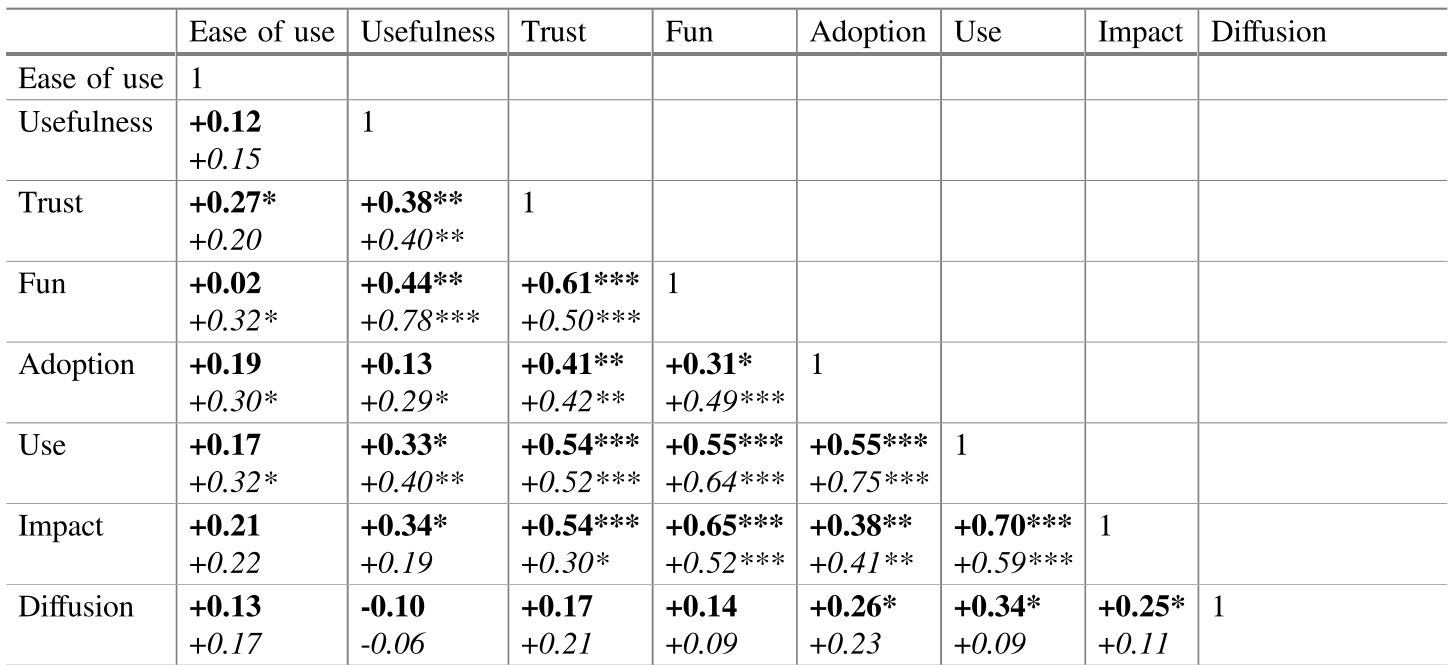
- The "Impact" Factor: In both cultures, the actual "Use" of a platform is most strongly correlated with its "Impact" on the user's information behavior (0.70 in Russia, 0.53 in Germany). If you use it, it changes you.
- Fun as a Barrier: For "Non-Standard" services, the correlation between "Fun" and "Ease of Use" becomes much stronger. This suggests that for a new service to be adopted, it must be perceived as easy to use just to be considered "fun."
- Diffusion and Culture: In Germany, "Diffusion" (how many others are using it) is the primary driver of perceived "Impact" (0.79). In Russia, this link is much weaker, suggesting different cultural motivations for SNS reliance.
Critical Analysis & Conclusion
The study proves that there is a psychological "Standard" premium. When a service is the national standard, users are more forgiving and perceive higher levels of trust and fun.
Takeaways for the Future:
- Local Over Global: "Network effects" are not just global; they are deeply regional. A global giant like Facebook cannot simply rely on its scale to conquer a market where a "National Standard" already provides the cultural "Fun" and "Trust" layers.
- The Trust Deficit: Non-standard services suffer from a massive trust deficit (e.g., Vkontakte in Germany scored only 3.83 vs. 5.90 for Facebook). Any platform attempting to enter a new market must address trust as a primary barrier to entry.
Limitations
The sample size (N=81) is relatively small and focused on students, who may be more tech-savvy than the general population. Future research should explore if these "Standard" gaps persist across older demographics or different types of digital services (like FinTech).
Final Thought: Success in social media isn't just about the code; it's about becoming the cultural "Standard" that defines a nation's digital social life.