
Beyond the Click: Rethinking Farmville and the Accessibility Gap in Social Gaming
Accessibility of a Social Network Game
This paper investigates the accessibility of the social network game Farmville within the Facebook ecosystem. It identifies critical barriers for users with disabilities and proposes a framework for leveraging existing Flash accessibility tools to create inclusive social gaming experiences.
TL;DR
Even as social networks become more inclusive, the games within them—like the massive hit Farmville—often leave users with disabilities behind. This paper deconstructs why Farmville (built on Flash) fails basic accessibility standards and provides a roadmap for how developers can utilize existing technology to ensure social gaming is a right, not a privilege.
Background: Inclusion Stops at the "Play" Button
Facebook has revolutionized digital social interaction, reaching impressive levels of WCAG compliance. However, the study points out a glaring paradox: while the platform is accessible, its most engaging content—social games—remains an exclusionary zone. Games like Farmville are not just entertainment; they are "third places" for social bonding and efficient tools for learning. When these games are inaccessible, we effectively lock a segment of the population out of a vital new form of human-computer interaction.
The "Flash" Problem: A Methodology of Negatived Space
The paper targets Farmville, implemented via Adobe Flash. The authors argue that Flash's reputation for being "inaccessible" is a misconception; the technical hooks for screen readers and keyboard navigation exist, but they are consistently ignored by developers.
The Audit: Where Farmville Fails
By testing the game against standard accessibility guidelines, the authors identified several structural "pain points":
- Input Lock-in: The game is almost entirely dependent on mouse clicks. Keyboard interaction is either non-existent or suffers from a "randomized" tab order that defies logic.
- The Black Box Effect: Graphical objects in the game lack meta-data. For a screen reader, the lush farm is simply invisible—a blank canvas.
- Feedback Loops: During high-latency periods ("rush hour"), the game provides no visual or auditory feedback for inputs, leaving users unsure if an action was registered.
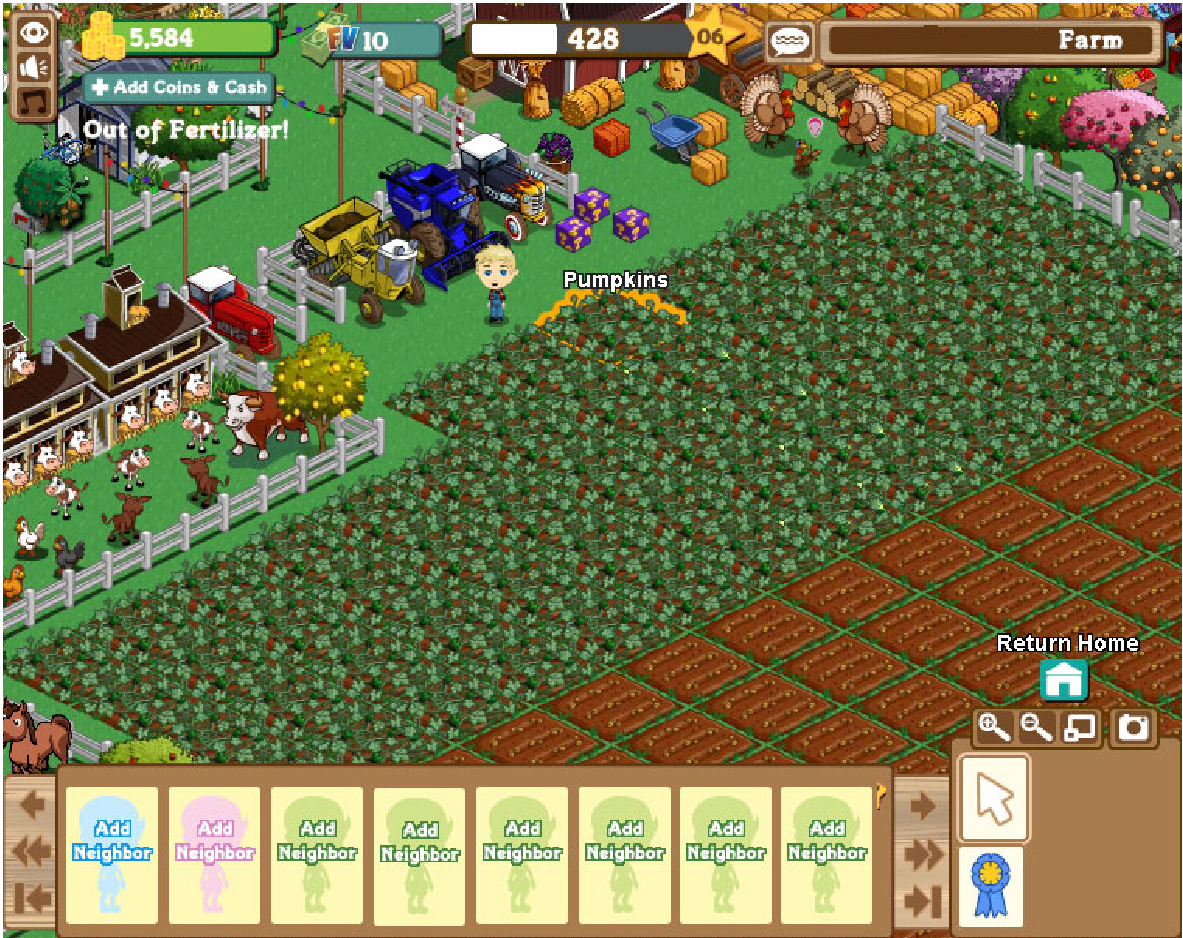 Figure 1: The standard Farmville UI, largely inaccessible to non-mouse users.
The Proposed Fix: Mapping the Farm
The authors don't just complain; they provide a structural solution. Since Farmville is essentially a board game based on a rectangular grid, navigation can be mathematically mapped to a keyboard-friendly coordinate system.
Key Technical Recommendations:
- Coordinate-Based Navigation: Use arrow keys to jump between planting rectangles rather than relying on pixel-perfect mouse precision.
- Meta-Data Injection: Assign descriptive Alt-text to every game object (crops, tools, animals) so assistive technologies can "see" the state of the farm.
- Visual Redundancy: Allow for adjustable contrast and scaling that doesn't break the UI layout.
Critical Insight: The "Sensitivity" Gap
One of the most telling parts of the study is the authors' attempt to contact the developer, Zynga. The response they received ignored the accessibility query entirely. This highlights a shift in the field's focus: the problem is no longer a lack of guidelines or tools—it is a lack of sensitization and industry "advertisement."
Conclusion
Social gaming is a pillar of modern digital inclusion. This paper serves as a vital reminder that technical feasibility is rarely the bottleneck for accessibility; rather, it is the developer's intent. By transforming game fields into structured data and embracing existing frameworks, we can ensure that the "social" in social gaming applies to everyone.
Future Outlook: As we move from Flash to HTML5 and the Metaverse, the lessons from Farmville remain: accessibility must be baked into the design phase, not treated as an afterthought or a "suspicious stand-alone activity."