
Accessible Crowdwork? Breaking Down the Barriers in Digital Microtasking
Accessible Crowdwork?: Understanding the Value in and Challenge of Microtask Employment for People with Disabilities
2015-02-24
Summary
Problem
Method
Results
Takeaways
Abstract
This paper presents the first formal multi-method study investigating people with disabilities in the microtask economy. By combining interviews with 17 stakeholders and a survey of 631 adults, it identifies how platforms like Amazon Mechanical Turk offer unique employment flexibility while simultaneously imposing significant accessibility barriers.
## TL;DR
While crowdsourcing is often hailed as a democratic future for labor, a significant portion of the workforce—people with disabilities—is being left behind by design. This seminal study by Zyskowski et al. explores how microtask platforms provide a sanctuary of flexibility from traditional office life, yet remain plagued by "invisible" accessibility barriers in their workflows.
**Academic Positioning**: This is a foundational CSCW (Computer-Supported Cooperative Work) paper that shifts the focus from using crowdsourcing to *help* people with disabilities to understanding people with disabilities as the *producers* of crowd labor.
## The Paradox of Digital Labor
For many individuals with disabilities, the traditional 9-to-5 is a logistical nightmare. Inaccessible public transit, the lack of private adaptive technology at work, and the social pressure to perform at a "normative" pace create a high barrier to entry.
The **Research Insight**: Crowdwork *should* be the perfect solution. It offers:
* **Spatial Flexibility**: Work from the comfort of a customized home setup.
* **Social Anonymity**: The "digital veil" allows workers to be judged on output rather than disability status.
* **Temporal Control**: The ability to choose when (and if) to work.
However, the authors discover that the "efficiency-first" design of these platforms often replicates the very exclusion it should solve.
## The Three Layers of Accessibility
The study breaks down accessibility into a more sophisticated hierarchy than simple "screen reader compatibility":
1. **UI Accessibility**: Can a screen reader navigate the dashboard? (Often blocked by CAPTCHAs).
2. **Workflow Accessibility**: Can the worker complete the task logic? Many tasks have rigid timers that don't account for the extra time needed to use assistive tech.
3. **Experience Accessibility**: Does the reputation system punish those who must abandon tasks due to unforeseen accessibility hurdles?
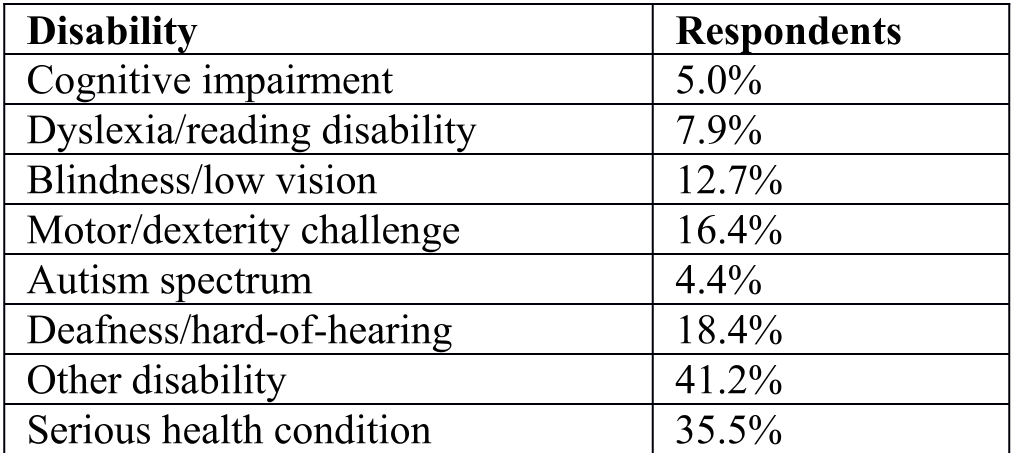
*Table 1: The diverse range of disabilities represented in the study, highlighting that "accessibility" is not a one-size-fits-all solution.*
## Methodology & Findings: The Friction in the Machine
The researchers utilized a mixed-methods approach, combining deep ethnography with broad surveys.
### The "Timeout" Trap
A recurring pain point was the **Strict Task Timer**. For a worker using a screen reader or a sip-and-puff device, a task that takes an abled worker 2 minutes might take 5 minutes. On platforms like mTurk, if the timer expires, the worker isn't just unpaid—their reputation score (completion rate) drops, potentially banning them from future high-quality work.
> "Sometimes it takes a little longer to make choices with a screen reader. I feel like that makes someone look bad as a worker when he or she has to return so many HITs." — Participant P1
### The "Third-Party" Gap
While Amazon’s core site might be accessible, the actual *content* of the task often redirects to a third-party website with zero accessibility standards. This "bait-and-switch" means workers accept a job only to find they cannot physically complete it halfway through.
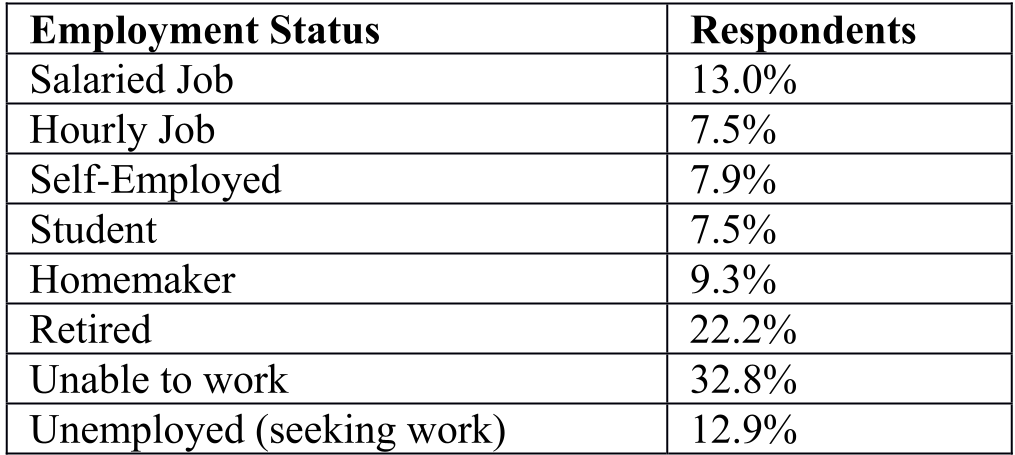
*Table 4: Highlighting the high percentage of "Unable to work" respondents, representing a massive untapped labor pool for accessible digital platforms.*
## Strategic Recommendations
The paper concludes with actionable design provocations for platform operators:
* **Ability-Based Metadata**: Requesters should tag tasks (e.g., "Requires Audio," "No Time Pressure").
* **Reputation Adjudication**: Systems to "forgive" abandoned tasks if an accessibility barrier was encountered.
* **Adaptive Timers**: Allowing workers to request reasonable time extensions if they use assistive technology.
## Conclusion: A Call for Inclusive Design
Zyskowski et al. remind us that accessibility is not just a technical checkbox; it is a prerequisite for **economic justice**. As we move toward an increasingly algorithmic labor market, we must ensure these systems don't build "digital walls" that are just as tall as the physical ones they replaced.
**Takeaway**: Future platform design must treat "accessibility" as a multidimensional workflow requirement, not just a UI skin.