
XAI: The New Bridge to Inclusive Cultural Heritage
Accessible Cultural Heritage through Explainable Artificial Intelligence
The paper "Accessible Cultural Heritage through Explainable Artificial Intelligence" explores the intersection of XAI, computer vision, and NLP to make cultural heritage more inclusive. It proposes a framework where Explainable AI (XAI) serves as a bridge for minorities, such as the visually impaired or those with mobility issues, to engage with art through multimodal, rationale-based explanations.
TL;DR
Artificial Intelligence is no longer just about recognizing objects; it's about explaining the "why" and "how" of human culture. This paper advocates for using Explainable AI (XAI) to make museums and art accessible to the blind, the deaf, and those with limited mobility. By combining Computer Vision, Natural Language Processing, and Generative Models, the authors propose a future where AI doesn't just see art—it interprets its spirit for everyone.
The Problem: The "Black Box" of Art
Traditional AI models used in cultural heritage often suffer from "Object Hallucination"—claiming things are in a painting that aren't there—or failing to understand the historical context (Spirit of the Age). For a blind person, a simple label like "a woman standing" is insufficient to convey the elegance of a Renaissance masterpiece. The gap between Raw Data and Human Meaning remains the biggest hurdle in inclusive technology.
Methodology: From Pixels to "Latent Souls"
The core insight of the paper is moving beyond simple image description to Rationale-based Explanations.
1. Neuro-Symbolic Reasoning
The authors suggest that by combining neural networks (good at pattern recognition) with symbolic logic (good at expert rules), we can create models that "understand" art history.
2. The Content vs. Form Framework
- Content: Literal description (What is in the image?).
- Form: Interpretative description (What does the style imply? What was the author's intention?).
 Table 1: The multidimensional challenges of bringing XAI to Cultural Heritage.
Generative Creativity and Robotics
The paper highlights the role of Generative Adversarial Networks (GANs), citing the famous "Edmond de Belamy"—the first AI-generated portrait sold at Christie's. XAI can be used here to "de-mystify" creativity by showing which historical styles influenced the AI's output.
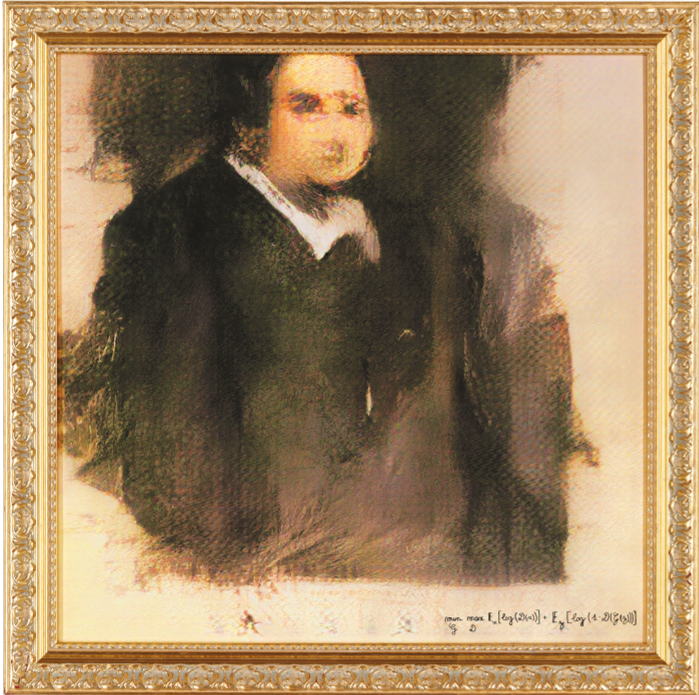 Figure 2: Edmond de Belamy, a testament to AI's ability to emulate artistic style through generative processes.
Furthermore, the authors discuss Robotic Tour Guides (like the FROG project). These robots don't just speak; they sense visitor boredom or interest and adjust their explanations. For those with mobility constraints, these robots serve as "Telepresence" avatars, allowing them to "walk" through a museum from their own homes.
Key Insights and Experimental Rationale
The paper posits several provocative hypotheses:
- Hypothesis 1: AI can generate "advisable explanations" (e.g., "Pay attention to how the light is set in this painting") to increase user engagement.
- Hypothesis 2: Digital "hallucination"—usually a bug in AI—can be a feature if it helps reconstruct missing parts of ancient frescoes (Digital Anastylosis).
Critical Analysis & Conclusion
The authors conclude that XAI is a facilitation medium. It shouldn't replace the human guide but should empower the viewer's curiosity.
Limitations: The paper notes that a single format does not fit all. A blind person requires different explanation standards than a technical researcher. We still lack universal "Subjectivity Metrics" to measure if an AI's interpretation of art is "good" or "moving."
Future Outlook: The goal is a "Universal Intermediate Language"—a way for deep representations to allow us to "sing a painting" or "draw a song," making the invisible visible through the power of words and reason.