
Scaling Physical AI Down: Fine-Tuning 3B-Parameter VLA Models on 8GB GPUs
Towards Accessible Physical AI: LoRA-Based Fine-Tuning of VLA Models for Real-World Robot Control
This paper introduces a resource-efficient framework for fine-tuning Vision-Language-Action (VLA) models, specifically adapting the 3.1B parameter SmolVLA for low-cost robotic platforms. By utilizing LoRA and 4-bit quantization, the authors achieve a 76% success rate in real-world button-pressing tasks using consumer-grade hardware (8GB VRAM).
TL;DR
High-end robotic brains no longer require high-end server farms. Researchers have successfully fine-tuned and deployed SmolVLA (a 3.1B parameter Vision-Language-Action model) on a consumer-grade RTX 4060 GPU and the affordable SO101 robotic arm. By leveraging QLoRA and Action Chunking, they achieved a 76% success rate in real-world manipulation tasks with just 200 demonstration episodes.
Background: The Accessibility Gap in Physical AI
Until recently, "Physical AI"—the seamless integration of Vision-Language Models (VLMs) with robotic control—was the exclusive playground of labs equipped with $100,000 Franka Emika arms and A100 GPU clusters. Models like OpenVLA offer incredible generalization, but their 24GB+ VRAM requirement makes them "un-deployable" for researchers on a budget.
This paper tackles the two-headed monster of computational constraints and embodiment adaptation: How do we make a model trained on thousands of different robots work on our specific, low-cost hardware without losing its "intelligence"?
Methodology: The "Smol" yet Mighty Architecture
The researchers utilized SmolVLA, which fuses a SigLIP-SO400M vision encoder with a Phi-2 (2.7B) language backbone. To cram this into an 8GB VRAM envelope, they employed two key technical levers:
- QLoRA (Quantized Low-Rank Adaptation): The model weights are compressed to 4-bit (NF4 quantization), while only small "adapter" matrices are trained. This reduces the trainable parameters from 3.1B to as few as 8.4M.
- Action Chunking: Instead of predicting a single joint position (which leads to jerky, reactive motion), the model predicts a sequence of 50 actions. This ensures temporal smoothness and allows the robot to "plan" its trajectory toward the target.
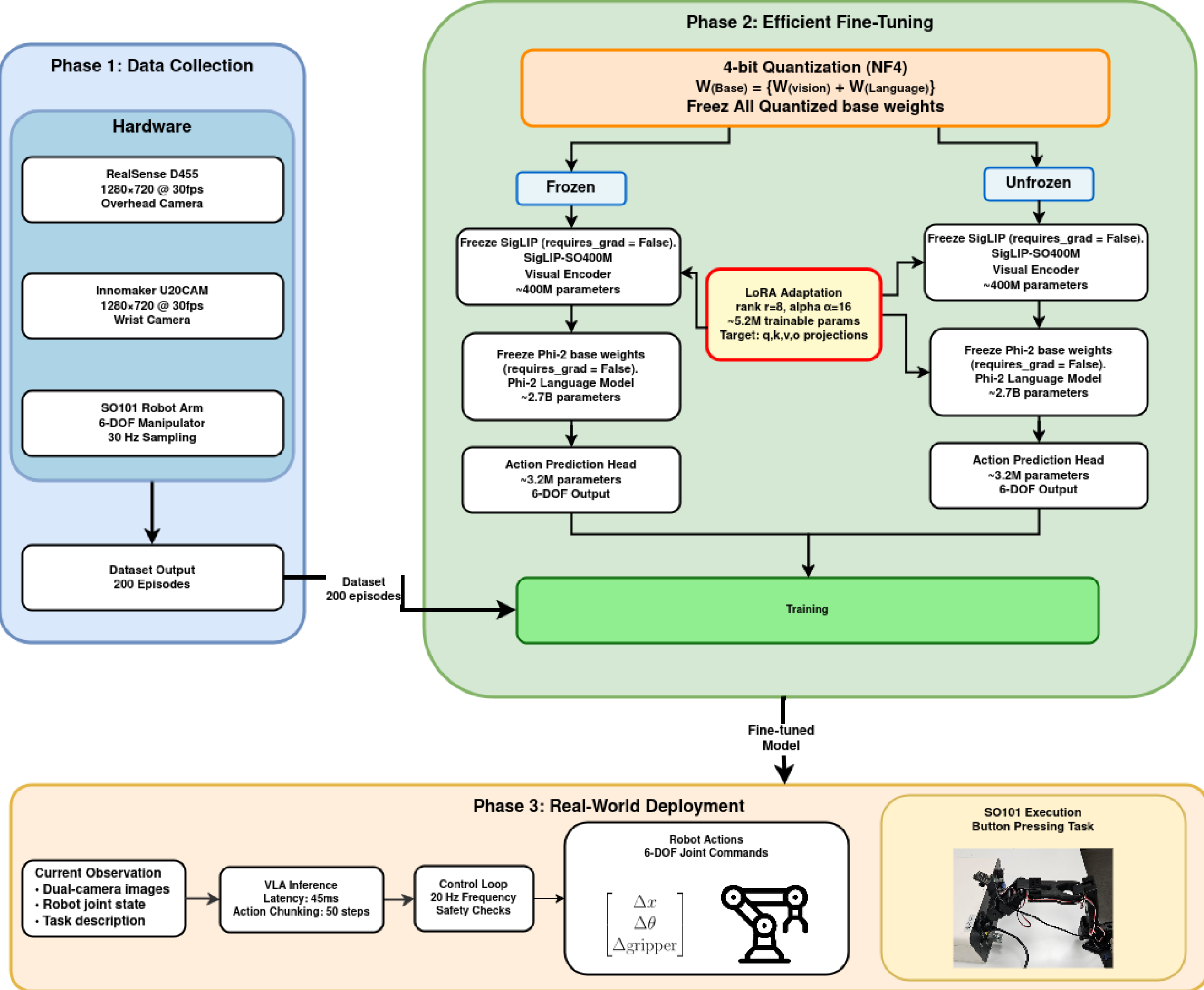 The end-to-end pipeline: from dual-camera data collection to QLoRA fine-tuning and real-time execution.
The "Vision Influence" Insight
A standout contribution of this paper is the diagnosis of why small-scale fine-tuning often fails. By zeroing out visual inputs and measuring the change in predicted actions (), the authors discovered that with low data (20 episodes), the robot ignores its cameras and relies solely on joint memory (proprioception).
It is only when training data crosses the 100-200 episode threshold that the "Vision Influence" score exceeds 3.0, indicating the model is truly "seeing" the target and adjusting its path in real-time.
Experimental Battle: Frozen vs. Unfrozen Vision
The authors investigated a classic dilemma: Should you fine-tune the "eyes" (vision encoder) or just the "brain" (language model)?
- Frozen Vision: Faster to train (12 hours), lower memory, but relies on pre-trained features.
- Unfrozen Vision: Slower (18 hours), but allows the model to adapt to specific lighting and camera angles of the $500 robot setup.
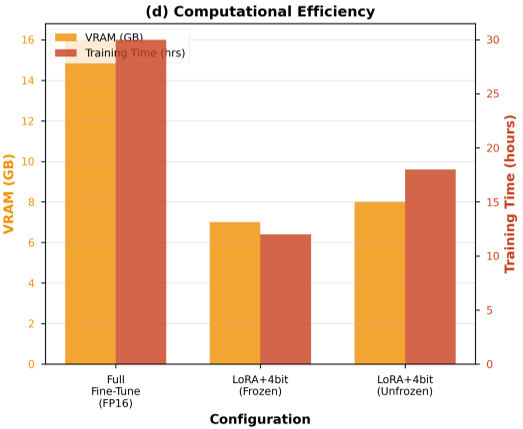 Results show that while Unfrozen Vision (orange) yields lower loss and higher success, even a Frozen backbone achieves 74% success with enough data.
Results & Performance
The deployment on the SO101 arm for a button-pressing task yielded impressive metrics for consumer hardware:
- Inference Latency: ~45ms (running at a consistent 20Hz control frequency).
- Peak VRAM: 6.8 GB (well within the 8GB limit).
- Success Rate: 76% with 200 episodes.
The failures typically weren't due to the AI "forgetting" the task, but rather physical nuisances like oscillatory behavior or slight calibration misalignments between the dual cameras (overhead and wrist).
Conclusion: A Blueprint for the Future
This research provides a clear takeaway: Physical AI is now accessible. You don't need a massive compute cluster; you need 200 good demonstrations. By combining parameter-efficient fine-tuning (LoRA) with aggressive quantization, the gap between high-end research and affordable, real-world deployment has officially closed.
For future work, the authors aim to move beyond simple button-pressing to long-horizon tasks and multi-object manipulation, further proving that "affordable" doesn't have to mean "incapable."