
Accrual Anomaly: Is Your Alpha Just Unpriced Risk or Investor Blindness?
The Accrual Anomaly: Risk or Mispricing?
This paper investigates the "accrual anomaly"—the phenomenon where firms with low operating accruals outperform those with high accruals. The authors develop an accrual-based factor-mimicking portfolio (CMA) and conduct "characteristics vs. covariances" tests to determine if the anomaly represents a rational risk premium or market mispricing. The study concludes that the accrual characteristic itself, rather than factor risk loading, predicts returns, confirming a behavioral mispricing explanation.
Executive Summary
TL;DR: This seminal paper by Hirshleifer et al. tackles one of the most persistent puzzles in financial markets: the Accrual Anomaly. By constructing a specialized "Conservative Minus Aggressive" (CMA) factor, the authors prove that the market's tendency to reward low-accrual firms isn't a "risk premium"—it’s a mistake. Investors, hampered by limited attention, overvalue firms with "bloated" balance sheets (high accruals) because they fail to realize that accrual-based earnings are less persistent than cash flows.
Positioning: This work is a definitive strike for the Behavioral Finance camp. It systematically deconstructs the possibility that the accrual effect is a rational response to risk, positioning it firmly as a psychological misvaluation in the capital market coordinate system.
Problem & Motivation: The "Quality" Blind Spot
When a company reports earnings, it consists of two parts: Cash Flow and Accruals (accounting adjustments).
- The Rational View: If low-accrual firms are "riskier," they should have higher "betas" relative to some risk factor.
- The Behavioral View: Investors have limited bandwidth. They see the "Bottom Line" but ignore the composition. Since accruals are more likely to reverse than cash flows, investors get "surprised" when high-accrual firms underperform later.
The authors ask: If we build a risk factor specifically for accruals (CMA), will the "risk loading" explain away the returns?
Methodology: The CMA Factor and Triple-Sorting
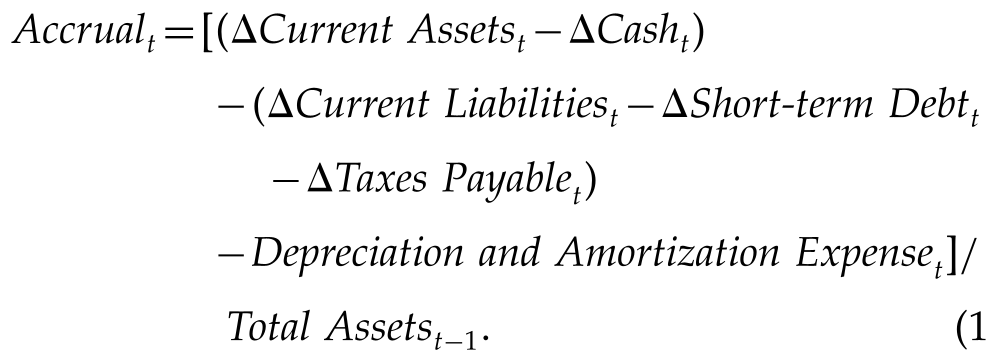
The authors define operating accruals using the indirect balance sheet method:
To separate "Being a low-accrual firm" (Characteristic) from "Moving like a low-accrual firm" (Covariance), the authors performed a Triple Sort:
- Sort by Size (to control for small-cap effects).
- Sort by Accrual Level (the characteristic).
- Sort by CMA Factor Loading (the risk sensitivity).
If the Rational Risk theory is correct, then within a group of firms with the same accrual level, the ones with higher CMA loadings should still earn higher returns.
Experiments & Results: The "Smoking Gun"
First, the authors show that the CMA factor is incredibly powerful. It captures massive comovement that the standard Fama-French model misses. The Sharpe ratio of a portfolio including CMA is significantly higher than the market alone.
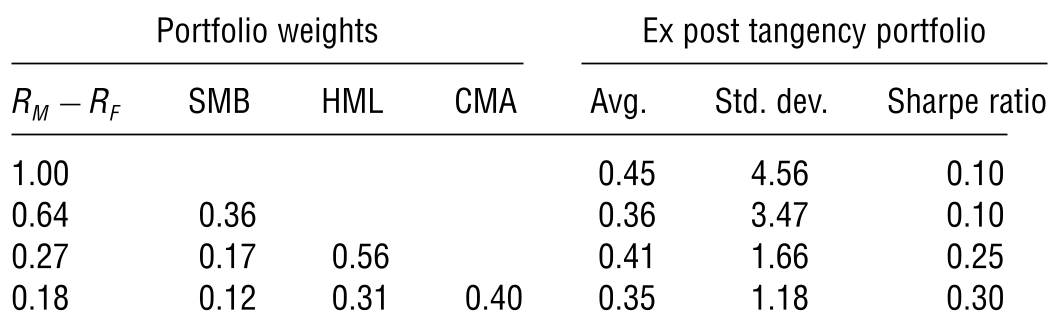 In this table, notice that CMA provides a Sharpe ratio (0.30) that dwarfs the Market (0.10) and is highly independent of other factors.
However, the "Characteristics vs. Covariances" test provided the killing blow to the risk argument. As shown in the cross-sectional regressions:
- Accruals Characteristic: Remains a powerhouse predictor ().
- CMA Loading (Beta): Becomes virtually zero ( or ) when the characteristic is present.
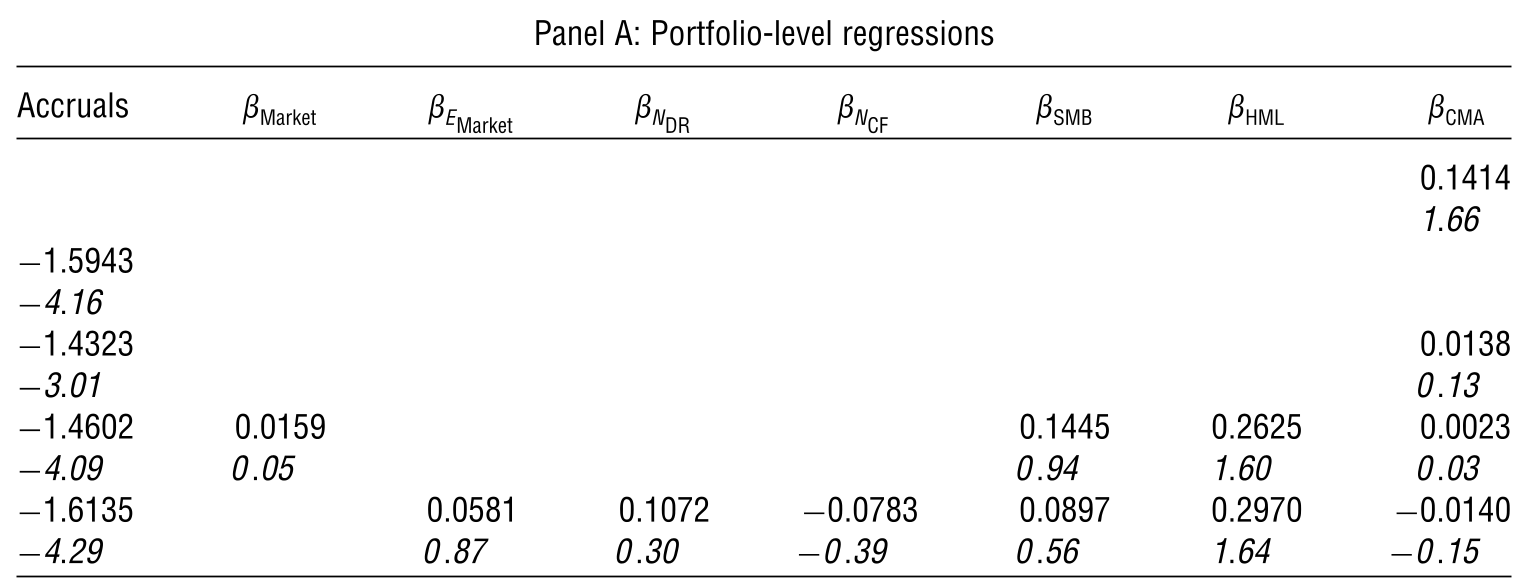 The regression evidence proves that it is the "what you are" (low accruals) rather than "how you move" (loading) that generates the alpha.
Critical Analysis & Conclusion
Takeaway
The accrual anomaly is a robust evidence of market inefficiency. The "CMA" movement in stocks exists, but the market doesn't price it as a "risk." Instead, the anomaly persists because humans are not perfect processors of accounting nuances.
Limitations
- Model Accuracy: While CMA is a strong proxy, one could argue an even more "hidden" risk factor exists that CMA doesn't capture perfectly.
- Arbitrage Frictions: The paper notes that while the anomaly exists in large caps, much of the mispricing is concentrated in volatile stocks where arbitrage is expensive and risky (limits of arbitrage).
Future Outlook
Since the publication of such studies, "Quant" funds have heavily exploited this anomaly. Data suggests the anomaly is weakening as institutional attention increases. For today's investors, the lesson is clear: Earnings quality matters more than earnings quantity.