
The Illusion of Influence: Unmasking Measurement Error in Informal Social Networks
Accuracy, stability and reciprocity in informal conversational networks in rural Kenya
2000-10-01
Summary
Problem
Method
Results
Takeaways
Abstract
This paper investigates the reliability of respondent-reported social network data in rural Kenya, focusing on informal "conversational networks" regarding family planning. Utilizing longitudinal survey data from the Kenya Diffusion and Ideational Change Project (KDICP), it evaluates reporting accuracy, network stability, and reciprocity by comparing ego reports with alter self-reports.
## TL;DR
Does your social circle actually influence your decisions, or do you just *think* they do because they are like you? This landmark study in rural Kenya reveals that our reports of our friends' behaviors are often reflections of our own actions—a phenomenon called **projection**. By tracking network partners over time, the researchers found that what we call "stable social networks" are often ephemeral, poorly recalled, and rarely reciprocal.
## The Motivation: Why Network Data is Dangerous
In international development and demography, "Social Diffusion" is a buzzword. The logic is simple: if your friends use family planning, you are more likely to do so. This correlation is usually interpreted as evidence of social influence.
However, authors Kevin White and Susan Cotts Watkins identified a massive methodological "black box." If the data comes entirely from the respondent (the "ego"), we cannot distinguish between:
1. **True Social Influence**: Alter's behavior changes Ego's behavior.
2. **Homophily/Selection**: People seek friends who are already like them.
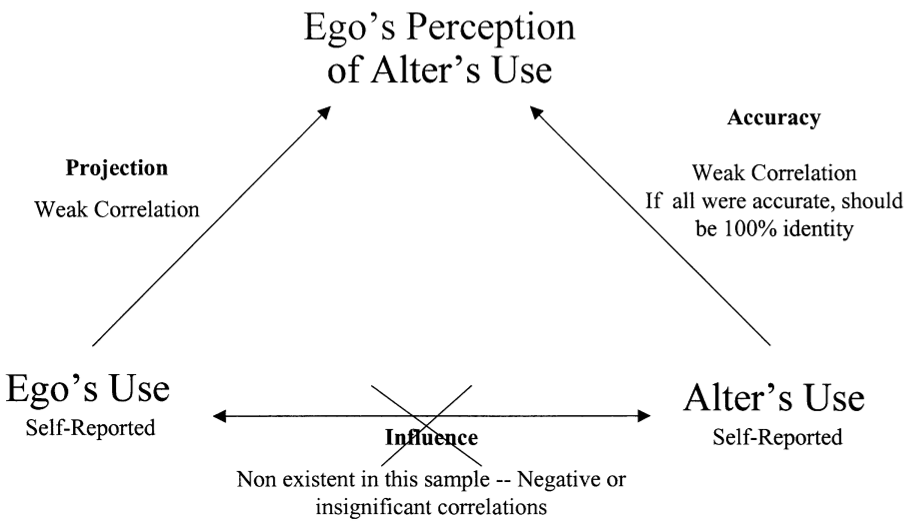
3. **Measurement Error (Projection)**: Ego assumes Alter behaves exactly like they do.
## Methodology: The Rarest Kind of Data
To crack this box, the researchers didn't just interview 1,700 people; they mapped the social web of a specific site, **Wakula South**. By matching the "names" mentioned in conversations to the actual people in the village, they could compare what **Person A said about Person B** with what **Person B said about themselves.**
## Key Findings: The Accuracy Trap
### 1. The "Visible vs. Invisible" Gap
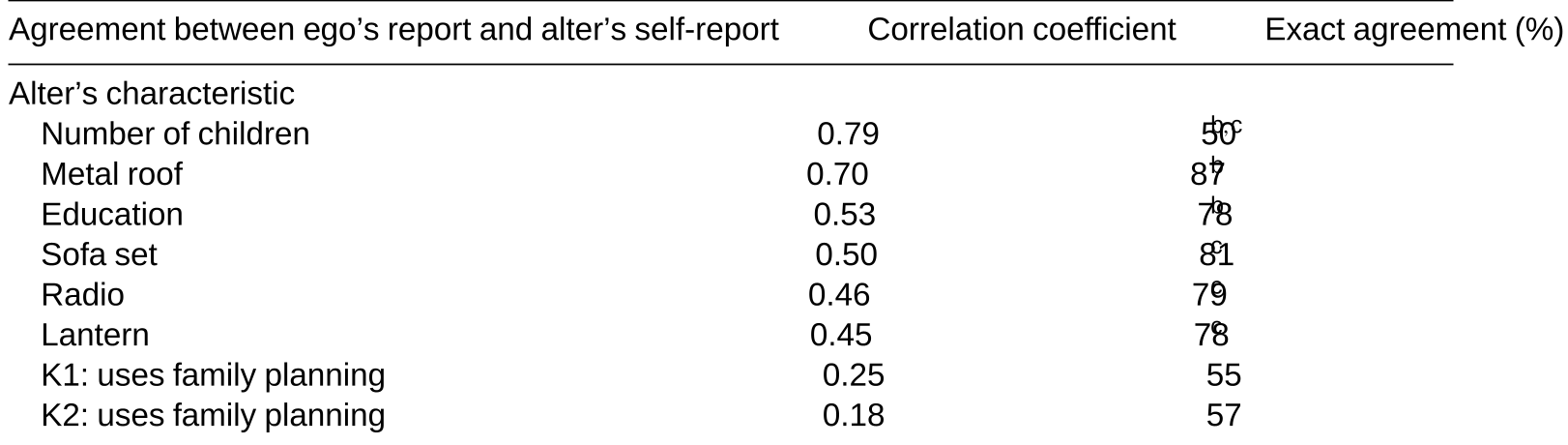
Egos were quite good at reporting if a friend had a **metal roof (87% agreement)**. But when it came to sensitive or "invisible" topics like family planning, the agreement plummeted.
* **The Bias**: Egos consistently *over-reported* their friends' use of family planning, likely to appear "modern" or "refined" to the researchers.
### 2. The Death of Reciprocity and Stability
The study found a "Procrustean bed" effect. When asked to name four partners:
* **Stability**: Only **18%** of the people named in the first year were named again two years later.
* **Reciprocity**: If I say I talked to you, there is only a **20% chance** you say you talked to me.
### 3. The Smoking Gun: Projection
The most striking result came from the logit regressions (Table 4).
* There was a **strong correlation** between Ego's use and Ego's *perception* of Alter's use.
* There was **zero (or even negative) correlation** between Ego's use and Alter's *actual self-reported* use.
**Conclusion**: The "social influence" seen in many studies is an artifact of the respondent's own mind. Users of family planning project that usage onto their friends; non-users project non-usage.
## Critical Analysis & Takeaways
This paper serves as a stern warning for academic researchers and policy designers.
* **Context Matters**: In places like rural Kenya, "conversations" are fluid, face-to-face, and often ephemeral. Reducing these to a "name-generator" list of four people fundamentally misrepresents the social structure.
* **The "Social Hub" Fallacy**: Targeting influential "nodes" in a network may fail if the links between those nodes and the community are as unstable and unreciprocated as this study suggests.
* **Limitations**: The study acknowledges that some misreporting might be "motivated"—respondents trying to please interviewers by presenting a "modern" network.
**Future Outlook**: To truly understand social learning, researchers must move beyond ego-centric surveys toward **full-network longitudinal studies** that capture the actual flow of information rather than just the respondent's biased memory of it.