
PGPI+: Deciphering User Shadows in Fragile Social Graphs
More Accurate Inference of User Profiles in Online Social Networks
The paper introduces PGPI+ (Partial Graph Profile Inference+), an advanced algorithm for social network user profiling that operates under the constraint of limited graph access. It achieves state-of-the-art accuracy by integrating "rich information" (likes, views, group memberships) with friendship links and is optimized for both nominal and numeric attribute prediction.
TL;DR
Inferring user profiles usually requires a "God's eye view" of a social network. PGPI+ changes the game by proving that you can predict sensitive attributes (like gender or status) with over 95% accuracy by only looking at a tiny, local fragment of the graph. By Combining friendship "triads," group memberships, and a new certainty mechanism, it outperforms benchmarks while using 90% less data.
Background Positioning: This work belongs to the "Lazy Relational Learning" family. It moves away from the iterative, full-graph requirements of Label Propagation and focuses on the high-efficiency, localized inference required for real-time ad targeting and privacy research.
The Problem: The Myth of the "Full Graph"
Most academic profiling algorithms (like Label Propagation or Collective Naive Bayes) operate on a flawed assumption: that the researcher has the entire social ecosystem (nodes and all edges) at their disposal. In reality:
- Cost & Privacy: API rate limits and privacy settings make the full graph invisible.
- Data Heterogeneity: Users aren't just dots and lines; they have "likes," "views," and group memberships—information often ignored by pure graph-link algorithms.
- The Black Box of Confidence: Most models give an answer but don't tell you how sure they are. For an advertiser, a "wrong" guess is often worse than "no" guess.
Methodology: Precision Engineering for Local Subgraphs
The core of PGPI+ is a dual-engine approach (PGPI-N+ for networks and PGPI-G+ for groups) that operates under a strictly capped maxFacts budget.
1. The Triad Insight
The authors realized that the previous distance-based weights decayed too fast. They introduced a Triad Optimization: Where represents common friends. This captures the sociological reality: if you and I share many friends, we are significantly more likely to share traits than if we are just connected by a single bridge.
2. Handling the "Age" Problem (Numeric Attributes)
Instead of treating age or weight as simple categories (Nominal), PGPI+ uses a weighted sum of neighbors, combined with a one-standard-deviation outlier filter. This prevents "noisy" neighbors (e.g., a student linked to a 90-year-old professor) from skewing the prediction.
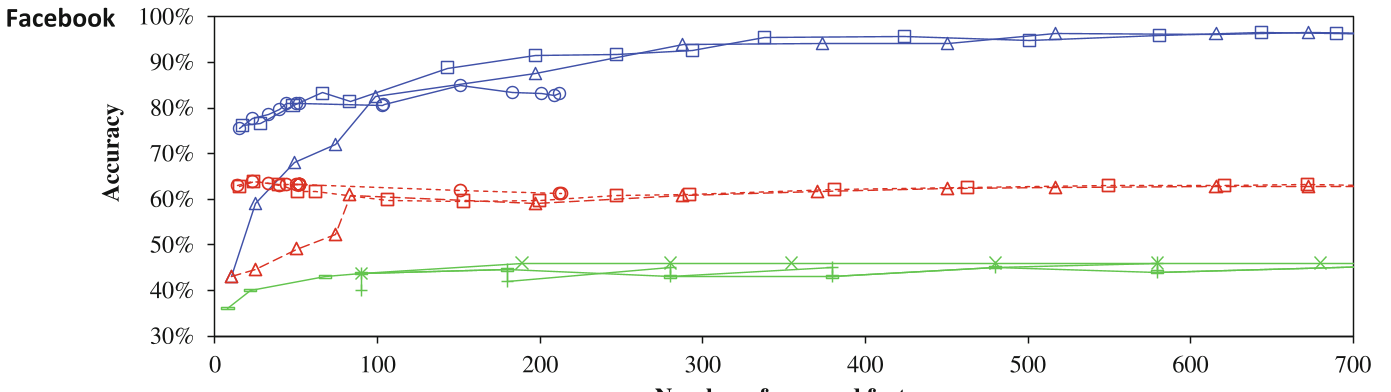 Figure 1: The dual-path architecture of PGPI focuses on balancing link-based and group-based weights.
Experimental Showdown
The authors tested PGPI+ against strong baselines including Naive Bayes variants and Label Propagation on datasets from Facebook and Pokec.
Key Breakthroughs:
- SOTA Domination: As shown in the benchmarking tables, PGPI+ scored 96.1% on Gender and 92.0% on Status (Facebook).
- Efficiency: While Label Propagation needed the full 10k+ node graph to achieve mediocre results (~48%), PGPI+ reached peak performance with only ~400 accessed facts.
- Certainty Validation: The model's internal "Certainty Value" proved to be a reliable filter. When the model was 70% sure, its actual accuracy jumped to over 90%.
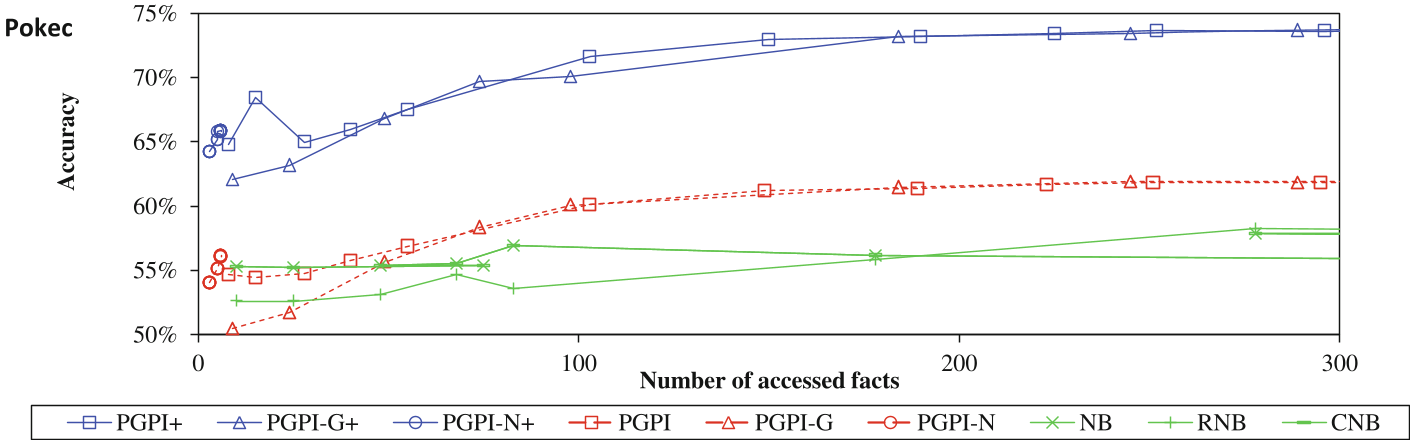 Figure 2: Notice how PGPI+ (top curves) maintains high accuracy even when the number of accessed facts is extremely low.
Deep Insight: Why it Works
The brilliance of PGPI+ lies in its Inductive Bias. By assuming that local clusters (groups/triads) are more informative than distant graph nodes, it avoids the "dilution" of information that happens in global propagation models.
Takeaway for Practitioners: If you are building an inference engine where data is expensive to fetch (e.g., via a paid API), stop trying to map the whole graph. Focus on the "Extended Ego-Network"—the groups your target belongs to and the friends-of-friends they share.
Critical Perspective & Limitations
While highly accurate, PGPI+ relies on the existence of "Rich Information" (likes/views). If a user is a "ghost" (no likes, no groups, few friends), the model’s performance naturally degrades. Future work could potentially integrate Cross-Platform Inference to fill these "silent" gaps using data from other social footprints.