
PGPI+: Mastering User Profiling with Only a Fragment of the Social Graph
Accurate Online Social Network User Profiling
This paper introduces PGPI+ (Partial Graph Profile Inference+), an advanced algorithm for online social network user profiling that operates under strict data constraints. It achieves SOTA accuracy by leveraging rich social interactions (likes, views, group memberships) and friendship links while specifically addressing both nominal and numeric attributes within a partial graph.
TL;DR
Inferring hidden user attributes (age, gender, interests) usually requires massive social graph data—knowledge that is often proprietary or hard to crawl. PGPI+ (Partial Graph Profile Inference+) breaks this dependency. By combining friendship structures with "soft" interactions like likes and hits, and employing a smarter weighted inference for numeric data, it achieves over 95% accuracy in gender prediction while looking at only a tiny fraction of the network.
Context & Motivation: The "Full Graph" Fallacy
In academic settings, researchers often play with complete datasets. In the real world, social networks like Facebook or LinkedIn are "walled gardens." You can't see the whole map; you only see a local neighborhood.
Existing methods like Relational Naïve Bayes (RNB) or Label Propagation break down when the graph is incomplete. They also struggle with:
- Numeric Data: Treating "Age" as a category (where 20 is as different from 21 as it is from 80).
- Information Sparsity: Ignoring non-friendship signals like group memberships or views.
- Distance Decay: Weighting distant connections so poorly that their collective signal is lost.
Methodology: The PGPI+ Architecture
PGPI+ is a "lazy" algorithm, meaning it doesn't train a global model but instead computes a profile on-the-fly for a specific target node. It splits its logic into two engines: PGPI-N (Network-based) and PGPI-G (Group-based).
1. Re-engineering the Influence Formula
The authors replaced the standard distance-based weight with a more resilient formula:
- Triadic Closure (): If you and a stranger have 10 mutual friends, you are much more likely to share traits than if you have zero.
- New Distance: Instead of , they use . This prevents the influence of a "friend of a friend" from vanishing too quickly.
2. Handling Numeric Attributes
Unlike its predecessor, PGPI+ treats age and height as continuous values. It calculates a weighted sum of the neighbors' values but introduces a crucial safeguard: it ignores any value more than one standard deviation from the mean, effectively filtering out "outlier" friends who don't represent the user's demographic.
 The core pseudocode for PGPI highlighting the queue-based neighborhood traversal.
Experimental Performance
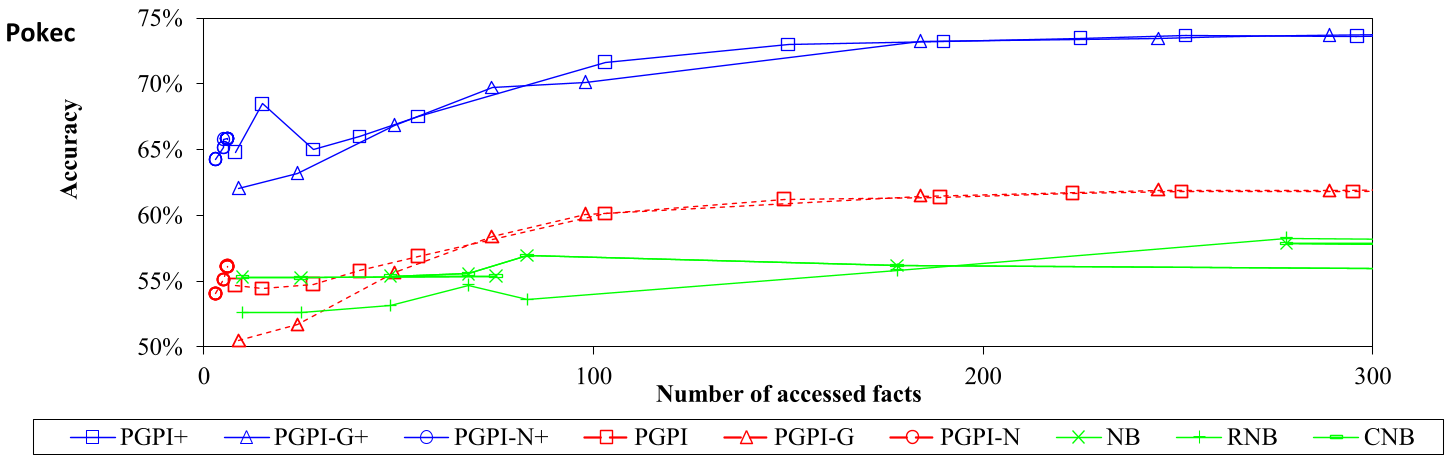
Testing against a 20,000-user slice of the Pokec social network, PGPI+ demonstrated a significant lead over traditional Naïve Bayes variants.
Nominal Attribute Accuracy
For categorical traits like Gender and Marital Status, PGPI+ reached accuracies that far surpassed Collective Naïve Bayes (CNB).
| Attribute | PGPI+ | CNB (Baseline) |
|---|---|---|
| Gender | 95.60% | 53.60% |
| Region | 18.60% | 6.20% |
| English | 76.35% | 69.74% |
Numeric Attribute Error (MAE)
In numeric prediction (where lower is better), PGPI+ showcased the power of its outlier-resistant weighted sum.
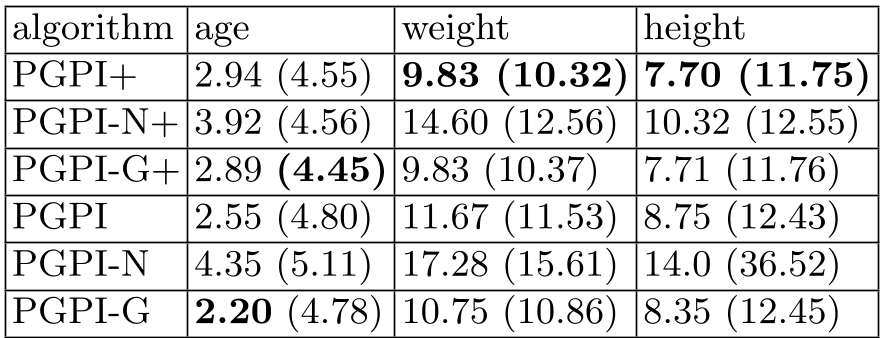 Note: PGPI+ consistently maintains lower error rates for Age, Weight, and Height compared to the standard PGPI.
Critical Insight: Why it Works
The secret sauce of PGPI+ is the balance of power ( constant). By scaling the influence of the friendship network (PGPI-N) to match the rich but often noisy group interaction data (PGPI-G), the model captures both "who you know" and "what you do." Furthermore, the decision to always return a prediction even when the maxFacts limit is reached (unlike the original PGPI) significantly boosted its coverage and practical utility.
Conclusion & Future Outlook
PGPI+ proves that we don't need a "God-view" of a social network to understand its users. By refining how we calculate distance and similarity, and by respecting the mathematical nature of numeric attributes, we can build highly accurate profiles from fragments.
Limitations: The algorithm still relies on some level of neighborhood connectivity. In extremely sparse "dark" networks where users have no public interactions, even PGPI+ would face the cold-start problem. Future research could explore integrating Transfer Learning to port behavioral patterns from one network to another.