
Bi-S-SRU: Mastering the Non-Linear Pulse of Smart Mariculture
Accurate Prediction Scheme of Water Quality in Smart Mariculture With Deep Bi-S-SRU Learning Network
This paper presents a deep learning-based water quality prediction scheme for smart mariculture, introducing the Bi-directional Stacked Simple Recurrent Unit (Bi-S-SRU). The method achieves a state-of-the-art prediction accuracy of 94.42% for critical parameters like pH, temperature, and dissolved oxygen, significantly outperforming standard RNN and LSTM models.
In the delicate world of smart mariculture, a slight shift in water pH or dissolved oxygen (DO) can be the difference between a thriving harvest and a massive ecological failure. However, predicting these parameters is notoriously difficult due to the "open system" nature of marine environments—where weather, feeding cycles, and sensor noise create a chaotic data stream.
A team of researchers from Hainan University has introduced a solution: the Bi-directional Stacked Simple Recurrent Unit (Bi-S-SRU). This architecture doesn't just look at what happened; it looks at the "future" context of data sequences to provide ultra-accurate forecasts.
TL;DR
The paper proposes a deep learning scheme that combines advanced data cleaning (Mean Proximity and Wavelet Filter) with a Bi-S-SRU network. The result is a system capable of 94.42% prediction accuracy for the next 3 to 8 days, processing sensor data in just 12.5ms.
The Gap: Why Traditional RNNs Fail at Sea
Existing water quality monitoring systems often struggle with two things:
- Data Fragility: Wireless transmission in marine environments often leads to missing packets. Standard linear interpolation creates "break points" (discontinuities) that confuse neural networks.
- Temporal Blindness: Standard Recurrent Neural Networks (RNNs) and LSTMs process data in a single direction. They cannot take advantage of the "contextual flow" where future trends help clarify the significance of current data fluctuations.
The authors’ insight was to move beyond simple recurrence toward a Bi-directional approach that uses SRUs—a faster, parallelizable cousin of the LSTM.
Methodology: The Bi-S-SRU Architecture
The core of this paper is the Bi-S-SRU. Unlike the standard RNN, the SRU (Simple Recurrent Unit) separates the calculation of the "gate" from the hidden state, allowing for much faster training (often as fast as CNNs).
1. Data Cleaning Pipeline
Before the data hits the model, it undergoes a rigorous refinement:
- Mean Proximity Method: Replaces missing values with the average of the nearest effective data to ensure a smooth, continuous curve.
- Wavelet Transform: Strips away the specific interference noise from 4G transmission.
2. Bi-directional Stacking
The "Bi" in Bi-S-SRU stands for Bi-directional. By processing the sequence in two directions—forward (past to present) and backward (future to present)—the model captures a holistic view of the water's state.
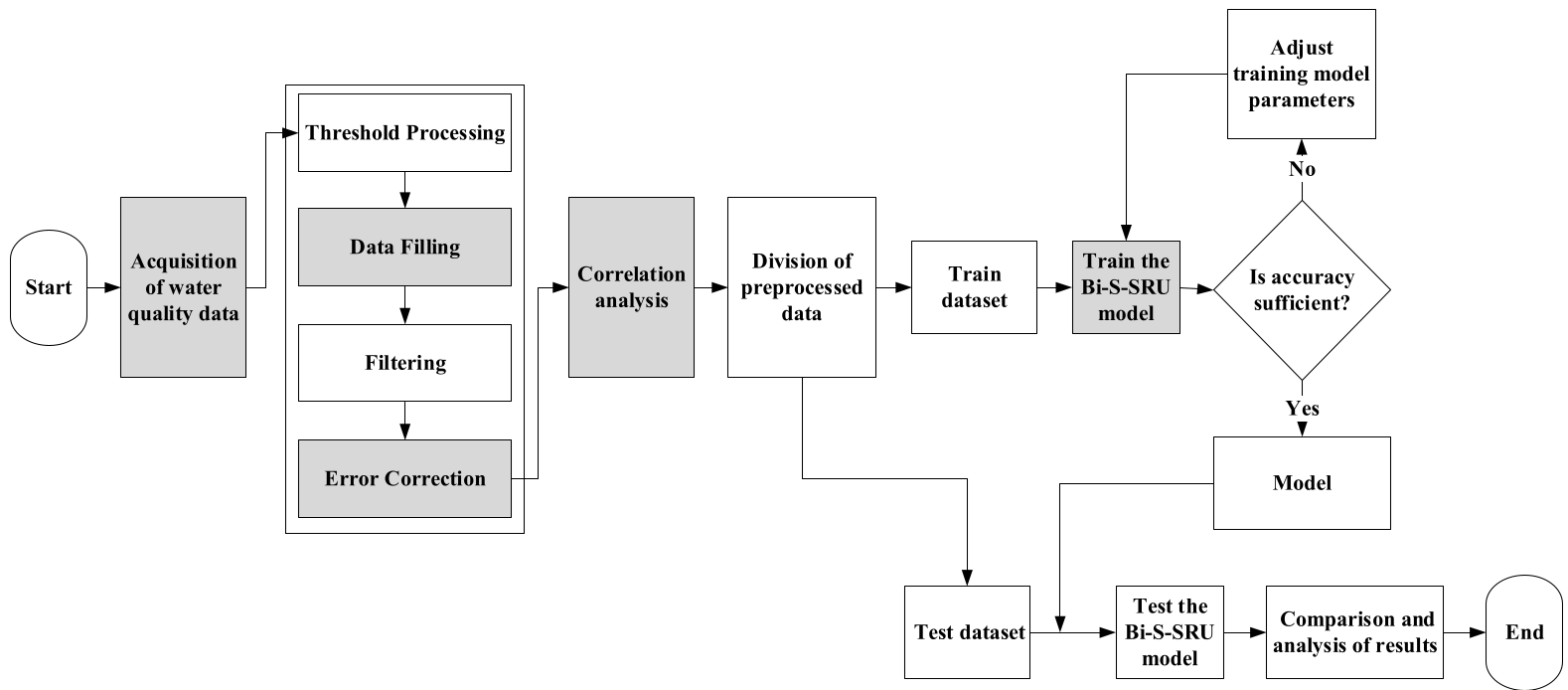 Figure: The overall water quality prediction scheme, highlighting the preprocessing and Bi-S-SRU integration.
Experimental Results: Precision Agriculture in Action
The team tested their model on a massive dataset of 23,204 groups of real-world data from a mariculture base in Hainan.
Performance vs. The Giants
When compared against standard RNNs and LSTMs, the Bi-S-SRU showed a massive improvement in error reduction:
- RMSE Reduction: The Bi-S-SRU’s RMSE was nearly 20% to 48% lower than that of the standard RNN across different parameters.
- Inference Speed: Despite the complexity, it maintains an average prediction time of 12.5ms, making it ideal for real-time edge computing on IoT nodes.
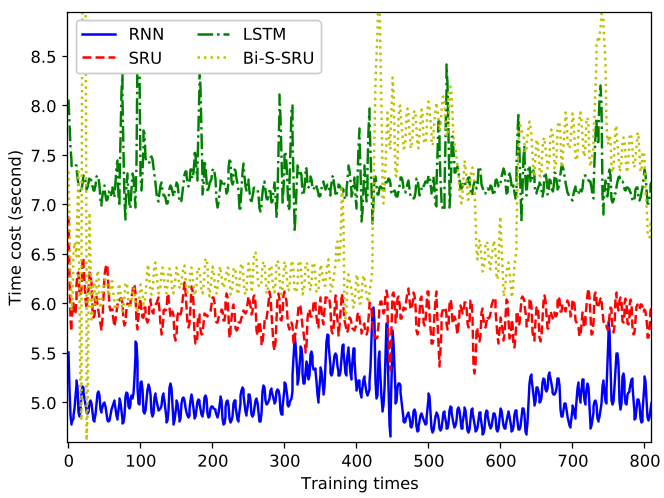 Figure: The Bi-S-SRU model (Red) shows a significantly tighter fit to the real values (Cyan) compared to traditional models.
Accuracy Breakdown
| Parameter | Method | MAE (Lower is Better) | Accuracy |
|---|---|---|---|
| Water Temp | Bi-S-SRU | 0.0160 | >94% |
| pH | Bi-S-SRU | 0.0031 | >94% |
| DO | Bi-S-SRU | 0.0427 | >94% |
Critical Insight: The Value of Prior Correlation
One of the cleverest parts of this paper is the use of the Pearson Correlation Coefficient. Instead of feeding all sensor data blindly into the model, the authors weight the inputs based on their known physical relationships (e.g., the strong positive correlation between pH and dissolved oxygen). This "information prior" helps the model converge faster and ignore irrelevant environmental noise.
Conclusion
The Bi-S-SRU scheme proves that deep learning can handle the "noise" of real-world biology if paired with the right data-cleaning infrastructure. By providing farmers with a 3-8 day warning window before water conditions turn toxic, this technology enables proactive rather than reactive management—a cornerstone of the next generation of precision agriculture.
Limitations: While highly accurate, the model was trained on specific Hainan waters. Future work should focus on transfer learning to adapt this architecture to different climates and species environments without requiring a new 23,000-point dataset.