
ACO-IM: Bridging the Gap Between Heuristic Speed and Greedy Accuracy in Social Networks
ACO-IM: maximizing influence in social networks using ant colony optimization
The paper introduces ACO-IM, a meta-heuristic algorithm for Influence Maximization (IM) in social networks, leveraging Ant Colony Optimization. It employs a novel two-hop local influence heuristic (EDV[2]) to approximate expected diffusion, achieving a competitive balance between influence spread quality and computational efficiency across IC, WC, and LT models.
TL;DR
Influence Maximization (IM)—the task of finding "seed" nodes to trigger the largest cascade of information—is a classic challenge in social computing. ACO-IM leverages Ant Colony Optimization and a refined two-hop local influence heuristic to find high-quality seed sets. It is significantly faster than the GOLD-standard greedy algorithms (like CELF++) and significantly more effective than simple degree-based heuristics.
Context: The NP-Hard Struggle
In viral marketing, identifying the "right" influencers is the difference between a product going viral or vanishing. Mathematically, this is an optimization problem on a graph.
- Greedy Methods: Use Monte Carlo simulations. They are accurate but painfully slow as they simulate the "ripple effect" thousands of times for every possible node.
- Heuristics: Fast but "blind." They look at local connectivity (like node degree) but ignore the fact that two popular nodes might have the same friends (influence overlap).
The Core Insight: Two-Hop Intelligence
The authors realized that information spread is often localized. Instead of simulating the whole network, they developed EDV2—a formula that approximates how many nodes will be activated within a two-hop radius.
Algorithm Architecture
ACO-IM works by deploying "artificial ants" that traverse the network to build a seed set.
- Pheromone Paths: Nodes that contribute to a high "Expected Diffusion Value" get more pheromone, signaling to future ants that this node is a powerhouse.
- Stagnation Avoidance: By using a dynamic probability , the algorithm encourages exploration in early stages and exploitation in later stages.
 Figure 1: Conceptual flow of Influence Maximization via word-of-mouth propagation.
Methodology Breakdown
The algorithm's fitness function is its secret sauce. Unlike standard ACO, it doesn't just look at path length; it uses the Expected Diffusion Value (EDV): This looks at the seed set itself (), its direct neighbors (), and the "friends-of-friends" (). This "limited vision" provides enough signal to select great nodes without the computational overhead of a full-graph simulation.
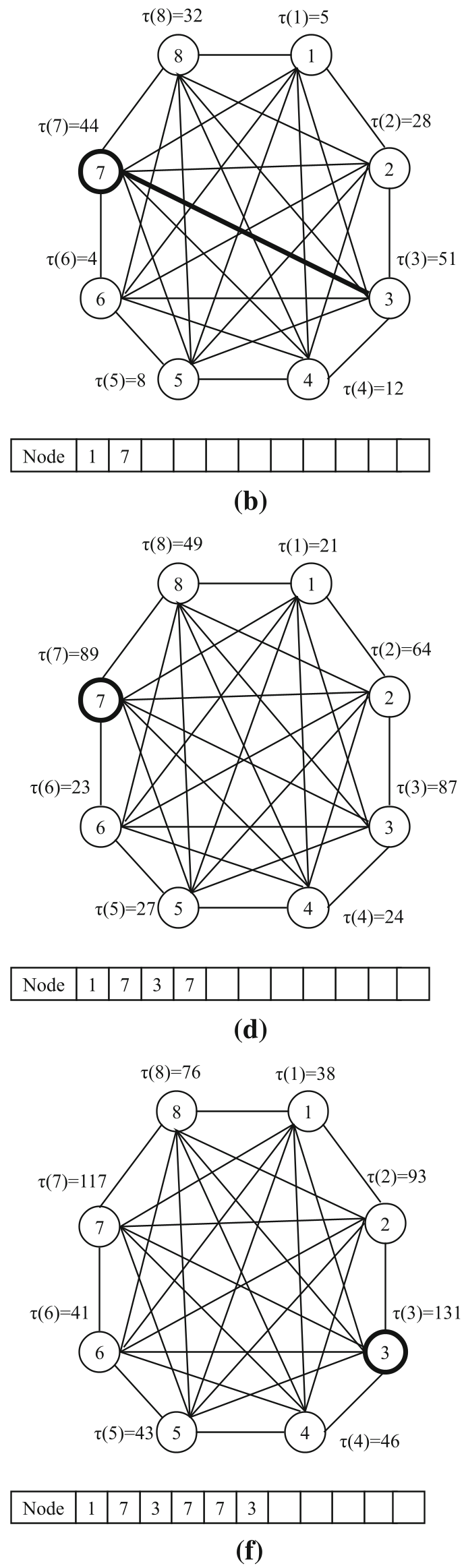 Figure 2: The step-by-step logic of the ACO-IM algorithm.
Performance: How Does it Stack Up?
The authors tested ACO-IM against six major baselines, including CELF++ (Greedy) and PSO (Particle Swarm Optimization).
- Seed Quality: ACO-IM closely matches the performance of CELF++. In some cases, it is virtually indistinguishable from the theoretical maximum spread.
- Efficiency: While Degree-based methods are the fastest, they are the least effective. ACO-IM resides in the "sweet spot"—it is orders of magnitude faster than CELF++ while being much smarter than Degree Discount.
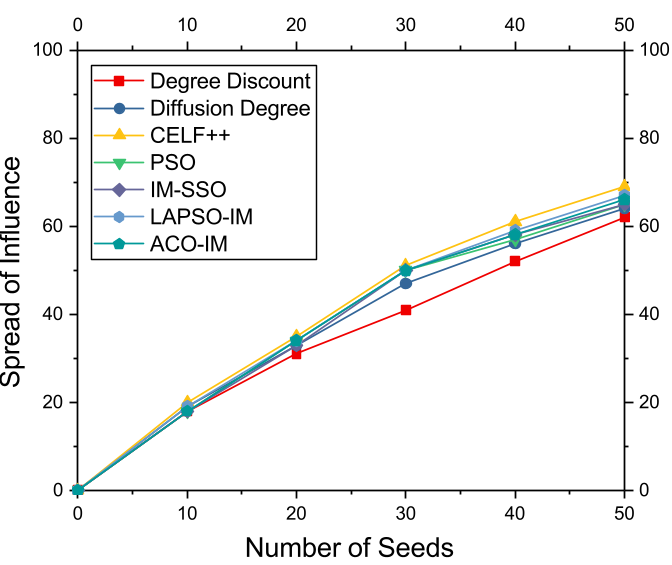 Figure 3: Influence spread comparison across various datasets. Note how ACO-IM (the proposed method) consistently stays near the top of the curve.
Key Quantitative Wins:
- 1.4x - 1.6x Increase in influence spread compared to Degree-based heuristics.
- Significant Speedup over Monte Carlo-based greedy methods.
- Robustness: Works consistently across different diffusion models (Independent Cascade, Weighted Cascade, and Linear Threshold).
Conclusion & Critical Analysis
ACO-IM succeeds because it combines the inductive bias of social network structures (the two-hop rule) with the global search power of Ant Colony Optimization.
Limitations: While faster than greedy methods, ACO-IM still requires multiple iterations, which might be challenging for billion-scale graphs (like the full Facebook graph) without further parallelization.
The Future: This framework is highly extensible. The next step is "Context-Aware" IM—adapting the ants' pheromone rules to account for user location, specific topics, or even competitive marketing where two brands are fighting for the same "mind-share" simultaneously.