
Compensating for Covariate Shift: A Transfer Learning Leap in Speech Emotion Recognition
17591_On Acoustic Emotion Recognition Compensating for Covariate Shift.
This paper addresses Speech Emotion Recognition (SER) by modeling channel and speaker differences as "covariate shift." It introduces Transfer Learning via three Importance Weighting (IW) algorithms—KMM, uLSIF, and KLIEP—integrated into Support Vector Machines (SVM) to achieve SOTA performance on the FAU Aibo Emotion Corpus.
TL;DR
Speech Emotion Recognition (SER) often fails in the "wild" because training data (recorded in specific labs) differs drastically from test data (different speakers, mics, and rooms). This paper treats this mismatch as Covariate Shift and introduces Importance Weighting (IW) algorithms from the transfer learning domain. By re-weighting training samples to match the test distribution, the researchers surpassed the winning results of the Interspeech 2009 Emotion Challenge.
Background: The Hidden Shift in Speech
In standard supervised learning, we assume . In acoustics, this is rarely true. A model trained on a 13-year-old child in a quiet classroom will naturally struggle with a 10-year-old in a noisy hall. While Automatic Speech Recognition (ASR) has long used normalization techniques like CMN (Cepstral Mean Normalization) and VTLN (Vocal Tract Length Normalization), the SER community has largely overlooked the rigorous mathematical treatment of these shifts.
The Intuition: What is Covariate Shift?
Covariate shift occurs when the input distribution changes between training and testing, but the relationship remains the same.
The authors' insight is simple but powerful: Not all training samples are equally useful. If a training sample looks nothing like the test data, the model should ignore it. If it looks very similar, the model should be penalized heavily for misclassifying it. This "similarity" is captured by the Importance Weight :
Methodology: Bridging the Gap with IW-SVM
The paper explores three primary ways to estimate these weights without performing expensive density estimation (which fails in high dimensions):
- KMM (Kernel Mean Matching): Matches the means of distributions in a Reproducing Kernel Hilbert Space (RKHS).
- uLSIF (Unconstrained Least-Squares Importance Fitting): Models the density ratio as a linear combination of basis functions and solves a least-squares problem.
- KLIEP (Kullback-Leibler Importance Estimation Procedure): Minimizes the KL divergence between the true test distribution and the weighted training distribution.
Architecture: Integrating Weights into SVM
Once is calculated for each training point, it is injected into the SVM optimization: High means the sample is "test-like," so the slack variable is penalized more, forcing the hyperplane to respect these points more than others.
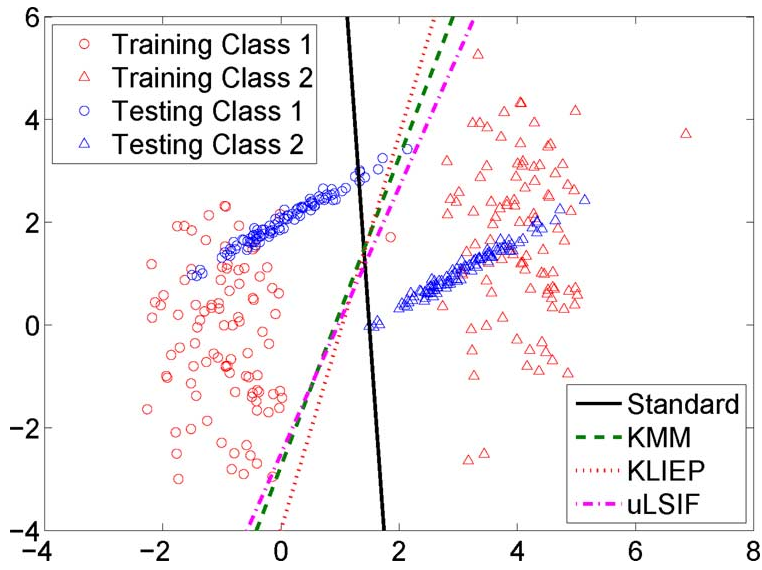 Fig 1: Toy example showing how IW-SVM (KMM, KLIEP, uLSIF) shifts the decision boundary compared to a standard SVM to better accommodate the test distribution (red vs blue).
Experimental Showdown: FAU Aibo Corpus
The researchers tested their approach on the FAU Aibo Emotion Corpus, a dataset of children interacting with a "disobedient" robot dog. The data features two distinct subsets: Ohm and Mont.
Using the Kolmogorov-Smirnov (K-S) test, they proved that 95.5% of features failed the distribution-identity test, confirming a massive covariate shift.
Key Results
On the 5-class emotion task (Anger, Emphatic, Neutral, Positive, Rest), the results were striking:
| Method | Unweighted Accuracy (UA%) |
|---|---|
| Standard SVM | 38.0% |
| CMN + VTLN (Traditional) | 39.4% |
| uLSIF (Transfer Learning) | 42.7% |
| Interspeech '09 Winner | 41.7% |
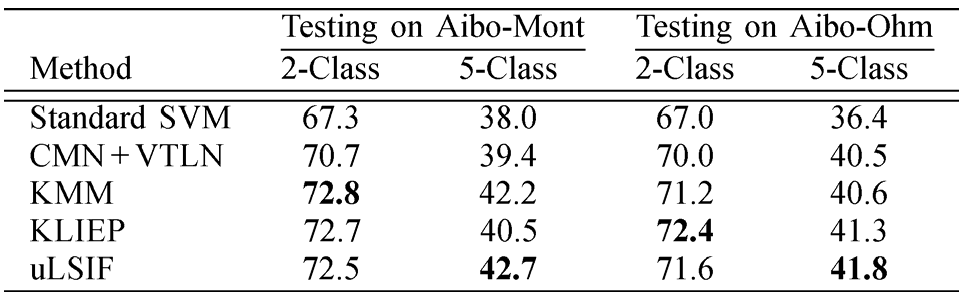 Table: Comparison of UA accuracy. The IW methods consistently outperform both the baseline and traditional ASR normalization.
Critical Insight: Why Don't We Use Both?
A natural question arises: can we combine CMN/VTLN with IW? The authors found that applying CMN+VTLN first reduces the shift (only 55% of features failed the K-S test afterward). However, importance weighting works best when there is a significant shift. When the shift was reduced by normalization, the IW algorithms struggled to find meaningful weights, leading to no further gains. This suggests that IW algorithms are a more "holistic" way to handle shift than manual feature warping.
Conclusion and Outlook
This work demonstrates that SER is not just a feature engineering problem, but a distribution matching problem. By adopting transfer learning techniques like uLSIF, we can build models that actually adapt to new speakers and environments rather than just being "robust" to them.
Limitations: The current IW methods are not yet optimized for real-time streaming, and the performance gain vanishes if the covariate shift is too small. Future research should look into integrating these density-ratio estimators directly into Deep Neural Network (DNN) loss functions for end-to-end emotional adaptation.