
Deciphering the Evolution of IDH-Mutant Glioma: A Longitudinal Multi-Omic Atlas
Acquired genetic and cell-state changes in IDH-mutant glioma progression
This study presents a multi-omic longitudinal atlas of IDH-mutant glioma progression, integrating snRNA-seq, snATAC-seq, and bulk sequencing from 75 temporally separated IDH-mutant gliomas across 35 patients. The research identifies five core malignant cell states—OPC-like, AC-like, NPC-like, MES-like, and Undifferentiated—mapping how genetic evolution and microenvironmental shifts drive the transition toward more aggressive, stem-like, and proliferative phenotypes at recurrence.
TL;DR
A landmark study published in Nature by the CARE consortium reveals that the progression of IDH-mutant gliomas is driven by two parallel forces: genetic mutations (like treatment-induced hypermutation) that push cells toward a primitive, proliferative state, and environmental stress (like radiation) that triggers a reactive, mesenchymal-like state. This longitudinal analysis of 35 patients provides a roadmap for understanding why these tumors become more aggressive over time.
The Progression Paradox
IDH-mutant gliomas are often considered the "slower" cousins of glioblastoma, yet they are eventually fatal. The central question has always been: Does treatment cause the tumor to evolve, or does it simply kill the weak cells, leaving the strong ones behind?
By tracking 75 samples across multiple surgeries, the researchers discovered that the "Cellular Analysis of Resistance and Evolution" (CARE) isn't just about survival of the fittest; it's about active transformation.
Methodology: The CARE Consortium Approach
The study’s strength lies in its multi-layered integration. For each patient, the team didn't just look at what genes were expressed (snRNA-seq); they looked at which genes could be expressed by analyzing chromatin accessibility (snATAC-seq) and matched these with bulk DNA sequencing to identify specific mutations acquired during treatment.
Core Insight: Five States of Malignancy
Using Non-negative Matrix Factorization (NMF), the team identified five malignant states:
- OPC-like & AC-like: Differentiated states resembling normal brain cells (Oligodendrocyte Progenitor and Astrocyte-like).
- NPC-like: Neural Progenitor-like, more primitive.
- Undifferentiated: The "stem-like" powerhouse of the tumor.
- MES-like: A reactive, mesenchymal state similar to what is seen in highly aggressive IDH-wildtype glioblastoma.
The Two Paths to Aggression
The researchers identified a fascinating divergence in how these tumors progress:
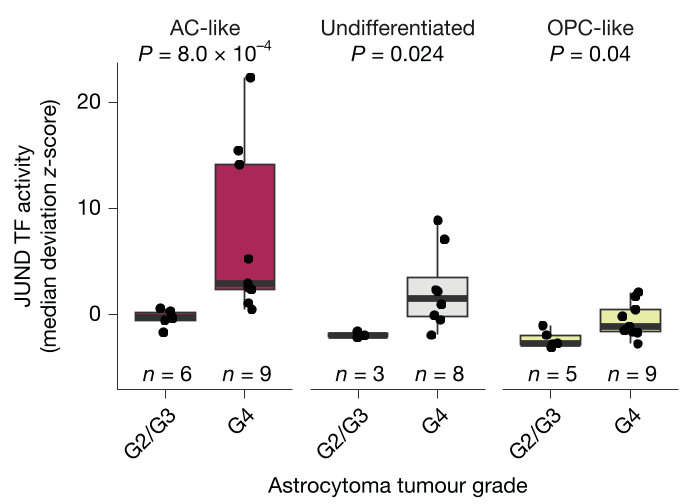
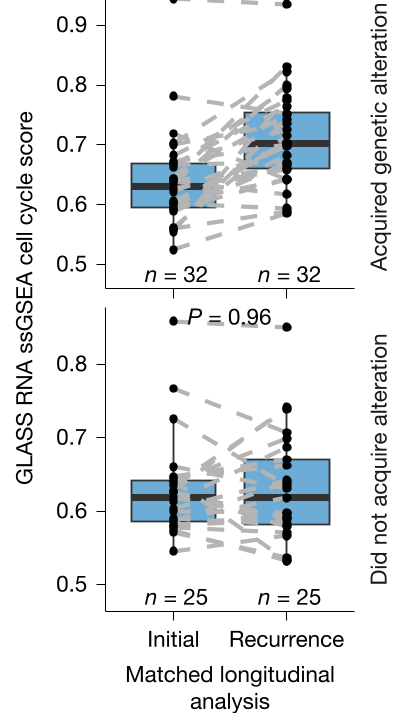
- The Genetic Path: Acquired alterations like PDGFRA amplification or hypermutation (often caused by alkylating chemotherapy) directly reduced differentiation. These cells shifted from AC-like (differentiated) to Undifferentiated or cycling (proliferative) states.
- The Extrinsic Path: The emergence of the MES-like state was not tied to mutations. Instead, it was driven by the tumor microenvironment. Specifically, radiotherapy appears to deplete resident microglia and recruit inflammatory macrophages, which in turn push tumor cells into a Mesenchymal-like state.
Evidence from the Lab
To prove these observations weren't just correlations, the team performed co-culture experiments. When IDH-mutant tumor cells were grown with macrophages and exposed to radiation, the abundance of the aggressive MES-like state spiked significantly compared to tumor cells grown alone.
Similarly, using CRISPR to knock out the tumor suppressor CDKN2A—a common event at recurrence—mechanistically drove the cells toward a less differentiated, more proliferative state.
Clinical Implications: Survival and Treatment
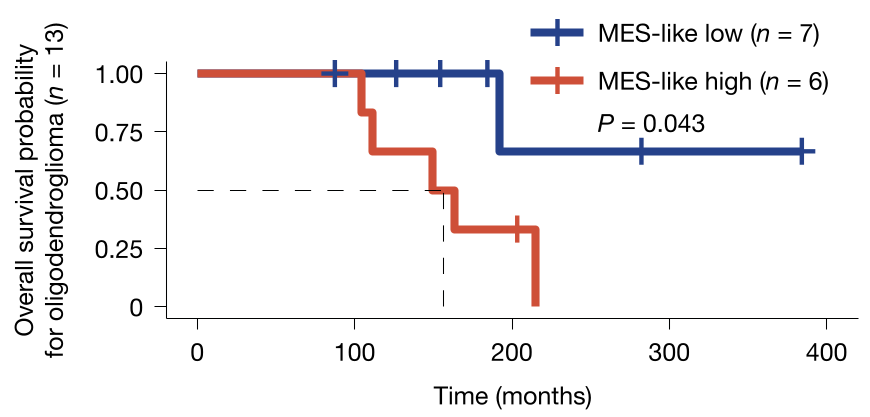
The findings have a direct impact on how we view patient outcomes. High levels of the MES-like state at the time of recurrence were a strong predictor of reduced overall survival.
Critical Analysis & Conclusion
This work challenges the "one-size-fits-all" approach to glioma treatment. It suggests that:
- Chemotherapy (Alkylating agents) can be a double-edged sword, providing survival benefits but also potentially driving hypermutation that fuels stem-like cell expansion.
- Radiotherapy alters the immune landscape in a way that promotes a reactive MES-like phenotype.
The Future: The next generation of IDH-mutant glioma therapy must go beyond just inhibiting the IDH enzyme. We need strategies that prevent de-differentiation and block the inflammatory signals from the microenvironment that trigger the Mesenchymal shift.
Takeaway
Progression is an "integrated model" of intrinsic genetic shifts and extrinsic immune-cell interactions. Understanding this crosstalk is the only way to turn IDH-mutant gliomas from a fatal certainty into a manageable condition.