
BS-CB: Acting Selfish for the Good of All in Vehicular Networks
11154_Acting selfish for the good of all contextual bandits for resource-efficient transmission of vehicular sensor data.
The paper introduces Black Spot-aware Contextual Bandit (BS-CB), a client-based opportunistic transmission framework for delay-tolerant vehicular sensor data. By combining Random Forests for throughput prediction, k-means for error-prone "Black Spot" clustering, and LinUCB for decision making, it achieves SOTA uplink performance in real-world cellular environments.
Executive Summary
TL;DR: Researchers from TU Dortmund University have developed BS-CB (Black Spot-aware Contextual Bandit), a hybrid machine learning framework that allows vehicles to "opportunistically" upload sensor data. By intelligently waiting for high-quality network conditions, the system nearly triples data rates while slashing network resource usage and power consumption.
Background: This work sits at the intersection of Anticipatory Networking and Vehicular Crowdsensing. While most network management happens at the base station, this paper argues for "client-based" intelligence, where the vehicle itself decides the best moment to transmit.
Problem & Motivation: The Cost of Persistence
In a perfect world, cellular coverage would be uniform. In reality, vehicles move through a chaotic landscape of "hotspots" and "coldspots."
- The Inefficiency: Traditional periodic transmission methods (MTC) send data regardless of channel quality. In a "coldspot," the device must use a low Modulation and Coding Scheme (MCS) and high transmission power, hogging the cell's "Resource Blocks" for longer periods just to send a few kilobytes.
- The Opportunity: Many vehicular tasks (e.g., updating HD maps or traffic telemetry) are delay-tolerant. We don't need the data this millisecond; we need it efficiently.
Methodology: The Hybrid ML Stack
The brilliance of BS-CB lies in its multi-stage pipeline, moving from raw network indicators to autonomous decision-making.
1. Supervised Learning: Throughput Prediction
Using a Random Forest (RF) model, the vehicle maps current network features (RSRP, RSRQ, SINR), mobility (speed), and application (payload size) to a predicted data rate.
2. Unsupervised Learning: The "Black Spot" Filter
The authors realized that ML models aren't equally accurate everywhere. They identified Black Spots—geospatial clusters where prediction error (RMSE) is high due to handovers or physical obstructions.
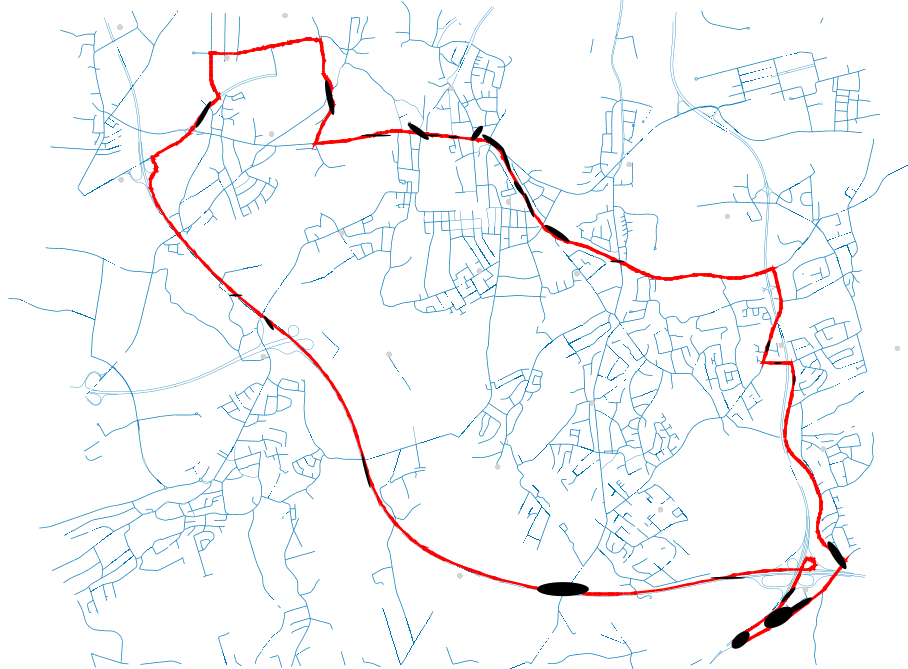 Figure: Geographical clusters identified as Black Spots for a specific MNO.
3. Reinforcement Learning: The Contextual Bandit
The core decision engine is a LinUCB Contextual Bandit. It chooses between two "arms":
- aIDLE: Buffer data and wait for a better channel.
- aTX: Clear the buffer and transmit now.
The reward function is meticulously designed to balance the "selfish" desire for high throughput with the "global" constraint of the maximum tolerable Age of Information (AoI).
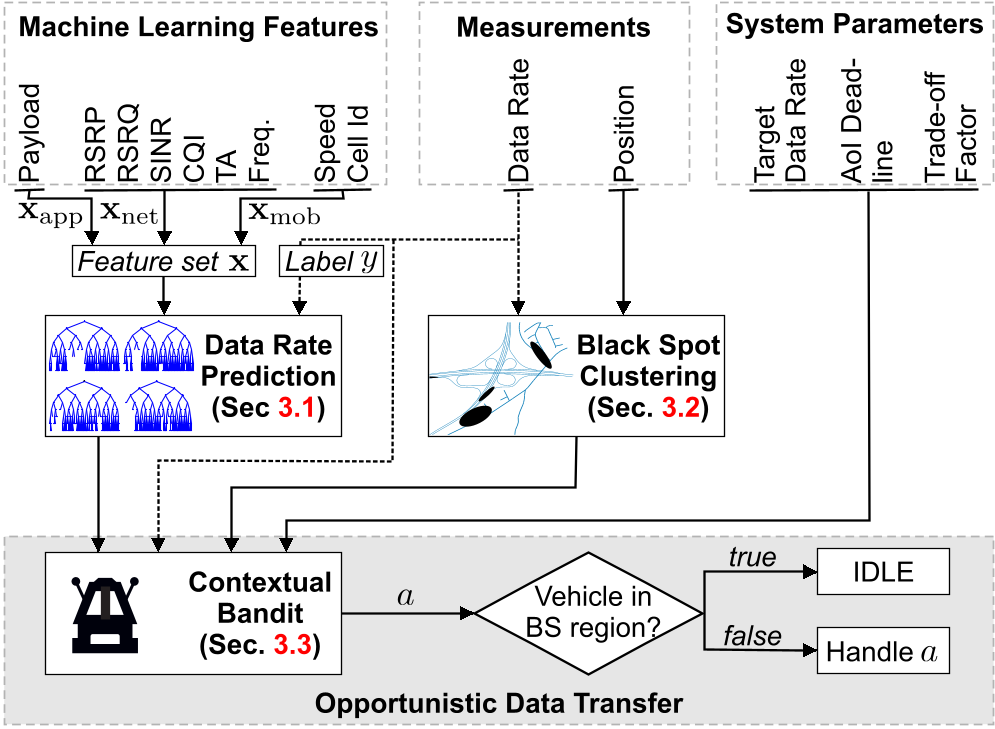 Figure: The overall BS-CB system architecture integrating supervised, unsupervised, and reinforcement learning.
Experiments & Results: Efficient Selfishness
The researchers tested BS-CB in the real world across three German Mobile Network Operators (MNOs).
- Throughput Gains: BS-CB achieved uplink rates 125% to 195% higher than periodic methods.
- The "Selfish" Paradox: By only transmitting when the channel was excellent, BS-CB actually occupied 84% less cell resources. By acting "selfishly" for its own speed, it freed up the network for everyone else.
- Power Savings: Because high-quality channels (high RSRP) require less transmission power, the UE's battery consumption related to transmission dropped by up to 75%.
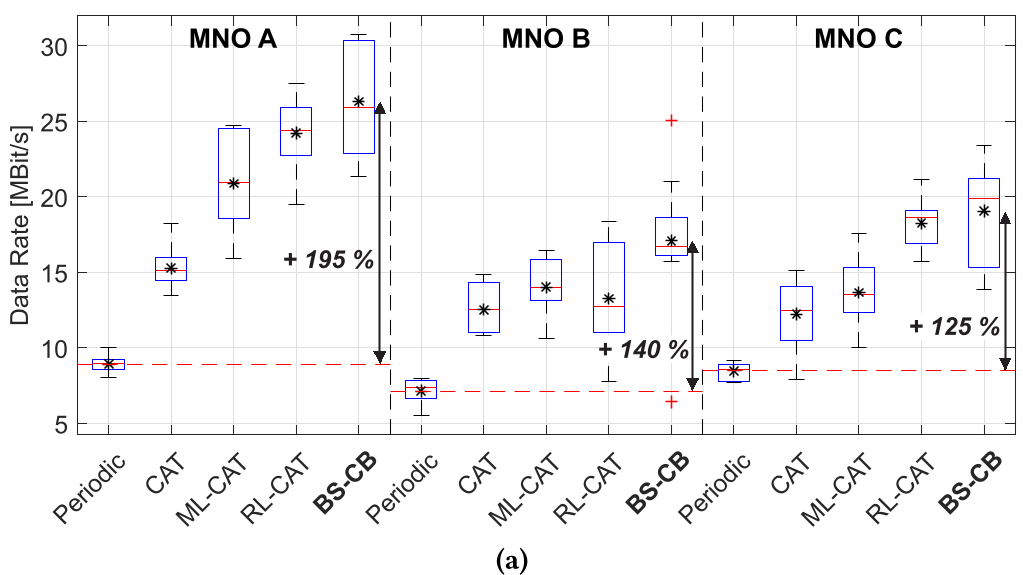 Figure: Comparison of throughput, resource efficiency, and power consumption across different MNOs.
Critical Analysis & Conclusion
Takeaway
The study proves that shifting intelligence to the client side is a powerful tool for 5G/6G. The Data-driven Network Simulation (DDNS) used for training allowed the Reinforcement Learning agent to converge in just ~200 epochs—much faster than standard Deep Q-Learning.
Limitations
- Delay Sensitivity: This method is strictly for delay-tolerant data. It cannot be used for safety-critical V2X communication (like collision avoidance).
- The Multi-MNO Gap: While the paper discusses multiple operators, the current agent only connects to one at a time. A multi-sim "Black Spot" avoidance strategy (switching networks dynamically) is the next logical frontier.
Future Outlook
As 6G moves toward Zero-Touch Optimization, BS-CB provides a blueprint for how mobile agents can autonomously navigate complex radio environments without constant instruction from the core network.