
MolmoAct2: Bridging the Gap Between Embodied Reasoning and Real-World Robotics
Action Reasoning Models for Real-World Deployment Haoquan Fang
MolmoAct2 is a fully open-source Vision-Language-Action (VLA) model designed for real-world robotic deployment. It leverages the Molmo2-ER backbone for spatial reasoning and a novel "think-then-act" architecture, outperforming π0.5 and reaching SOTA on 7 simulation and real-world benchmarks across multiple robot embodiments.
TL;DR
MolmoAct2 is a state-of-the-art, fully open-source Vision-Language-Action (VLA) model that cracks the nut of "latency vs. reasoning." By utilizing a spatially-specialized backbone (Molmo2-ER) and an adaptive "Think" mechanism, it achieves high-success rates on low-to-medium cost robot platforms (like SO-100 and YAM) while maintaining a control frequency of up to 55Hz.
Background: The Struggle for Real-World Deployment
Most frontier VLA models are "black boxes"—their weights are closed, and their training recipes are proprietary. Even open-weight models often require proprietary datasets or expensive Franka arms to function. Moreover, the "Chain-of-Thought" (CoT) reasoning that makes these models smart usually makes them slow, creating a bottleneck for real-time robotic control. MolmoAct2 fixes this by focusing on three pillars: Openness, Spatial Intelligence, and Efficiency.
Methodology: How MolmoAct2 "Thinks" and "Acts"
1. The Spatial Backbone: Molmo2-ER
The researchers identified that standard VLMs lack "Metric Insight"—the ability to judge distances and scene geometry. They trained Molmo2-ER on a 3.3M sample corpus focusing on pointing, detection, and egocentric-exocentric correspondence. This backbone alone outperforms GPT-5 on embodied reasoning tasks.
2. The Architecture: Per-Layer KV Connection
Unlike standard models that only use the VLM's final hidden state, MolmoAct2 grafts a continuous-action expert onto the VLM using per-layer KV-cache conditioning. This gives the action expert direct access to the hierarchical visual features at every level of the VLM backbone.
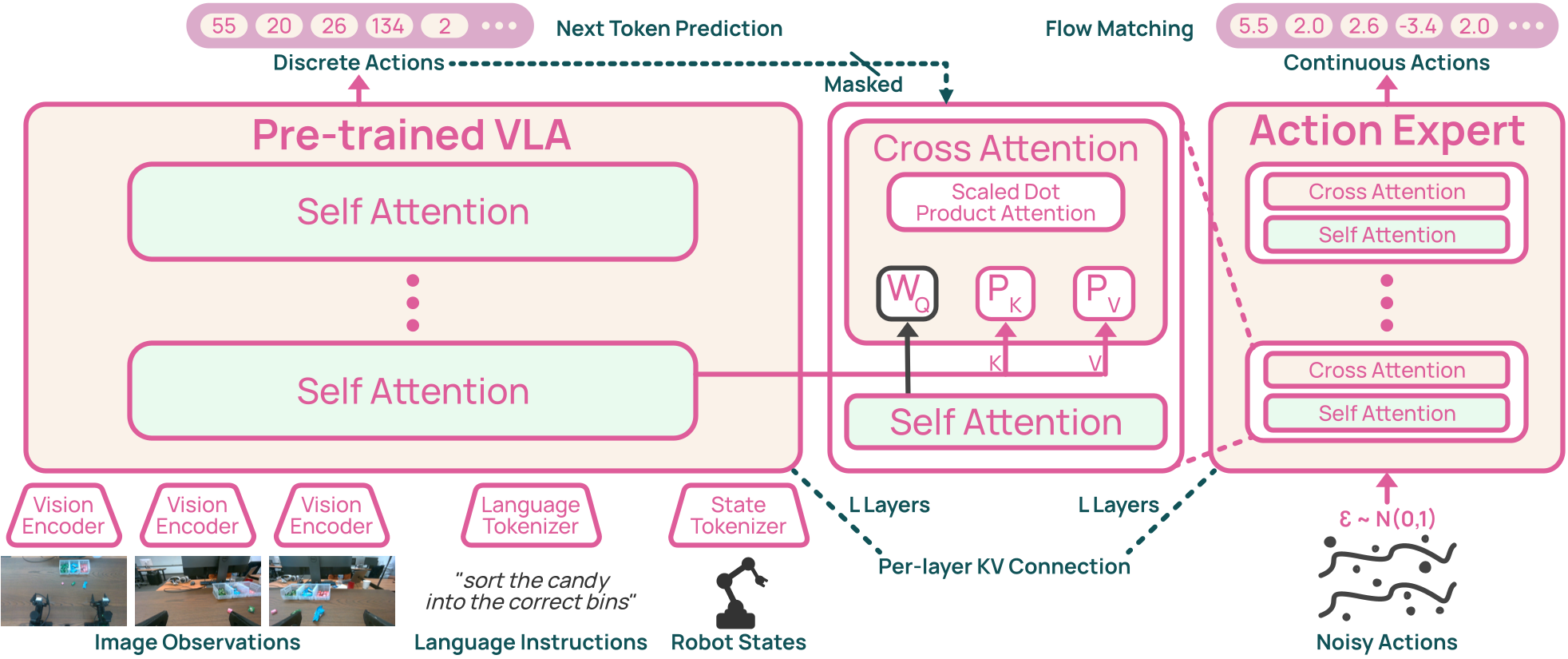
3. Adaptive Depth Reasoning (MolmoAct2-Think)
To solve the latency problem, the model uses adaptive depth tokens. Instead of re-calculating the entire scene's geometry, it only predicts depth tokens for parts of the scene that changed. This drastically reduces the number of tokens generated, allowing for reasoning without the "speed penalty."
Experimental Results: SOTA Performance
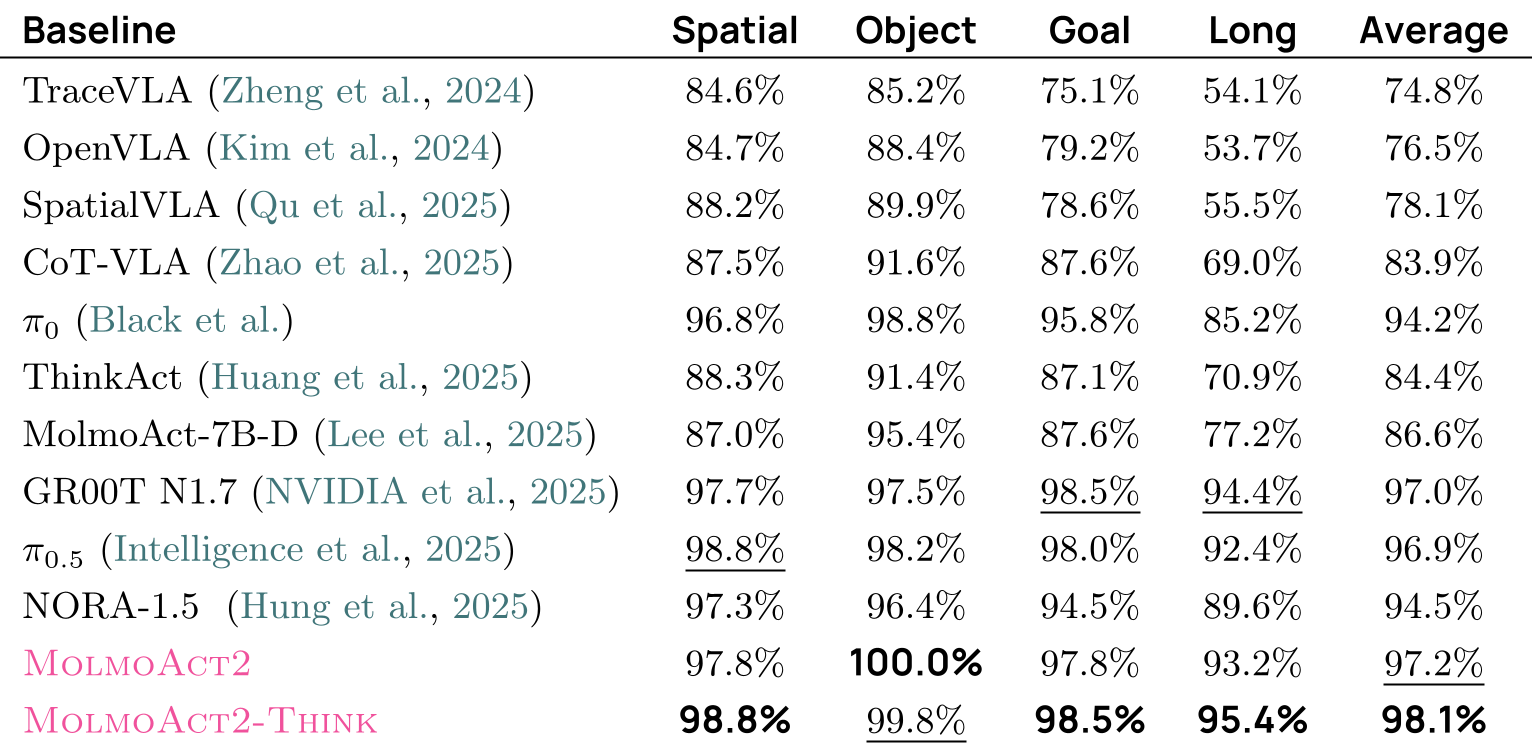
MolmoAct2 was tested against heavyweights like π0.5 and earlier Molmo models.
- Zero-Shot Deployment: On the DROID real-world benchmark, MolmoAct2 reached an 87.1% average success rate, nearly doubling the performance of many baselines.
- Simulation Mastery: On LIBERO, the model achieved 97.2% overall success, with the "Think" variant pushing it even further to 98.1%.
- Inference Speed: Thanks to CUDA Graph optimizations, the model runs at 55.79 Hz, which is more than sufficient for high-speed manipulation.
Critical Analysis & Conclusion
MolmoAct2 is a significant milestone for the open-source community. It proves that:
- Specialization beats scale: A 4B-8B model with spatial specialization can beat "Giant" Generalist VLMs.
- Reasoning is essential: Geometric grounding (depth tokens) is the key to handling complex tasks like "Apple on Plate" or "Pipette in Tray."
Limitations: While the model is highly efficient, the adaptive depth reasoning is currently less optimized for CUDA Graphs than the fixed-shape flow-matching expert, meaning there is still room for improvement in "thinking" speed.
In conclusion, MolmoAct2 provides the community with a robust, interpretable, and deployable foundation for the future of general-purpose robotics.