
ACES: Unmasking Hidden Social Structures via Active Ensemble Clustering
Active Clustering with Ensembles for Social structure extraction
The paper introduces ACES (Active Clustering with Ensembles for Social structure extraction), a novel framework for automatically extracting social networks from unconstrained video collections. It combines an active semi-supervised ensemble clustering method (ACE) with co-appearance analysis to identify individuals, social groups, and "bridge" persons without requiring pre-enrolled identity databases.
TL;DR
The ACES (Active Clustering with Ensembles for Social structure extraction) algorithm is a specialized framework designed to map social networks from ad hoc video clips. It bypasses the need for existing identity databases by using a "human-in-the-loop" active clustering approach (ACE) to group faces accurately, then applies graph-theoretic measures to find social communities and the "bridge" people who link them.
Background & Positioning
In the era of massive social media video sharing, understanding the underlying social fabric—who knows whom and how groups interact—is a significant challenge for computer vision. ACES sits at the intersection of Face Recognition, Semi-Supervised Clustering, and Social Network Analysis (SNA). Unlike prior works that require manual labeling or assume a person belongs to just one group, ACES handles identity ambiguity and overlapping community memberships.
Problem & Motivation: The "Wild" Video Challenge
Identity clustering in unconstrained videos is notoriously difficult due to:
- Variations in Pose and Lighting: Standard face matchers often fail or provide ambiguous scores.
- Incomplete Data: Most identity-clustering methods are purely automated and propagate errors.
- Complex Social Roles: Most SNA vision models use "hard" membership; they don't account for "bridges"—individuals who act as intermediaries between different social circles.
The authors' insight is that by focusing user attention only on the most ambiguous pairs (where the algorithm is "unsure"), they can maximize accuracy with minimal human effort.
Methodology: The ACE Framework
The core of the system is the Active Clustering with Ensembles (ACE) algorithm.
1. Multi-View Ensemble
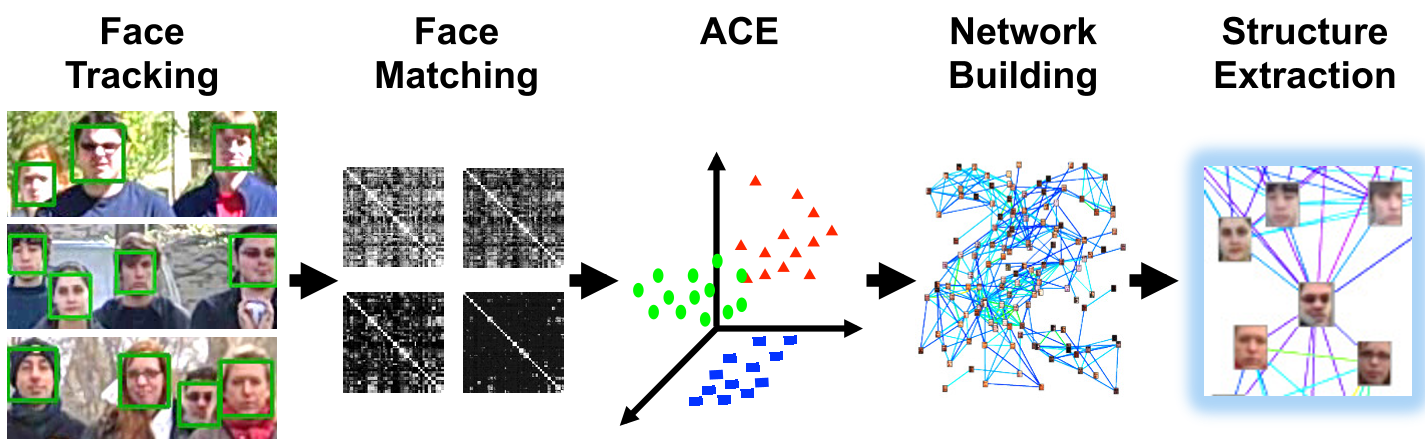
Instead of relying on a single similarity metric, ACES generates four affinity matrices (Min, Max, Median, and Mean scores from the face matcher). This provides "multiple views" of the data, which feed into an ensemble of SCOP-KMEANS clusterers.
2. Constraints as Knowledge
The system uses three types of constraints:
- Must-not-link: If two faces appear in the same frame, they cannot be the same person.
- Soft Constraints: Gender classification scores help separate clusters.
- Active User Constraints: The system identifies pairs where the ensemble consensus is split (e.g., 50% say "match", 50% say "no match") and asks the user for a verdict.
3. Bridging Communities
Once identities (nodes) and co-appearances (edges) are established, the algorithm uses a Modularity-Cut spectral technique to find groups. Crucially, it calculates a membership weight for each person across all groups. High-entropy weights indicate a "Bridge," a person who belongs to multiple communities.
Experiments & Results
The authors introduced the SN-Flip dataset, featuring 190 subjects across 28 crowd videos—characterized by blurriness and occlusionstypical of consumer cameras.
- Clustering Accuracy: With just 50 "active" queries per iteration, the ACE method reached an F-measure > 0.80, markedly higher than the baseline.
- Robustness: Even when the user makes mistakes (10% error rate in feedback), the active selection method remains robust, whereas random selection performance collapses.
- Bridge Identification: The system successfully identified key individuals who appeared in multiple video scenes, effectively mapping the "connectors" within the social graph.
 (Note: Users should refer to Figure 4 in the original paper for the detailed F-measure growth curves).
Critical Insight & Conclusion
The true value of ACES lies in its efficiency of human intervention. By using the ensemble's "uncertainty" as a signal for active learning, the algorithm avoids asking the user thousands of trivial questions, focusing instead on the "edge cases" that clarify the entire network structure.
Limitations: The system still relies on a "black box" face matcher (VeriLook). Future improvements could involve integrating more modern Deep Metric Learning features to reduce the initial ambiguity before the active clustering phase begins.
Takeaway: This work proves that social network extraction doesn't need to be fully manual or fully automated; a strategic "middle ground" using active ensemble clustering can recover complex social connections from low-quality, real-world video.