
Active Learning: Slashing the Human Cost of Environmental Anomaly Detection
Active learning for anomaly detection in environmental data
This paper introduces an Active Learning (AL) framework for automated anomaly detection in environmental sensor data, specifically focusing on water quality monitoring. By utilizing "Uncertainty Sampling" with discriminative models like Random Forest and Neural Networks, the authors achieve SOTA-level F1 scores using less than 1% of the total labeled data.
TL;DR
Environmental monitoring generates massive amounts of data, but identifying "anomalies" still requires a human expert to sit in front of a screen for weeks. This paper proves that by using Active Learning (AL)—specifically querying the most "confusing" data points—we can train high-accuracy models like Neural Networks using less than 1% of the labels typically required.
Perspective: The Labeling Bottleneck
In the field of environmental science, we are "data rich but label poor." In-situ sensors provide high-frequency streams of water quality data, but the ground truth for what constitutes a "sensor fault" or a "biological event" exists only in the minds of experts.
The authors identify a critical friction point: supervised learning is effective but requires massive labeled sets. However, environmental data is highly unbalanced (anomalies are <10%) and non-linear. Randomly picking data to label is a waste of an expert's time because 98% of what they label will be "normal" data that the model already understands.
Methodology: Querying the "Unknown"
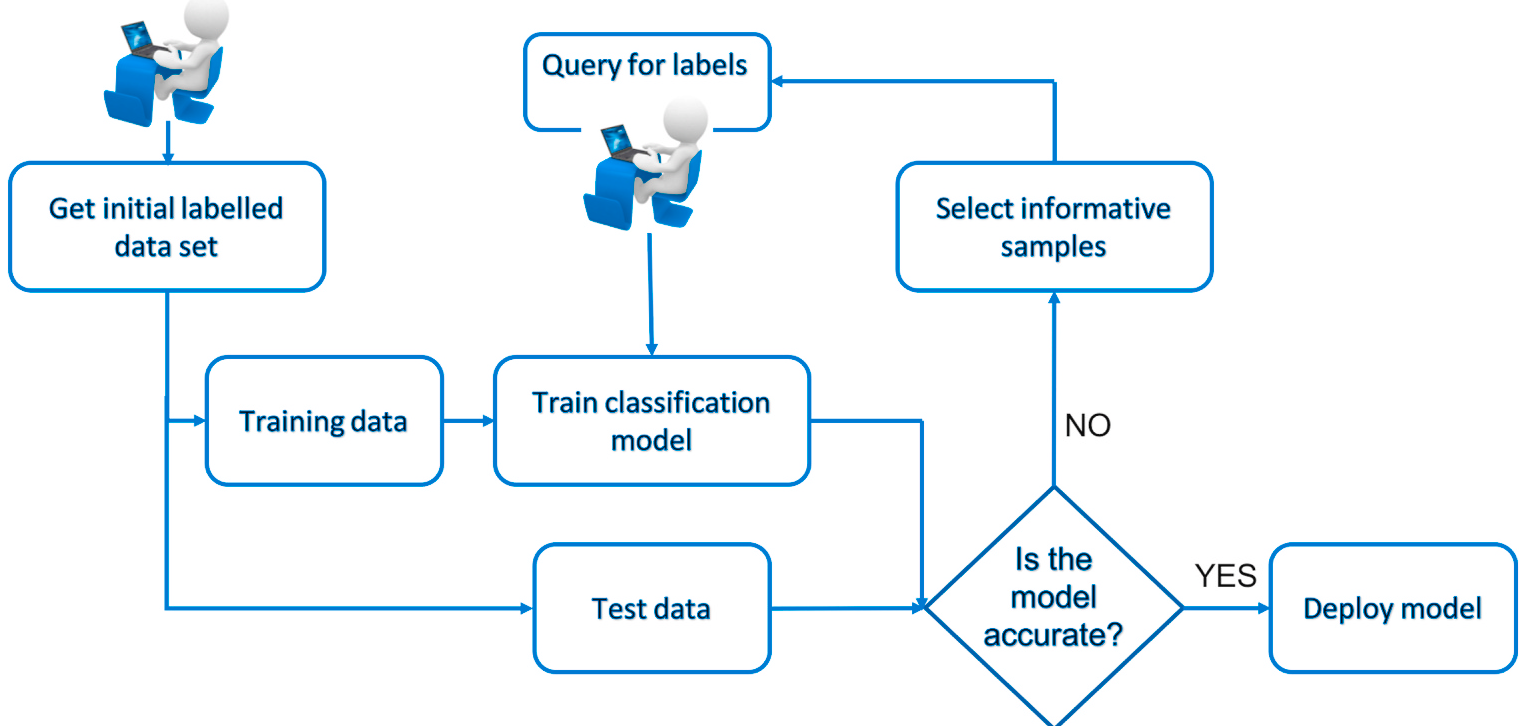
The core innovation lies in the iterative Uncertainty Sampling loop. Instead of training once on a fixed dataset, the system follows this cycle:
- Train a model on a tiny seed of labeled data.
- Run the model on the unlabeled "pool."
- Identify samples where the model's prediction is closest to 0.5 (maximum uncertainty).
- Ask the human expert: "What is this?"
- Retrain and repeat.
The study compared five models, ranging from simple Naive Bayes (NB) to complex Artificial Neural Networks (ANN). The physical intuition here is that a linear boundary (LR/NB) is too rigid to separate complex environmental anomalies, whereas non-linear models can adapt their boundaries more efficiently when fed highly "informative" samples.
Experimental Breakthrough: 20x Efficiency
The results from the experiment on pond ecosystem data (conductivity, pH, Temperature, etc.) were striking.
- Efficiency: The ANN reached near-peak performance () with only 0.48% of the data labeled.
- Anomaly Discovery: The AL strategy naturally "hunts" for anomalies. As shown in the query logs, the Uncertainty strategy selected significantly more red-labeled (anomalous) points than Random sampling.
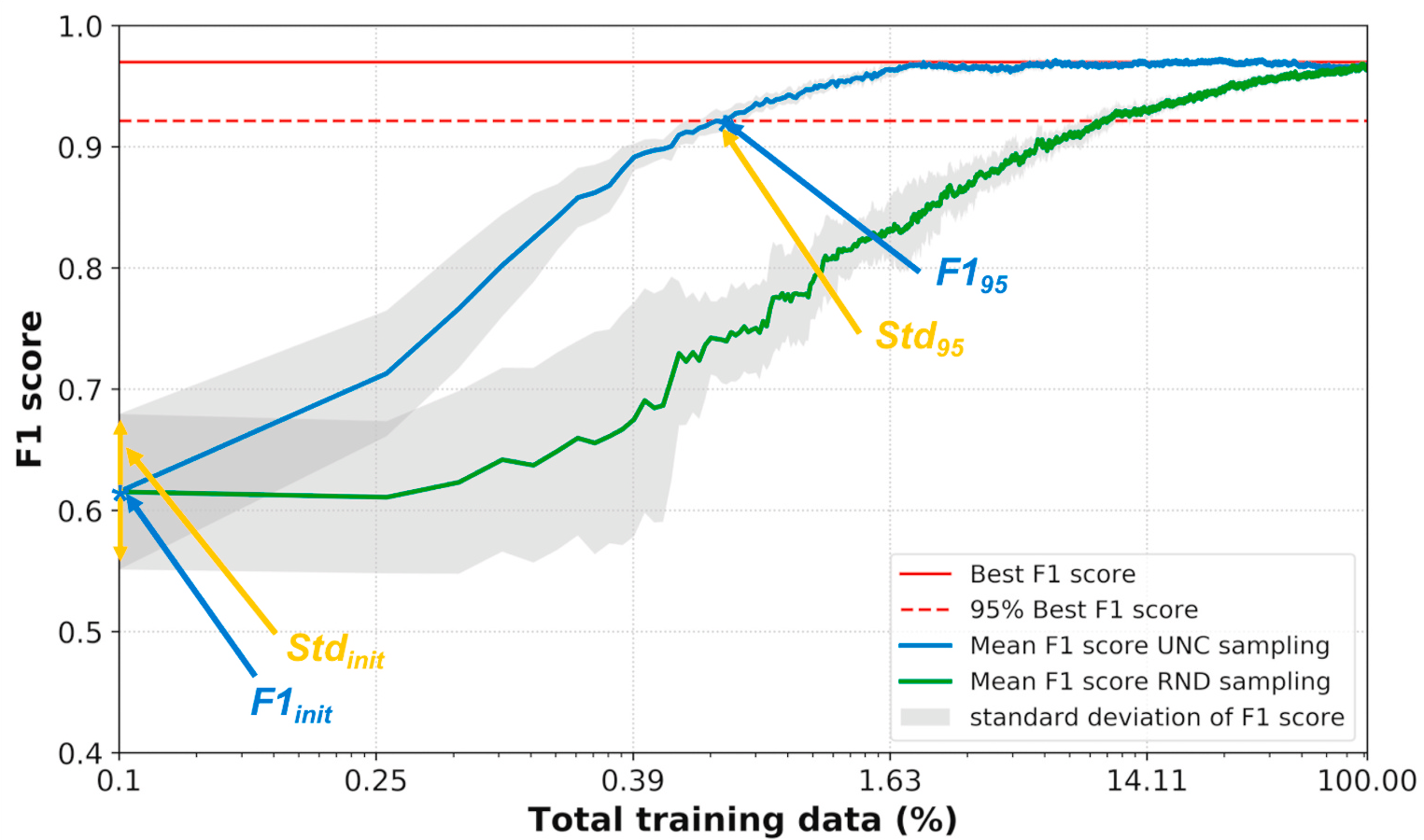 Figure: The RF model with Uncertainty Sampling (UNC) reaches a high F1 score significantly earlier than Random (RND) sampling.
Critical Insight: Why Discriminative Models Win
The paper confirms a classic ML hypothesis in a new domain: Discriminative models (RF, kNN, ANN) outperform generative models (NB) here.
Why? Environmental "normal" data isn't stationary—it changes with the seasons. Generative models try to model the distribution of the data itself, which is a moving target. Discriminative models focus solely on the decision boundary. By using Active Learning to "populate" that boundary with the most difficult cases, the model learns the difference between a natural seasonal spike and a sensor failure with surgical precision.
Limitations & Future Outlook
While the results are impressive, two challenges remain:
- Hyperparameter Tuning: Real-time AL makes tuning difficult because you don't have enough data at the start to perform a proper grid search.
- The "Oracle" is Human: Humans get tired and make mistakes. Future work must account for "noisy labels" where the expert might provide inconsistent ground truth.
Conclusion
This work provides a clear roadmap for scaling environmental monitoring. By transitioning from "label everything" to "label what matters," we can deploy sophisticated AI across global sensor networks without exhausting our human experts.
Takeaway: If you are building an anomaly detection system for complex sensor data, stop labeling at random. Use a Random Forest or ANN with an uncertainty-query loop to cut your costs by 95%.