
Active Learning with Crowdsourcing: Solving the Needle-in-a-Haystack Cold Start
Active Learning with Crowdsourcing for the Cold Start of Imbalanced Classifiers
The paper introduces a cooperative Active Learning (AL) and crowdsourcing framework specifically designed for the "cold start" phase of imbalanced classification. The core method, guided by unsupervised clustering, utilizes cluster quality (Conductance) and impurity (Adjusted Mutual Information) indexes to prioritize sample selection, achieving SOTA results in isolating rare positive events from massive unlabeled Twitter streams.
TL;DR
Training a classifier when you have millions of unlabeled data points but very few "positive" examples is a nightmare. This paper presents a novel strategy that uses unsupervised clustering to guide Active Learning. By calculating the quality and impurity of clusters, the system knows exactly where to ask a human (or crowd) for labels to maximize information gain in imbalanced datasets like Twitter flood detection.
The "Chicken and Egg" of Imbalanced Cold Starts
Most Active Learning (AL) strategies assume you already have a "decent" initial model to start querying uncertain points. But in real-world scenarios—like identifying specific flood-related tweets among millions of memes and news—the positive class is so rare that random sampling effectively yields zero positive examples.
Without positive examples, your initial classifier is useless, and your AL strategy never gets off the ground. This is the Cold Start Problem.
Methodology: Clustering as a Canvas
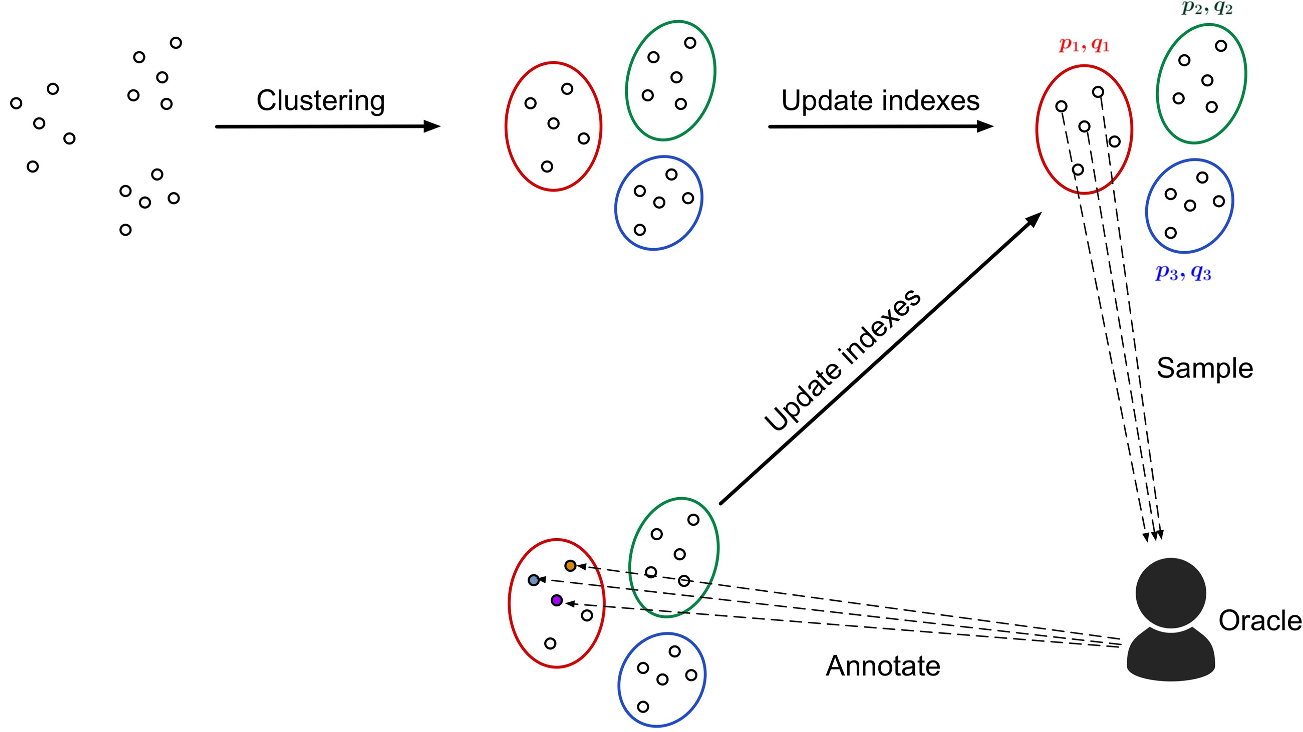
The authors propose that before even training a classifier, we should look at the natural structure of the data. They use two primary metrics to rank clusters () for sampling:
- Cluster Quality (): Measured using Conductance. Does this cluster represent a compact, well-separated group of data? High quality means a label obtained for one member is likely representative of the whole group.
- Impurity Estimate (): Measured using Adjusted Mutual Information (AMI). Does this cluster contain a mix of different ground truth labels? High impurity means we need more labels from this specific region to resolve the ambiguity.
The Strategy: Sample items from clusters where is highest.
Theoretical Insight: Subspace Reconciliation
One of the most impressive parts of the methodology is how it handles heterogeneous data. Tweets have both textual content (500-D vector) and spatio-temporal coordinates (3-D). To prevent the "curse of dimensionality" from favoring one space over the other, the authors remap distances using a distribution, allowing them to combine high-dimensional text clusters with low-dimensional spatial clusters meaningfully.
Experiments: Hurricane Harvey Case Study
The researchers tested this on a corpus of 7.5 million tweets from the 2017 Harvey tropical storm.
- Data Representation: Text was processed via a character-based language model (Tweet2Vec), while spatio-temporal data focused on Houston urban surroundings.
- The Imbalance: Only 7.6% of tweets were actually relevant.
- Clustering Outcome: The textual space yielded 47 clusters, while the spatio-temporal space yielded 24. Their Cartesian product created a granular grid of 1,128 clusters.
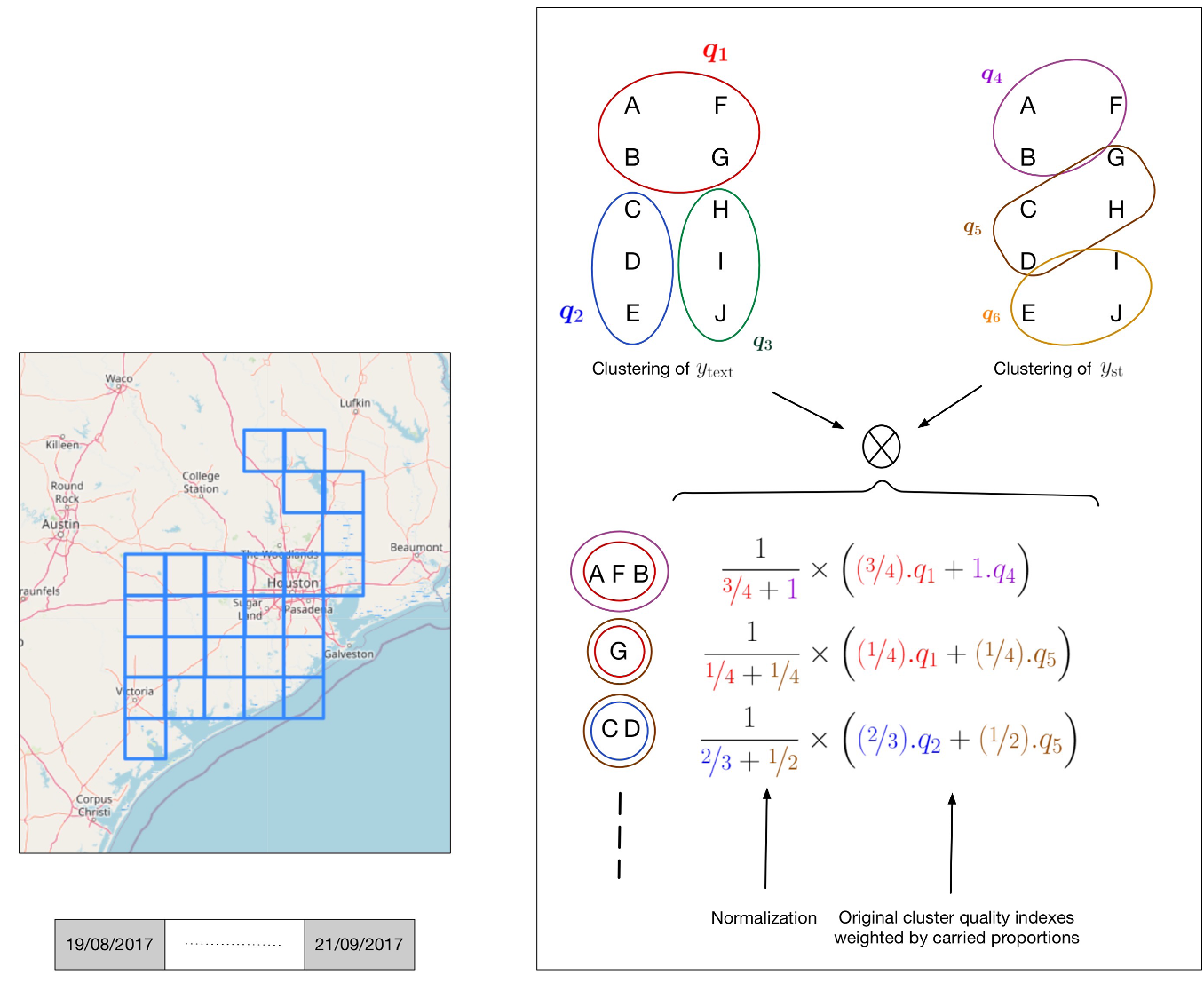
The results showed that by focusing on high-quality/high-impurity clusters, the model could rapidly identify the "positive" tweets required to bootstrap a more complex neural network for flood probability estimation.
Critical Analysis & Conclusion
Takeaway
This work shifts the focus of Active Learning from "What does the model think is uncertain?" to "What does the data structure tell us is important?". By grounding the sampling process in unsupervised clustering, it effectively bypasses the initial bias of empty training sets.
Limitations
- Static Granularity: The clustering structure is fixed at the start. If the initial clustering is poorly aligned with the actual class density, the AL strategy remains limited.
- Computational Overhead: Calculating conductance across millions of pairs in high-dimensional space can be heavy, requiring the similarity remapping techniques the authors mention.
Future Outlook
The next logical step, as the authors suggest, is integrating Hierarchical Agglomerative Clustering (HAC). This would allow the AL process to "zoom in" or "zoom out" of clusters as labels are acquired, potentially discovering even smaller sub-clusters of rare events.