
Active CRFs: Reducing the Annotation Burden in Speech Emotion Recognition
Active Learning for Speech Emotion Recognition Using Conditional Random Fields
This paper introduces an Active Learning framework for Speech Emotion Recognition (SER) utilizing Conditional Random Fields (CRFs) as the base classifier. By proposing a modified information density query strategy, the method achieves competitive classification accuracy while significantly reducing the human annotation effort required for training.
TL;DR
Recognizing human emotions through speech usually requires massive amounts of labeled data. This paper proposes a solution using Active Learning paired with Conditional Random Fields (CRFs). By intelligently selecting the most "informative" and "representative" speech samples for experts to label, the system achieves performance levels comparable to traditional supervised learning but with significantly fewer annotated samples.
Background and Motivation
Human-Computer Interaction (HCI) increasingly relies on understanding affective states. However, the bottleneck remains the Emotion Corpus. While raw audio is easy to collect, labeling a sentence as "Angry," "Happy," "Neutral," or "Sad" requires careful human intervention, which is both slow and costly.
The authors identify a gap: while Active Learning has been successful in NLP tasks like Named Entity Recognition or Text Classification, its application in Speech Emotion Recognition (SER) was largely unexplored at the time of this research. Their goal is to move away from "Random Selection" toward a strategy that asks, "Which unlabeled sample will improve my model the most?"
Methodology: The Core of Active CRFs
The system relies on two pillars: the CRF model for sequence-based classification and a Modified Information Density Query Strategy.
1. Why Conditional Random Fields?
Unlike Hidden Markov Models (HMMs) which assume strict independence between observations, CRFs are undirected graphical models that look at the entire sequence. They allow the inclusion of overlapping features (like pitch, energy, and MFCCs) without worrying about their interdependence, effectively overcoming the "label-bias" problem of other conditional models.
2. The Intelligent Query Function
The "Active" part of the learning comes from how the model picks the next samples. Standard active learning often uses Uncertainty Sampling (picking what the model is most unsure about). However, this can pick outliers. The authors improve this by adding a Density Measure:

- Uncertainty: Uses the entropy of the CRF output to find samples where the model's confidence is low.
- Density: Uses cosine similarity to find samples that are "central" to clusters of unlabeled data.
- Combined Insight: By picking the most uncertain and representative samples, the model avoids wasting time on noise and focuses on the most valuable regions of the feature space.
(Note: The active learning process follows an iterative loop of training, labeling the most informative samples, and retraining.)
Experimental Setup & Features
The authors used a Chinese Mandarin corpus (1,800 utterances) with four emotions (Anger, Happiness, Neutral, Sadness). They extracted a robust set of features:
- Statistic Features: F0 (Pitch), Delta F0, Log Energy, LPCC.
- Temporal Features: 12-dimensional MFCCs + Delta coefficients.
Results: Efficiency Gains
The results confirm that the model learns faster. As shown in the comparisons, starting with as few as 20 labeled samples and iteratively adding 10 informative ones leads to a steady climb in accuracy.
SOTA Comparison: Comparing the performance of 1000 samples chosen by the Active Strategy vs. Random Selection:
| Model Type | Training Data Size | Female Acc (%) | Male Acc (%) |
|---|---|---|---|
| Random Sampling | 1000 | 73.7% | 77.2% |
| Active Learning | 1000 | 76.1% | 79.4% |
| Full Dataset | 1800 | 78.5% | 80.5% |
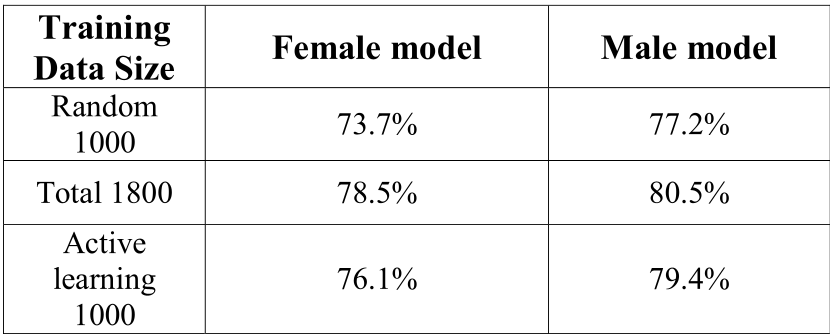
The Active Learning approach with only 1000 samples nearly matches the performance of the full 1800-sample dataset, representing a nearly 45% reduction in labeling requirements.
Critical Analysis & Conclusion
Why it works
The synergy between CRFs and the density-based query strategy is the key. CRFs provide a nuanced probabilistic output that makes the "Uncertainty" calculation much more reliable than simple hard-margin classifiers like early SVMs.
Limitations
- Speaker Dependency: The study treats male and female corpora separately; future work needs to address speaker-independent scenarios.
- Feature Complexity: While MFCCs and F0 are standard, modern deep learning features (like embeddings) might offer even greater gains in an active learning framework.
Future Outlook
This paper lays the groundwork for "Smart Data Labeling" in speech. As we move toward massive multimodal models, the ability to selectively annotate data will be the difference between a project being commercially viable or too expensive to pursue.