
ASA: Bridging Cognitive Gaps with Active Situation Awareness on Social Networks
Active situation awareness framework for social network services
The paper introduces the Active Situation Awareness (ASA) framework, a multi-layered system designed to simulate human cognition by processing Social Network Service (SNS) data. It integrates perception via TF-IDF mining, comprehension through ontology and rule-based reasoning, and projection using automated inference to provide proactive user suggestions.
TL;DR
The research team from the University of Aizu presents a novel framework for Active Situation Awareness (ASA). Unlike traditional passive systems, ASA doesn't just wait for data; it actively mines Social Network Services (SNS) using a combination of TF-IDF mining and ontology-based reasoning to project future events and provide real-time suggestions to users.
Background: The Limits of Passive Awareness
In the realm of Awareness Computing, the standard model (derived from the JDL data fusion levels) consists of three pillars: Perception, Comprehension, and Projection. However, most current implementations are "passive"—they react only when specific data points change. This creates a bottleneck in dynamic environments like social media, where user intent and environmental contexts shift rapidly. The authors argue that a truly "human-like" system must be active, meaning it proactively requests and analyzes info to anticipate needs.
Methodology: The Three-Layered Intelligence
The ASA framework is built on a unified architectural pyramid that ensures "seamless computation" across levels.
1. Perception Layer (Data Mining)
Instead of just scraping text, the system uses a TF-IDF (Term Frequency-Inverse Document Frequency) algorithm to calculate the weight of words in SNS posts. This allows the system to categorize content and, more importantly, detect a change in topic (e.g., a student shifting from "food" to "research").
2. Comprehension Layer (Ontology & Rules)
The raw data perceived is transformed into "Facts." These facts are mapped onto a dedicated Situation Awareness Ontology. By using predefined rules (similar to SWRL), the system infers the meaning behind the data.
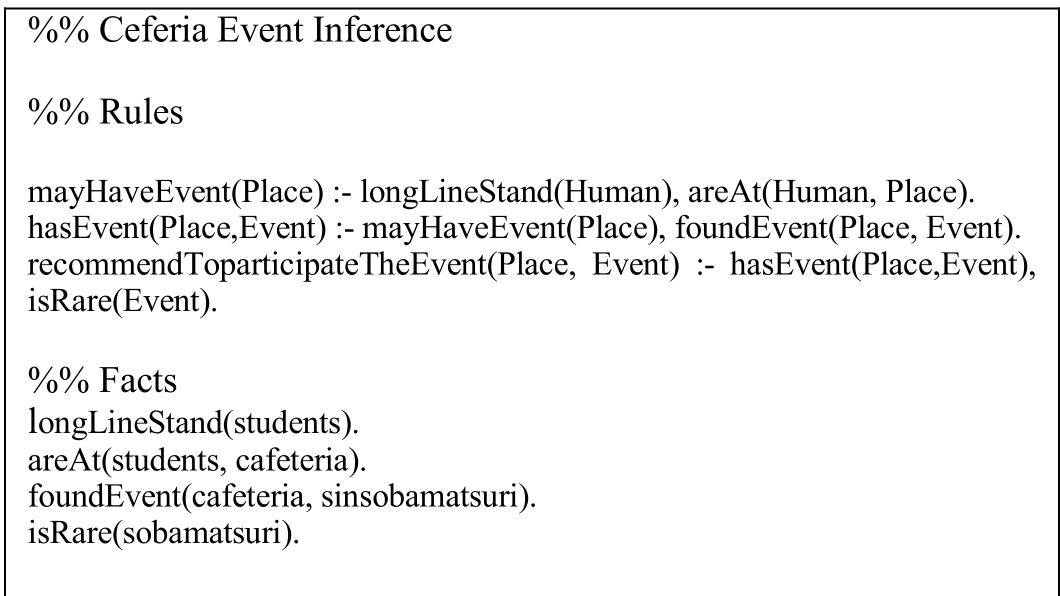 Figure: The ASA Architecture integrating perception, comprehension, and projection.
3. Projection Layer (Inference)
This is the "Active" part of ASA. Based on the comprehended situation, the system generates a Projection—a suggestion or a notification about a future state. For example, if the system perceives a "long line" post near a cafeteria and comprehends an "Event" fact, it projects a suggestion to the user's smartphone.
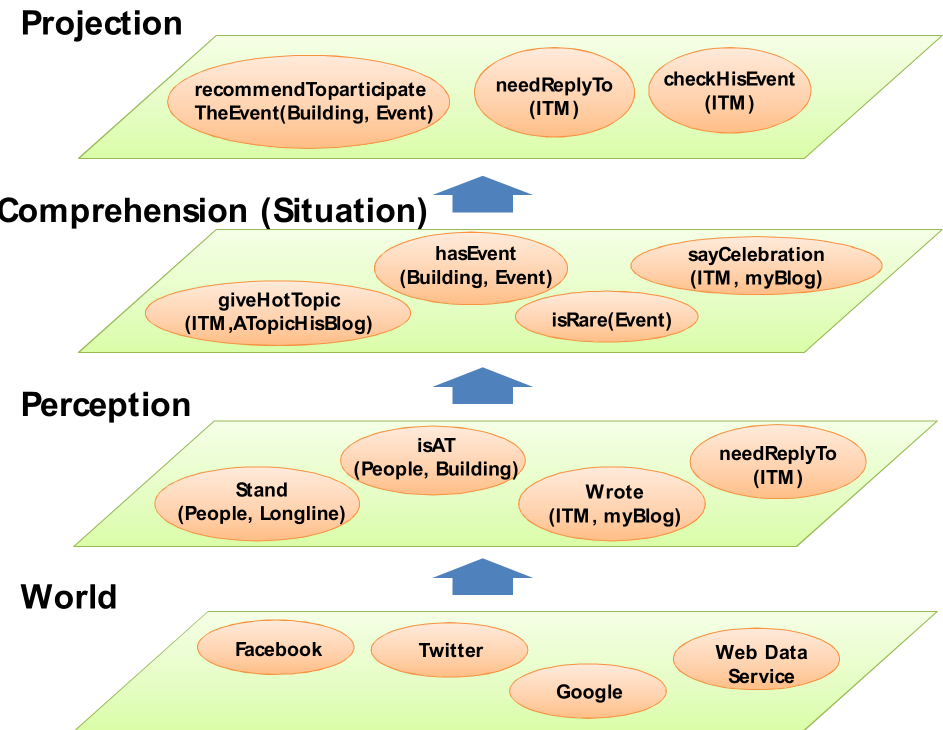 Figure: The unified ontology used to streamline the flow between layers.
Real-World Scenarios
The paper validates the framework through two key scenarios:
- The Cafeteria Scenario: A user is notified about a "Soba Festival" based on real-time SNS mining, preventing them from missing out due to long lines.
- The Meeting Scenario: A Smart Mobile Device (SMD) provides a summary of a visitor's recent interests (e.g., part-time jobs, topic shifts) by analyzing their Facebook activity right before a meeting starts.
Experiments & Core Insights
The system utilizes a RESTful service architecture to handle the heterogeneity of SNS platforms. Whether the data comes from Facebook or Twitter, the REST interface normalizes the sentences into standard facts for the inference engine.
One of the core mathematical contributions is the Category_calculate function, which uses data mining to determine the most common category of user documents, allowing the system to determine if a user’s "state of mind" has significantly changed compared to previous periods.
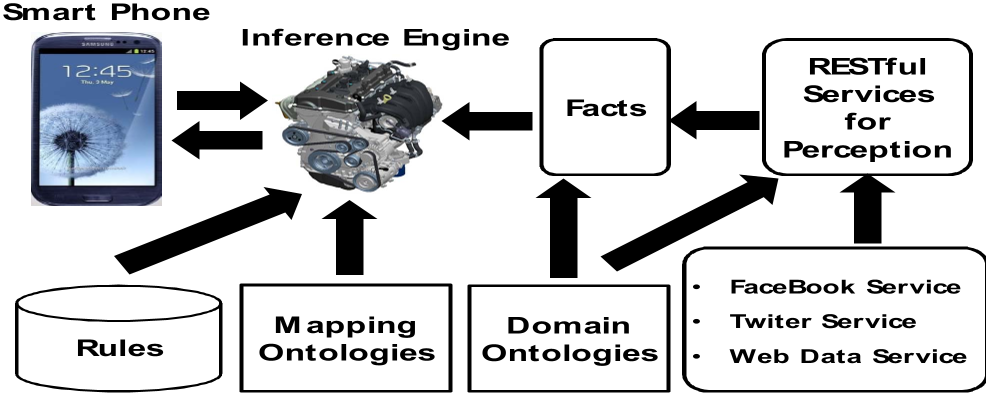 Figure: A sample projection output as seen on a mobile device.
Critical Analysis & Conclusion
Takeaway
The ASA framework successfully moves beyond simple "keyword matching" by introducing a semantic layer between raw data and user action. By using a unified ontology, it solves the "vocabulary gap" that often plagues multi-source data fusion.
Limitations & Future Work
While the rule-based inference is robust, it requires manual definition of domain ontologies and rules. Future iterations could benefit from automated rule generation using deep learning to handle the sheer variety of "arbitrary contexts" found on the modern web. Additionally, the privacy implications of "active mining" of user Social Network data remain a critical area for further investigation.
Overall, this work provides a solid blueprint for the next generation of proactive digital assistants.