
Actively Learning to Infer Social Ties: Coloring the Black-and-White Social Web
Actively learning to infer social ties
The paper introduces a general framework for inferring the semantic labels of social ties (e.g., advisor-advisee, manager-subordinate) in large-scale social networks. It proposes the Partially-Labeled Pairwise Factor Graph Model (PLP-FGM) and integrates two active learning strategies—Influence-Maximization and Belief-Maximization—to achieve high accuracy with minimal user feedback.
TL;DR
While online social networks like LinkedIn or Facebook track who is connected, they rarely capture how individuals are connected (e.g., "Is this my boss or my friend?"). This paper presents a robust semi-supervised framework called PLP-FGM to automatically infer these "colorful" relationships. By leveraging Active Learning, the system can ask users a few critical questions to dramatically improve its predictions across the entire network.
Background: The Semantic Gap in Social Networks
In physical social networks, relationships are rich with context. Online, however, we are usually just "friends" or "connections." Understanding the underlying semantics of these ties is crucial for recommendation systems, viral marketing, and community detection. The challenge lies in the scale of the data and the scarcity of labeled examples—users rarely take the time to categorize their contacts.
Methodology: The PLP-FGM Framework
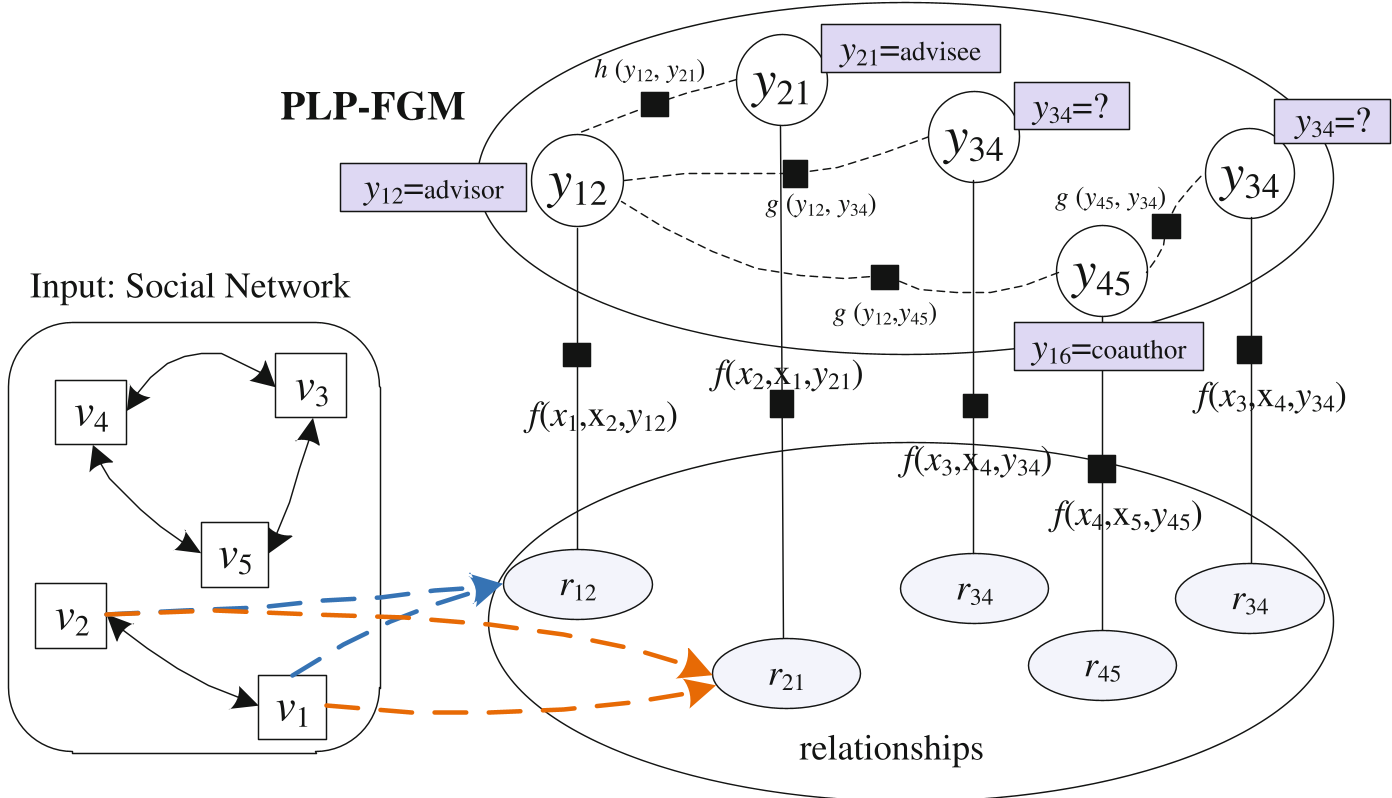
The researchers move away from traditional node-centric models. Instead, they treat each relationship as a node in a Factor Graph. This allows the model to capture three distinct types of information:
- Attribute Factors: Based on local data (e.g., number of emails sent, co-authorship counts).
- Correlation Factors: Capturing structural patterns (e.g., "If and both report to , they are likely colleagues").
- Constraint Factors: Enforcing logical rules (e.g., one student usually has a limited number of primary advisors).
Why Active Learning?
Even the best models make mistakes. The authors propose an interactive loop where the system selects the most "informative" relationships for the user to verify. They developed:
- IMS (Influence-Maximization Selection): Based on the idea that correcting a "central" node in the social graph will automatically fix its neighbors through influence propagation.
- BMS (Belief-Maximization Selection): A submodular optimization approach that selects nodes which, when labeled, maximize the overall confidence (belief) across the remaining unlabeled network.
Experiments & Key Insights
The model was tested on three diverse datasets: Publication (ArnetMiner), Email (Enron), and Mobile (MIT Reality Commons).
- Unlabeled Data is Key: Using unlabeled data improved accuracy by 2.2% to 11.8%, proving that the structural context of the whole network helps even if you don't have many labels.
- Correlations Matter: In the Email dataset, accounting for "co-recipient" and "co-manager" patterns added a 7.6% boost in performance.
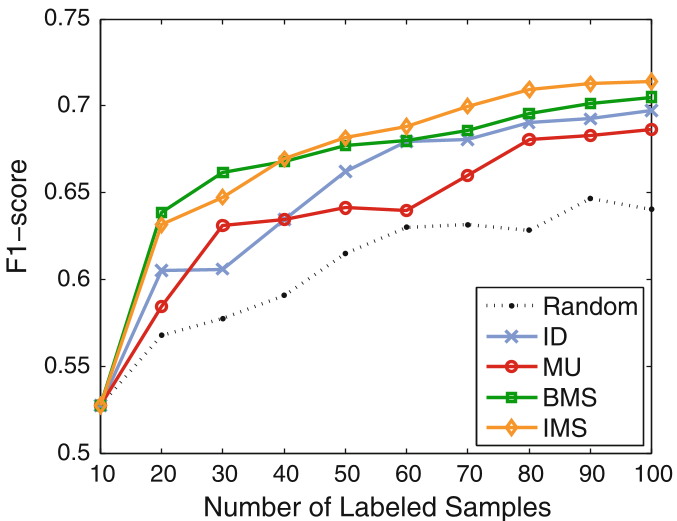
- Active Learning Efficiency: As shown in the learning curves below, the proposed active strategies (BMS/IMS) reach high performance much faster than random selection.
Scalability through Distributed Learning
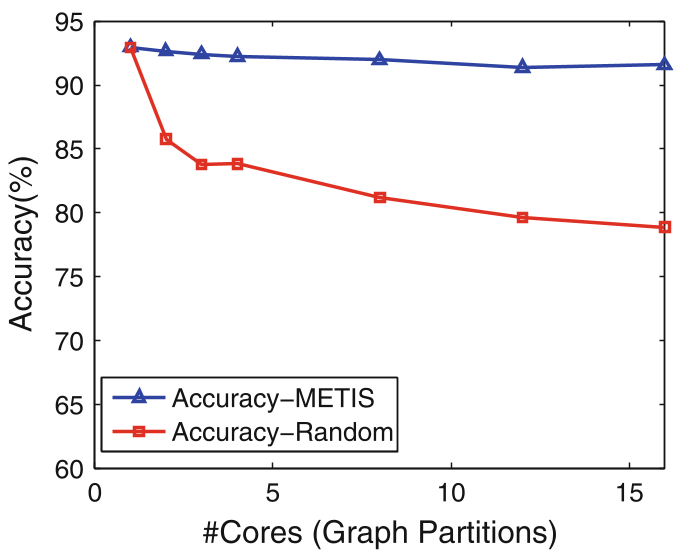
To handle real-world graphs, the authors implemented a distributed version of the Loopy Belief Propagation (LBP) algorithm using MPI. By partitioning the graph with METIS and discarding minimal cross-subgraph factors, they achieved an 8x speedup on 12 cores with negligible loss in accuracy.
Conclusion & Future Directions
The PLP-FGM model provides a solid mathematical foundation for turning "black-and-white" links into a "colorful" social landscape. The real breakthrough is the marriage of Factor Graphs with Active Learning, acknowledging that while AI can do the heavy lifting, a few well-placed human "corrections" go a long way.
Future Work: The authors suggest extending this to dynamic networks (where social ties shift over time) and exploring unsupervised equivalents to reduce the initial labeling requirement even further.