
The SPHERE ADL Ontology: Bridging the Semantic Gap in Ubiquitous eHealth
Activities of Daily Living Ontology for Ubiquitous Systems
The paper introduces the SPHERE ADL Ontology, a hierarchical framework designed to standardize the labeling and recognition of Activities of Daily Living in ubiquitous eHealth systems. Developed through the SPHERE project, it integrates existing taxonomies like BoxLab and the Compendium of Physical Activities to provide a unified "ground truth" for activity recognition (AR) algorithms.
TL;DR
The SPHERE ADL (Activities of Daily Living) ontology offers a robust, hierarchical framework to categorize and label human behavior within smart environments. By aligning sensor data with standardized clinical concepts, it addresses the "ground truth" quality problem that plagues Activity Recognition (AR) algorithms, facilitating data reuse and cross-disciplinary research in Ambient Assisted Living (AAL).
Background: Why We Need a Shared Language for Daily Living
As the global population ages, ubiquitous systems—sensor-filled environments that monitor health—have moved from the vision of Mark Weiser (1991) into reality. However, a major bottleneck remains: semantic ambiguity. If one researcher labels "sweeping" as "home management" and another as "light exercise," the data becomes siloed and difficult to compare.
The SPHERE project researchers identified that for machine learning to be useful in clinical settings, we need more than just raw data; we need a machine-understandable structure that captures not just what is happening, but where, how, and with whom.
Methodology: Building the Hierarchy
The researchers developed the SPHERE ADL ontology by merging clinical requirements with existing technical taxonomies (BoxLab and CPA).
1. The Core Architecture
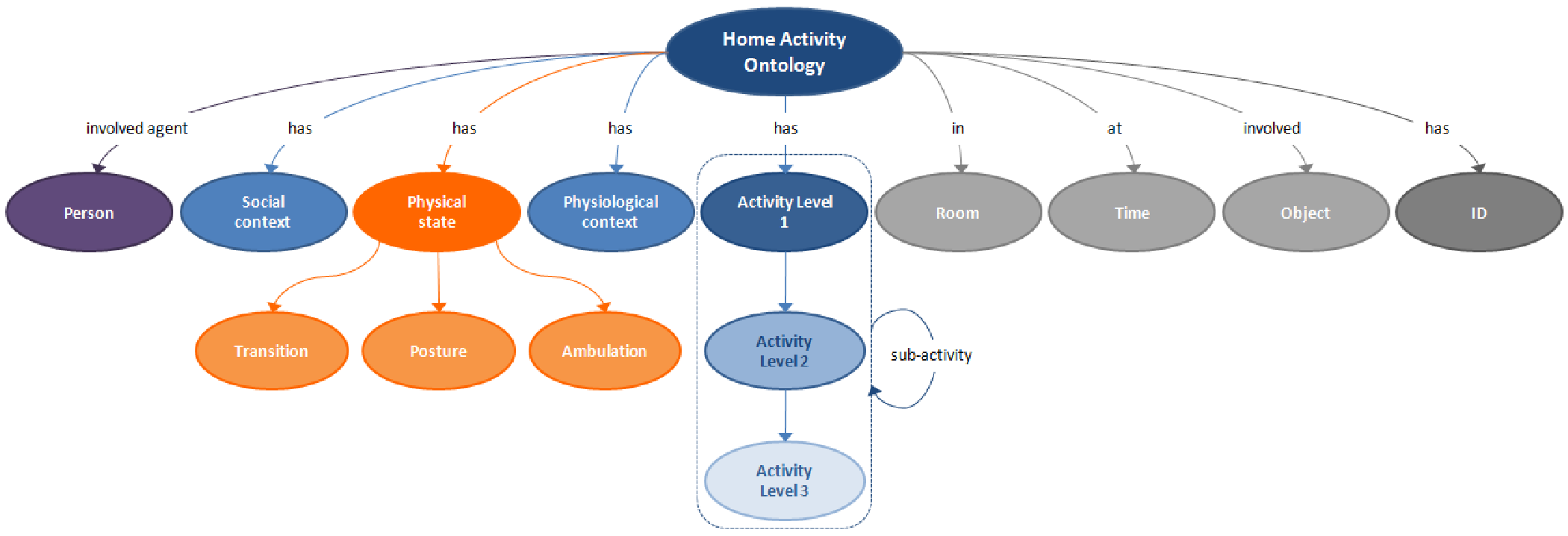
The ontology moves beyond flat lists of activities. It treats an ACTIVITY as a complex entity with multiple dimensions:
- Physical State: Subdivided into Ambulation, Posture, and Transitions (e.g., sit-to-stand).
- Contextual Information: Including Room/Location, Social Context (is the subject alone?), and Physiological Context (glucose levels, heart rate).
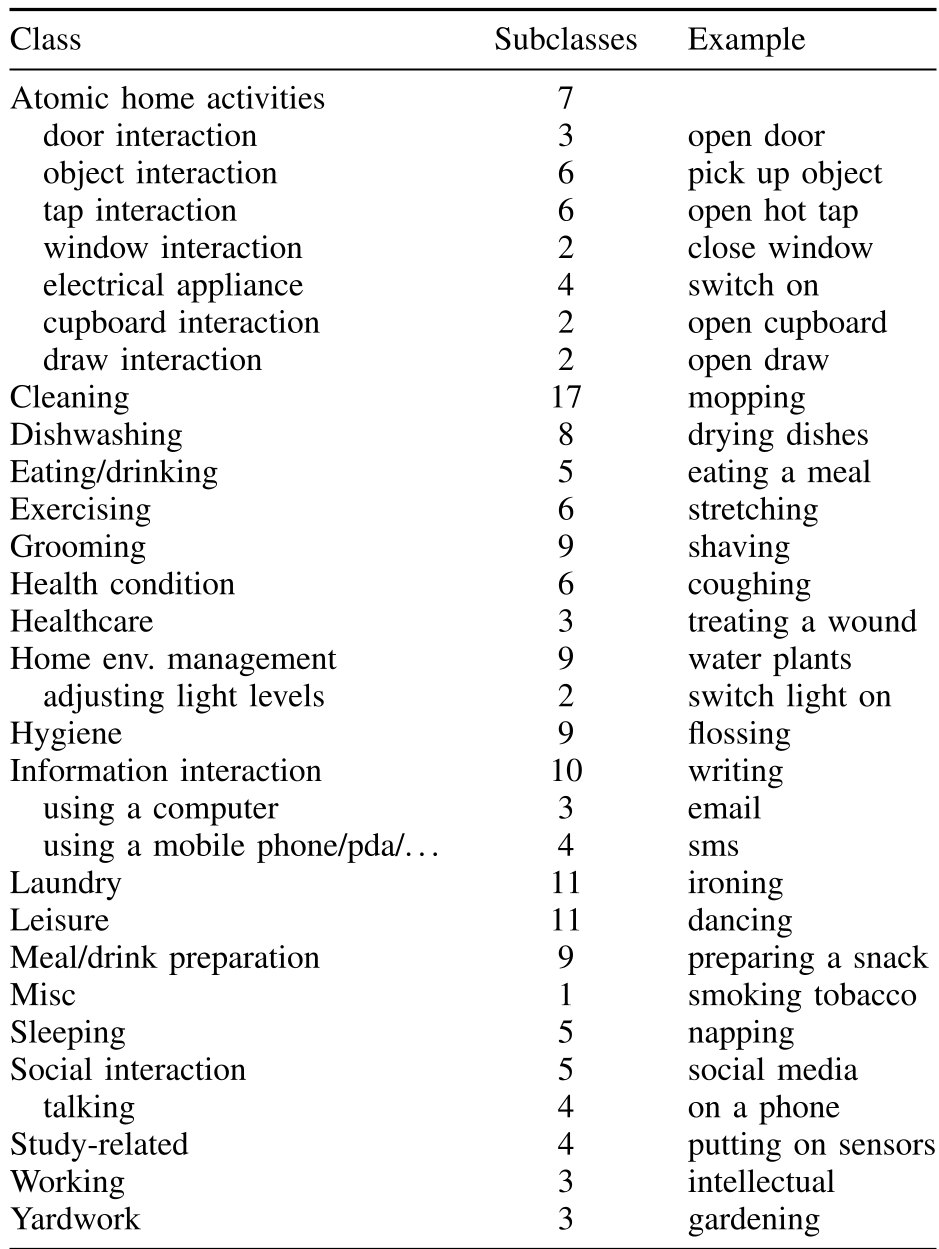
- Atomic Home Activities: This is a critical addition. It focuses on low-level interactions like "opening a cupboard" or "tapping an electrical appliance," providing the "building blocks" for more complex activity recognition.
2. Clinical and Health Integration
Unlike purely technical models, SPHERE includes a Health Condition class. This captures symptoms like coughing, falls, or tremors, allowing systems to predict early warning signs of illness by correlating these symptoms with daily activity levels.
Real-World Use Cases: Putting Theory to the Test
The paper validates the ontology through two distinct "Ground Truth" acquisition methods:
Case A: Expert Video Annotation
Using tools like ELAN, experts annotated video footage of scripted experiments. The ontology's tiered structure allowed researchers to label data at different granularities—from high-level tasks to atomic movements—enabling high-quality validation of AR algorithms.
Case B: Unscripted Self-Annotation
Study participants in a "smart home" used an Android app to log their own activities via voice or NFC tags. The ontology proved intuitive enough for non-experts to use without significant training, proving that the underlying complexity of the semantic graph can be effectively hidden behind a user-friendly UI.
Technical Insights for Machine Learning
For AI practitioners, the value of this ontology lies in Data Post-processing. Because the data is structured as a graph:
- Filtering: To train a location classifier, one can simply strip away all labels except the
Room/Locationbranch. - Feature Engineering: To explore physical motion, one can focus exclusively on the
Physical Statehierarchy.
This "filterability" significantly reduces the manual labor involved in preparing datasets for supervised learning.
Deep Insight & Conclusion
The SPHERE ADL ontology is a significant step toward "Future-Proof" healthcare research. While it currently faces some limitations—such as the lack of automated reasoning support in the OBO format compared to OWL (Web Ontology Language)—its practicality and clinical alignment make it a powerful tool.
The Takeaway: For developers building AI for the home, the lesson is clear: don't just collect data—anchor that data in a standardized ontology. Doing so ensures that your "smart" system can communicate its findings not just to other machines, but to the clinicians responsible for patient care.
Future Work
The team is now working on mapping "natural speech" (free utterances) directly into the ontology terms, bridging the gap between how humans describe their day and how machines categorize it.