
SSLP: Refining Activity Location Inference through Social Topology and Sequential Propagation
Activity location inference of users based on social relationship
The paper introduces Sequential Spatial Label Propagation (SSLP), a network-based method for inferring the top activity locations of social media users. By leveraging implicit social relationships and a specific inference sequence, the model achieves state-of-the-art accuracy in Location-based Social Networks (LBSNs) like Brightkite and Gowalla.
TL;DR
Inferring where a user "actually" spends most of their time is a cornerstone of Location-Based Social Networks (LBSN), yet privacy concerns often leave this data hidden. This paper presents SSLP (Sequential Spatial Label Propagation), a robust framework that predicts top activity locations by filtering noisy social ties and employing a strategic sequence for label propagation. It outperforms existing baselines in accuracy while reducing computational overhead.
The Core Challenge: Noise and Sparsity
The fundamental intuition in spatial social analysis is that "friends live nearby." However, in the digital age, this Inductive Bias is frequently challenged by:
- Celebrity Ties: Following someone across the globe introduces spatial noise.
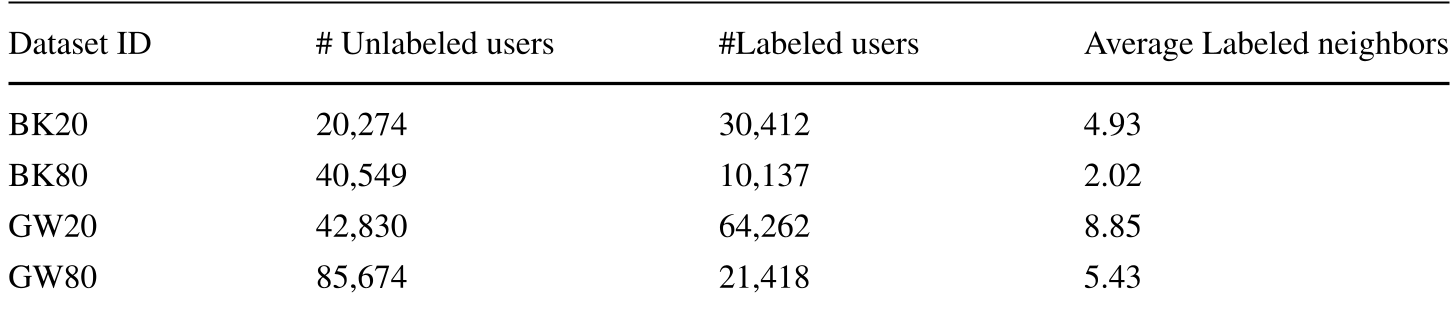
- Data Sparsity: If 80% of your network is "dark" (no location data), standard propagation becomes unstable.
- Error Cascades: In iterative models like SLP, one poorly guessed location can "poison" the entire neighborhood.
Methodology: The SSLP Architecture
The authors propose a three-pronged approach to clean the social graph before and during propagation.
1. Neighbor Validation & Social Closeness
Not all friends are created equal. SSLP filters neighbors based on two heuristics:
- Distance Likelihood: Using the Backstrom formula, it masks a labeled user's location and tries to predict it via their friends. If the error is >160KM, that user is deemed an "unreliable" reference.
- Social Closeness (): It calculates the Jaccard-like similarity of shared neighbors. Only friends above a threshold are used for inference.
2. The Power of Priority: Sequential Inference
Instead of updating all nodes simultaneously, SSLP utilizes a Priority Queue. Users are ranked based on:
- Closeness to Mean (): Prioritizing those whose neighbors are already tightly clustered.
- Label Density: Trusting users with more "ground truth" neighbors first.

Experiments: Performance in the Wild
The researchers tested SSLP on Brightkite and Gowalla datasets across different sparsity levels (20% vs 80% unlabeled users).
Key Findings:
- Accuracy Boost: In the sparse "BK80" setting, SSLP achieved nearly 60% accuracy within a 160KM radius, outperforming traditional SLP by nearly 10%.
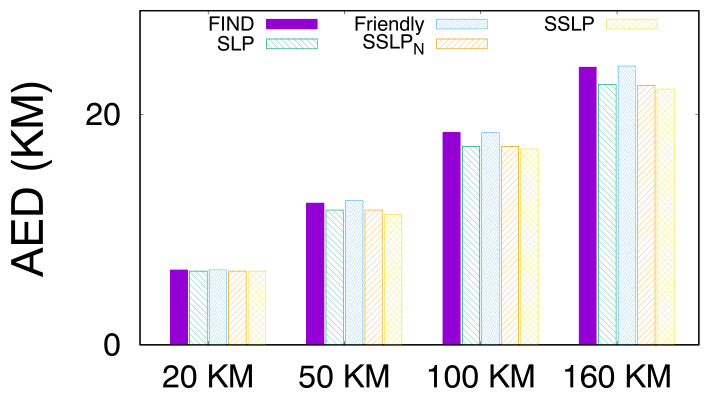
- Error Reduction: The Average Error Distance (AED) was consistently lower across all distance thresholds compared to FIND, SLP, and Friendly models.
Efficiency:
By ignoring lower-closeness neighbors, SSLP significantly reduced the computation time. In the Gowalla (GW80) test, SSLP proved much faster than the iterative SLP, which lacks a prioritized pruning mechanism.
Critical Insight: Why it Works
The brilliance of SSLP lies in its Inference Sequence. By solving the "easy" cases first (users with many nearby labeled friends), the model creates high-confidence "anchor points" that then stabilize the prediction for more difficult, sparse nodes. This prevents the "vicious cycle" of error propagation that plagues vanilla label propagation.
Conclusion & Future Outlook
SSLP proves that even with 80% of location data missing, social topology can reconstruct the spatial map of a network with surprising precision. However, a limitation remains: the model relies heavily on the presence of some geographical community. In purely virtual communities, network-based inference may still require hybrid approaches (combining NLP on user posts).
For developers of apps like Meetup or Groupon, this research provides a roadmap for "Smart Targeting"—finding where your users will be using the spatial context of who they know.