
Activity Profiles: Decoding User Identity Through Temporal Fingerprints
Activity profiles in online social media
The paper introduces the concept of "Activity Profiles" to classify online social media users based on their 24-hour temporal communication patterns. Using a clustering approach on the Boards.ie dataset, the authors demonstrate that these language-independent profiles effectively group users with similar behaviors and significantly improve the identification of multiple aliases.
TL;DR
This research introduces a method to classify social media users by their "Activity Profiles"—stable 24-hour patterns of when they are most and least active. By clustering users into chronotypes (morning vs. evening types), the authors achieve a 95% consistency rate in user behavior and significantly boost the accuracy of detecting multiple aliases, all while reducing the computational overhead of traditional stylometrics.
Background: Beyond the Words We Type
Most social media analysis focuses on what we say (Natural Language Processing) or who we know (Social Network Analysis). However, this paper argues that when we post is just as revealing. Drawing from biological research on human chronotypes, the authors suggest that individuals have stable "peak" activity times that act as a behavioral fingerprint.
The Problem with Traditional Alias Detection
Detecting if two accounts (aliases) belong to the same person is traditionally done via Stylometry—analyzing writing style, punctuation, and vocabulary. While effective, it has three fatal flaws:
- Complexity: It is computationally expensive to compare every user against every other user.
- Language Dependence: Most models are tuned to a specific language.
- Data Requirements: It often requires massive amounts of text to be accurate.
Methodology: The 24-Hour Behavioral Lens
The authors propose a "Activity Profile" framework that is remarkably simple yet effective. They split the day into six 4-hour intervals and identify:
- Primary Peaks: The timeframe where a user is most active.
- Secondary Peaks: The next most active timeframe.
- Inactivity Periods: Time intervals where the user is likely sleeping or working.
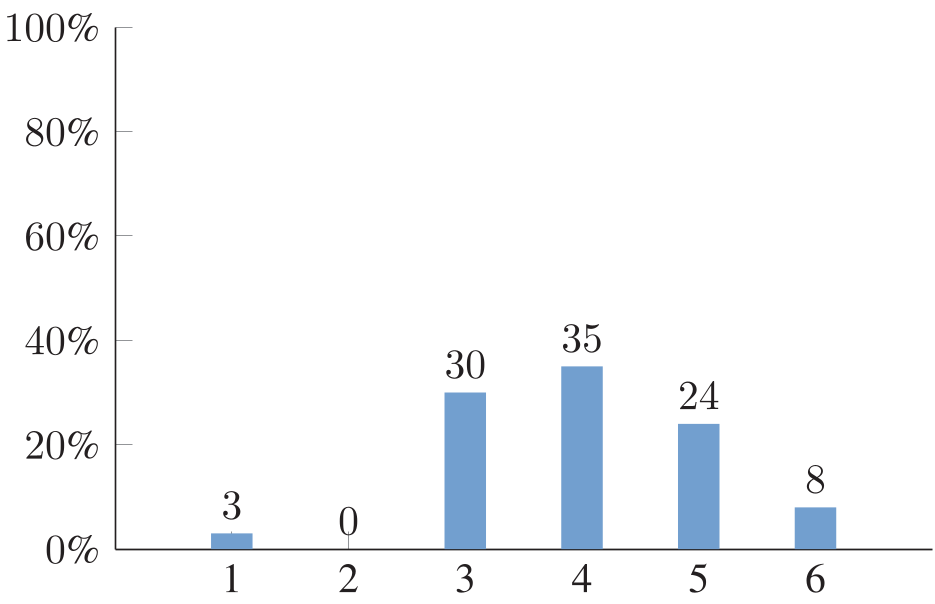 Fig 1: A specific user's post distribution across 4-hour intervals.
The Clustering Pipeline
To make this scalable, the researchers used a hierarchical grouping:
- Users are first grouped by their Primary Peak.
- These groups are subdivided by their Inactivity Period.
- Finally, they are partitioned by their Secondary Peak.
This results in 150 unique behavioral bins, allowing researchers to ignore 99% of non-matching candidates instantly.
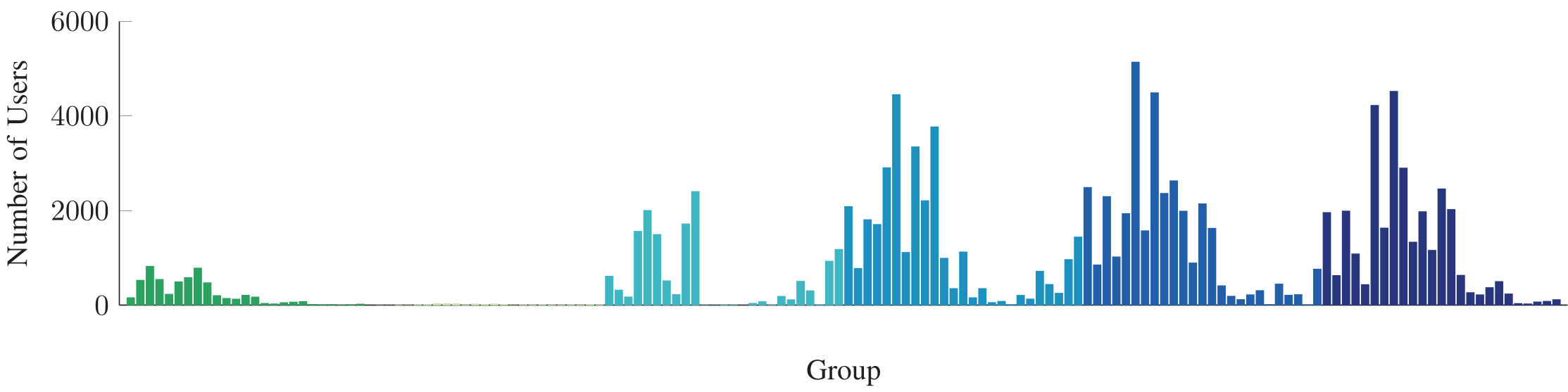 Fig 2: Heatmap showing how 11,000 users are distributed across the 150 activity groups.
Experimental Results: Stability and Precision
To prove the method's robustness, the authors performed a "Split-User" test. They took a single user's posts, split them into two sets (even vs. odd posts), and checked if both "halves" were assigned to the same activity group.
- 99% accuracy for Primary Activity Groups.
- 95% overall accuracy after applying all three filters.
When applied to the problem of Multiple Alias Identification, combining Activity Profiles with Stylometry outperformed pure stylometry across the board. For a dataset of 1,000 users, the Top-1 accuracy jumped from 76% to 82%.
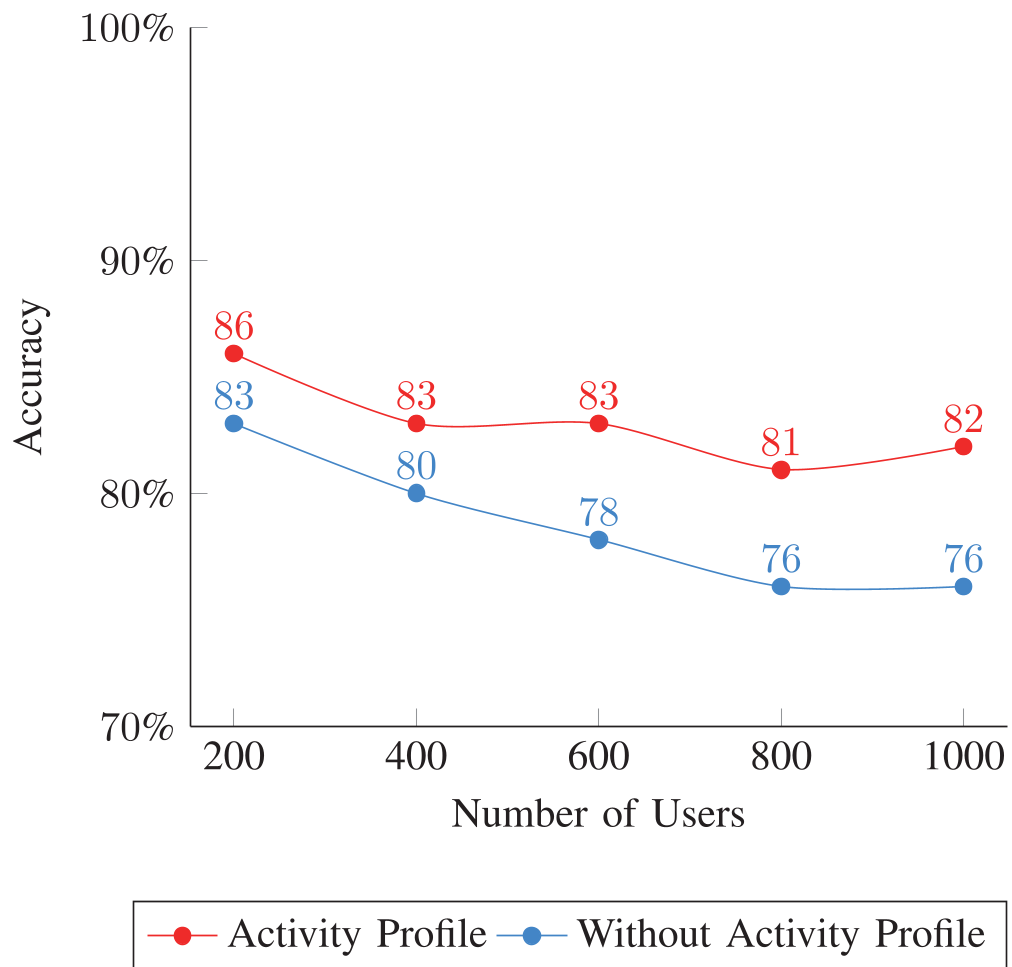 Fig 3: Performance gain in alias detection when using Activity Profiles.
Critical Insight: The Privacy Paradox
While the authors frame this as a tool for Security (detecting extremists) and Marketing (knowing when to send notifications), the findings are a double-edged sword. This research proves that even if you change your name, your location, and your language, the mere "rhythm" of your digital presence can act as a beacon.
Limitations and Future Work
The study primarily looked at a single forum (Boards.ie). A core question remains: do users maintain the same rhythm across different platforms (e.g., LinkedIn for work vs. Reddit for fun)? The authors intend to explore dynamic clustering like K-Means and cross-platform correlation in future studies.
Conclusion
This work demonstrates that temporal metadata is not just "noise" but a high-value feature. By grouping users into activity-based clusters, we can make social media analysis more scalable, more precise, and—crucially—independent of the language being spoken.