
Meeting Challenges of Activity Recognition for the Ageing Population in Real-Life Settings
Meeting challenges of activity recognition for ageing population in real life settings
The paper presents a robust Activity Daily Living (ADL) recognition scheme specifically designed for the ageing population using a single chest-worn accelerometer. By utilizing a Support Vector Machine (SVM) classifier and a novel heuristic selection between orientation-sensitive and rotation-invariant models, the system achieves 81.7% accuracy in real-life, uncontrolled environments.
TL;DR
Recognizing activities (sitting, walking, laying) in the elderly is notoriously difficult outside the lab. This research introduces an adaptive SVM-based framework that uses a single accelerometer to monitor frail populations in their own homes. The core innovation lies in its ability to automatically detect sensor misplacement and switch to a rotation-invariant mathematical model, maintaining accuracy even when the wearable vest is put on incorrectly.
Background: Beyond the Laboratory
While high-tech smartwatches and AI models often boast 95%+ accuracy in activity recognition, these numbers are frequently "inflated" by testing on young, healthy students in controlled environments. For the elderly—especially those suffering from frailty syndrome—movement patterns are slower, more inconsistent, and the hardware (wearable vests) is often subjected to real-world "noise" like improper orientation or variations in sensor hardware.
The Core Challenge: The "Misplacement" Problem
The authors pinpoint three primary obstacles:
- Axes Rotation: If a sensor is tilted 90 degrees, "Up" becomes "Forward," breaking standard algorithms.
- Hardware Heterogeneity: Different clinical centers use different sensor versions with varying scales.
- Physical Variability: Frail individuals may have "transition states" (e.g., getting up from a chair) that look very different from a healthy adult's movement.
Methodology: The Dual-Model Heuristic
The researchers developed a sophisticated pipeline to combat these "Inconsistent Measurements." Instead of one rigid model, they built two:
- Orientation-Sensitive Model: Uses 10 high-ranked features (Relief-F algorithm) for maximum precision when the sensor is worn correctly.
- Rotation-Invariant Model: Uses 40 features derived from the mean of tri-axial signals, making it immune to sensor tilting, albeit at a slight cost to specific activity sensitivity.
How the Model Chooses:
The system uses a two-step heuristic logic to decide which "brain" to use:
- Step 1: It checks if the gravity vector (normally on the X-axis) is where it expects it to be using an 80th-percentile range check.
- Step 2: If Step 1 is ambiguous, it calculates a 3-D Kolmogorov-Smirnov distance between the current data distribution and the known "correct" training distribution. If the distance is too high, it assumes the sensor is rotated and switches to the invariant model.
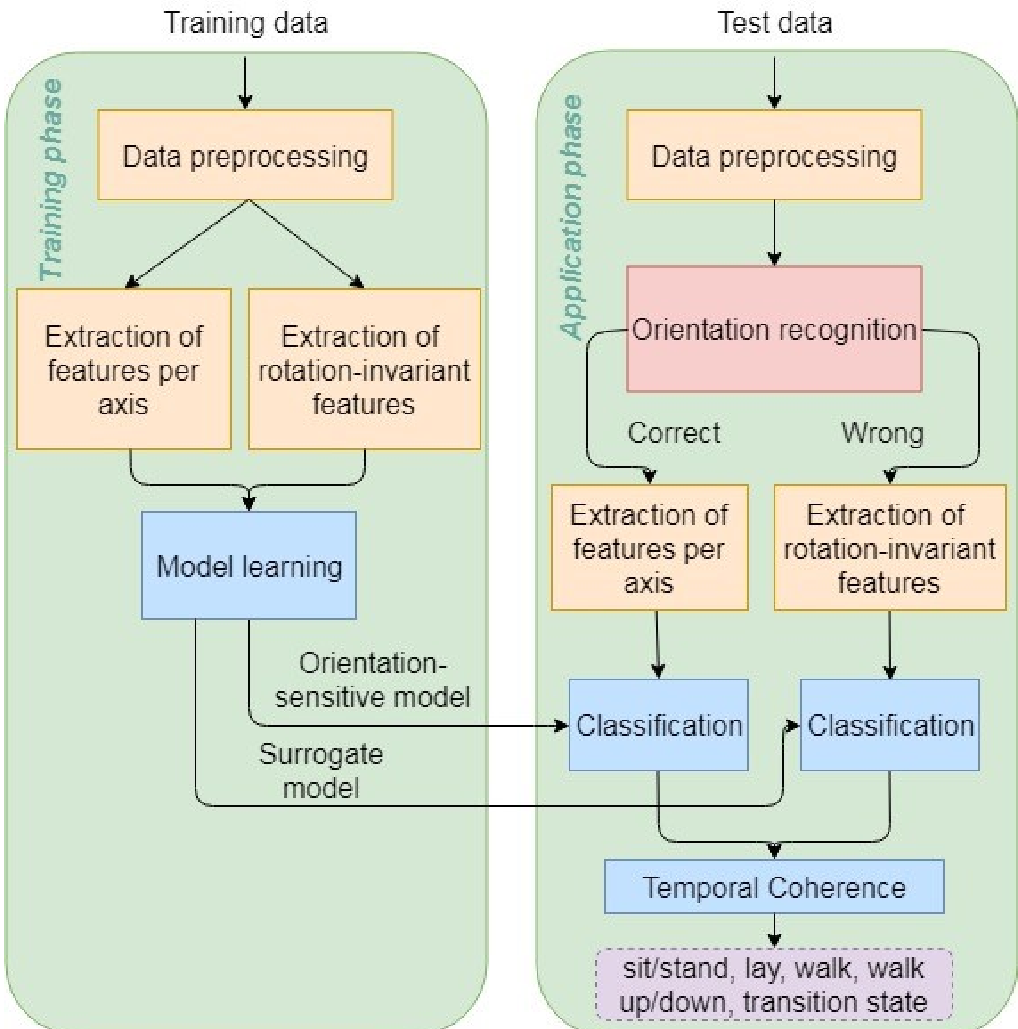 The schematic representation of the complete classification workflow, featuring the heuristic model selection.
Experiments and Results
The study involved 20 subjects aged 70-92, split between non-frail and pre-frail.
- Standard Accuracy: 81.7% on independent test sets (unobtrusive, real-home data).
- The "Rotated" Rescue: When sensors were intentionally rotated, the standard model's accuracy plummeted to ~19%. However, the Surrogate Model restored this to over 60%, a massive 40%+ gain in robustness.
- Baseline Correction: By aligning the "baseline" of different devices, they improved cross-device accuracy from 37.5% to 61.7%.
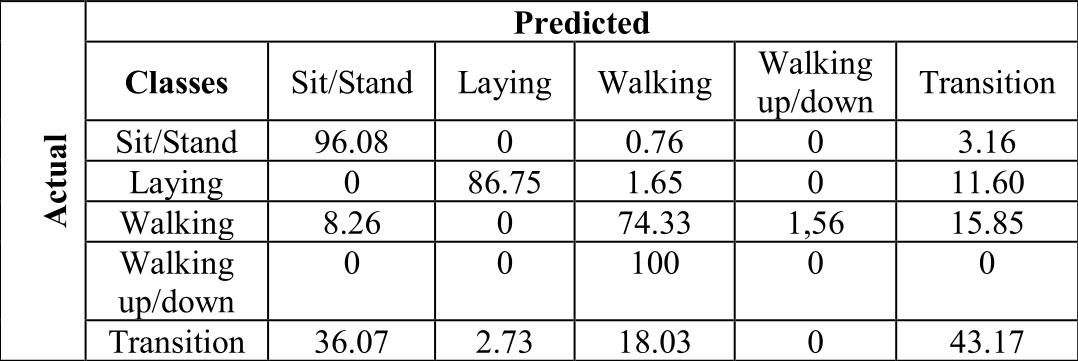 Table showing that "Sit/Stand" is the most accurately recognized class, while "Transitions" remain the most difficult to isolate.
Critical Insight: Real-World Resilience
The "Academic SOTA" (State-of-the-Art) is often fragile. This paper demonstrates that Inductive Bias — specifically, the assumption that we know which way is "Down" (gravity) — is a double-edged sword. By introducing a rotation-invariant fallback, the authors sacrifice a small amount of peak accuracy for a massive increase in system reliability.
Limitations and Future Work
- Sample Size: While 20 subjects is solid for a geriatric study, larger cohorts are needed to capture the full spectrum of frailty.
- Transitions: The model still struggles with "Transition States" (intermixed with other classes), which are critical for predicting falls.
- Future Potential: Integrating the gyroscope and magnetometer recordings (which were excluded here for computational efficiency) could further refine the recognition of upstairs/downstairs walking.
Conclusion
This work is a vital step toward making "Ambient Assisted Living" a reality. It moves the conversation from "How accurate is our AI?" to "How resilient is our AI when the user wears it upside down?" For the future of geriatric health-tech, resilience is the more valuable metric.