
AdaJEPA: Why World Models Must Adapt While They Act
AdaJEPA: An Adaptive Latent World Model
AdaJEPA is an adaptive latent world model framework that integrates Test-Time Adaptation (TTA) into the closed loop of Model Predictive Control (MPC). By utilizing observed state transitions as self-supervised signals during deployment, it achieves state-of-the-art planning success in goal-reaching tasks under significant distribution shifts.
TL;DR
Static world models fail when the world changes. AdaJEPA introduces a closed-loop system where the latent world model updates its own parameters after every single action. By turning the "Plan-Execute-Replan" cycle into a "Plan-Execute-Adapt-Replan" cycle, it achieves radical robustness to unseen physics and visual noise with just one gradient step of overhead.
The "Frozen Model" Dilemma
In the quest for autonomous intelligence, Latent World Models (like JEPA) are the "brains" that allow robots to imagine the future. However, most contemporary models suffer from a fundamental flaw: they stop learning once they are deployed.
When a robot trained in a bright lab is moved to a dimly lit factory, or tasked with pushing an object with a different friction coefficient, its "internal imagination" drifts. These small prediction errors compound quickly, leading the MPC (Model Predictive Control) to optimize for a fantasy world, ultimately resulting in task failure.
Adaptation as the Missing Link
AdaJEPA, developed by researchers at NYU and AMI Labs (including Yann LeCun), argues that a world model should be a plastic, living entity. The core insight is that every time an agent acts, the environment provides a "ground truth" transition for free.
The Methodology: Plan-Execute-Adapt-Replan
Instead of ignoring the prediction error, AdaJEPA uses it as a self-supervised training signal.
- Plan: Use the current world model to find the best action sequence to reach a goal.
- Execute: Perform the first action in the real world.
- Adapt: Take the observed transition and run a single gradient descent step to update the model.
- Replan: Use the newly calibrated model to plan the next move.
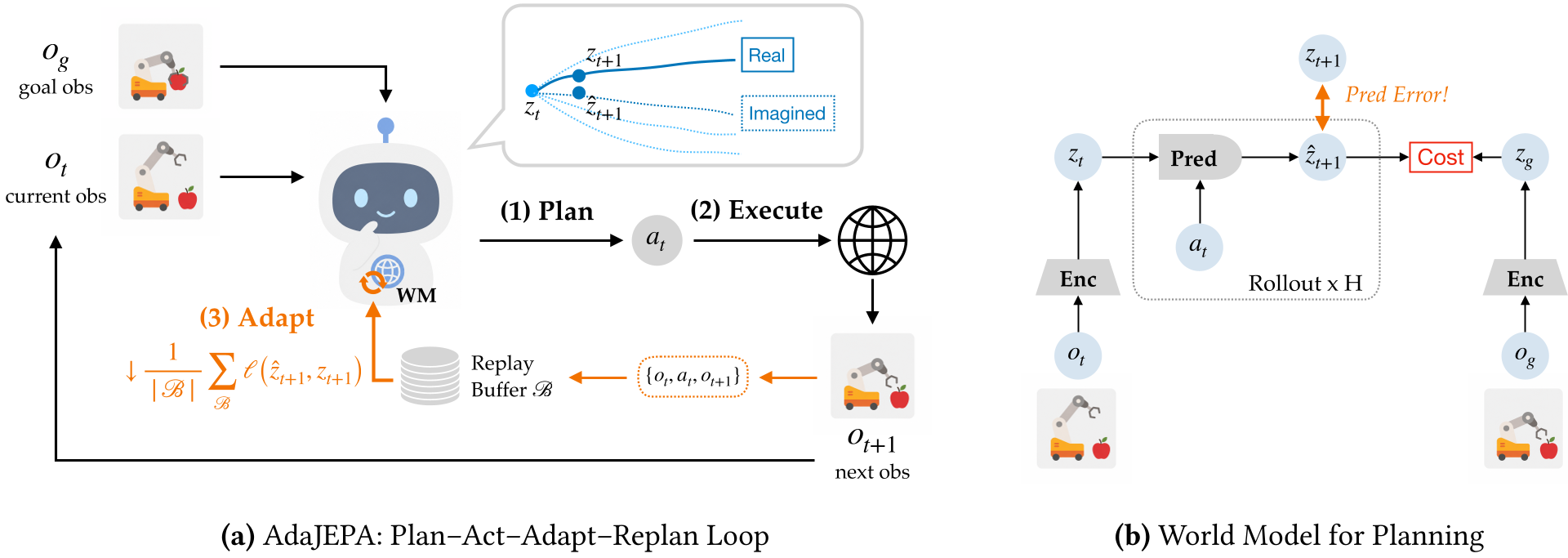
This mechanism is incredibly lightweight. The researchers found that updating only the final layers of the visual encoder and the predictor is sufficient for the model to "re-align" itself with the new environment dynamics or visual corruptions.
Experimental Proof: Better than Scaling
The paper puts AdaJEPA through a gauntlet of "Distribution Shifts":
- Shape Shifts: Training on T-shapes, testing on squares.
- Visual Shifts: Testing with Salt-and-Pepper noise or changing the robot's color.
- Dynamics Shifts: Changing mass or damping in a PointMaze environment.
Key Result: The Efficiency of Learning
One of the most striking findings is the sample efficiency. An adaptive model trained on a tiny dataset (1,000 trajectories) can actually outperform a frozen model trained on 16,000 trajectories. This suggests that the ability to adapt at test-time is a powerful substitute for exhaustive data coverage.
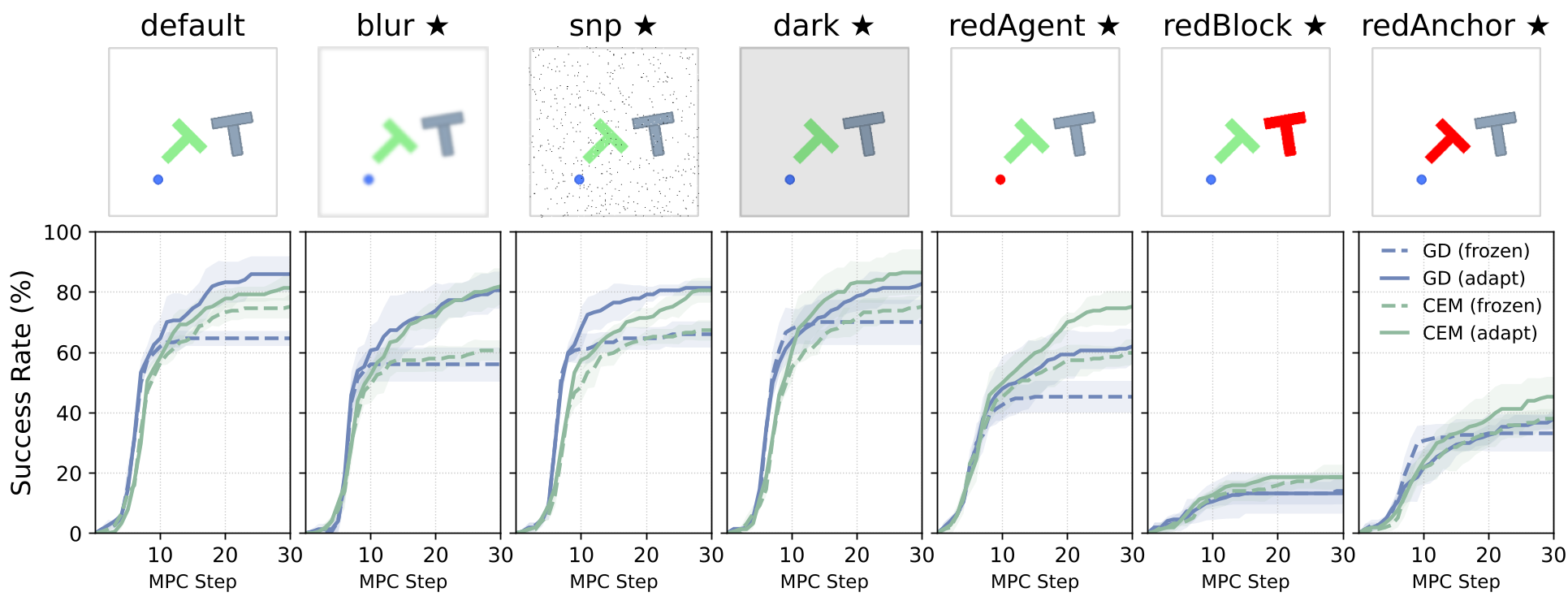
As shown in the charts above, the success rate for AdaJEPA (orange) continues to climb as the agent interacts with the environment, while the frozen model (blue) plateaus. The model literally "gets its bearings" as it moves.
Architecture & Latency
Critics of online learning often point to latency. However, AdaJEPA adds only 10–30 milliseconds to the MPC loop. By using a small "Online Buffer" of recent transitions and performing only a single update, the system remains viable for real-time robotic control.
| Encoder/Predictor | Setting | GD Success (%) | Additive Latency (s) |
|---|---|---|---|
| WM (Global Feat) | Frozen | 84.0 | - |
| WM (Global Feat) | Adapt | 85.3 | +0.03 |
| WM (Spatial Feat) | Frozen | 91.3 | - |
| WM (Spatial Feat) | Adapt | 92.0 | +0.01 |
Critical Insight: The Latent Manifold
Why does it work so well? Visualizations of decoded latent rollouts show that AdaJEPA doesn't just "overfit" to the new noise. Instead, it seems to map the "weird" test-time observations back onto the learned latent manifold. For instance, if the block color changes to red at test-time, the model's internal imagination still "sees" it as the gray block it was trained on—effectively performing a real-time "denoising" of the task-relevant dynamics.
Conclusion
AdaJEPA provides a robust blueprint for the future of Embodied AI. It moves away from the "train-then-freeze" paradigm and toward a "continous recalibration" approach. While there are still limitations—such as being bounded by the initial coverage of the pretrained representation—this work proves that a little bit of online learning goes a very long way in making robots resilient to a changing world.