
AdaExplore: Scaling GPU Kernel Excellence through Failure and Diversity
AdaExplore: Failure-Driven Adaptation and Diversity-Preserving Search for Efficient Kernel Generation
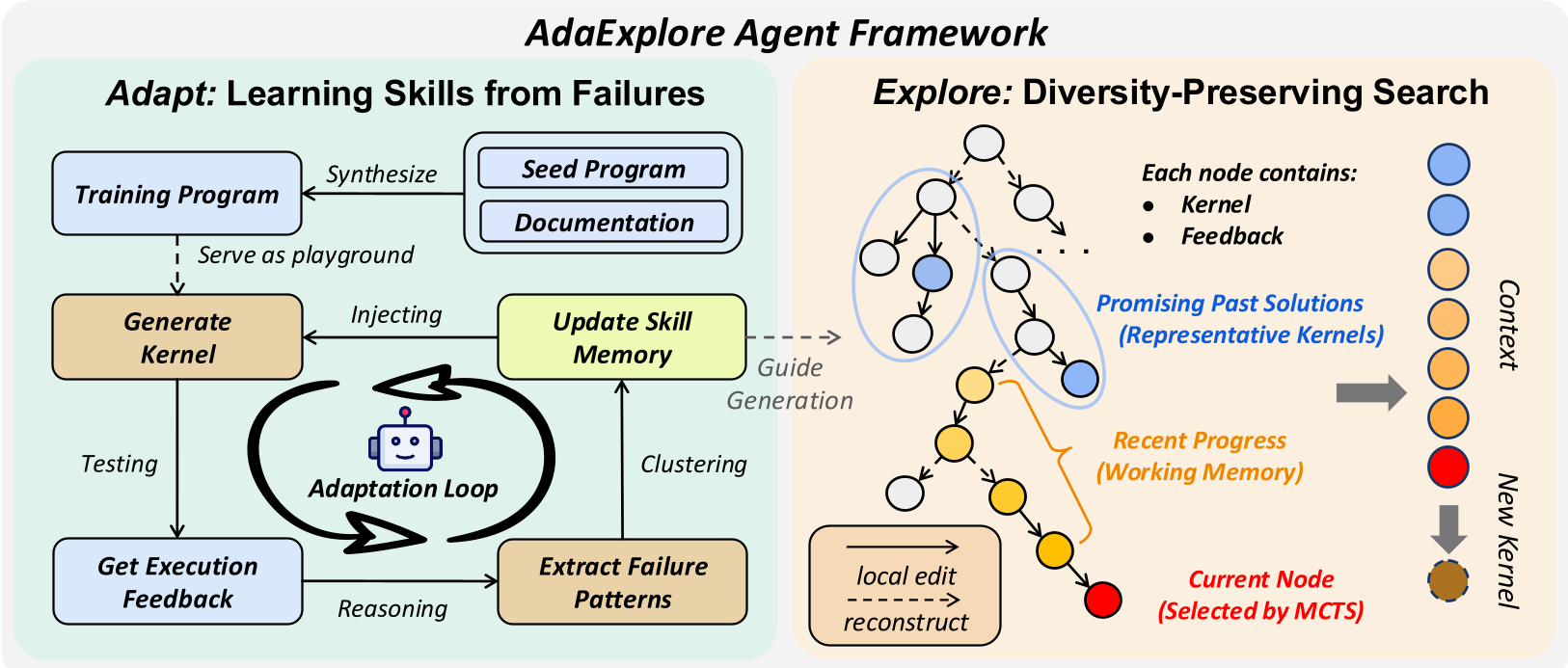
The paper introduces AdaExplore, a dual-stage agent framework for efficient GPU kernel generation (Triton/CUDA). It combines "failure-driven adaptation" to learn validity constraints and "diversity-preserving search" via MCTS to optimize runtime performance, achieving 3.12× speedup on KernelBench Level-2.
TL;DR
GPU kernel optimization is a "high-stakes" coding game where a single character error leads to a crash, and a slight architectural tremor can double the runtime. AdaExplore is a new LLM agent framework that masters this by (1) building a "cheat sheet" of common mistakes from synthetic failures and (2) using a tree-structured search to ensure the agent doesn't get stuck in mediocre "local optima" solutions.
The Problem: The Sharp Boundary of Low-Level Code
Why can't GPT-4 or Claude simply write a SOTA Triton kernel in one shot? The authors identify two fundamental bottlenecks:
- Low-Resource Invalidity: Data for languages like Triton is sparse. Models often fail on basic syntax or hardware constraints (e.g., memory pointers).
- The Rugged Landscape: Improving performance isn't linear. Moving from a 1.2x speedup to a 2x speedup often requires a total rewrite of tiling strategies, not just changing a parameter.
Methodology: Adapt then Explore
AdaExplore breaks the workflow into a "Learning" phase and an "Execution" phase.
1. Adaptation (Learning from the "Grave")
Instead of fine-tuning the model, the authors let the agent "fail" on 200 synthesized tasks. Every time the compiler screams, the agent summarizes why. These summaries are distilled into a Cross-Task Skill Memory. For example: "You cannot call tl.float32 as a function inside a Triton kernel."
This acts as a "System Prompt" extension that drastically increases the Pass@1 rate by preventing the model from making the same amateur mistake twice.
2. Exploration (Tree Search over Chains)
Standard LLM coding usually follows a single refinement chain (Try -> Feedback -> Fix). AdaExplore uses MCTS (Monte Carlo Tree Search).
- Small Steps: Local patches for incremental gain.
- Large Steps: Complete structural regeneration to jump to a different "optimization peak."
Experimental Breakthroughs
The results on KernelBench are impressive. AdaExplore doesn't just "pass"; it optimizes.
- Level-2 Accuracy: Boosted from 22% (GPT-5-mini base) to 100%.
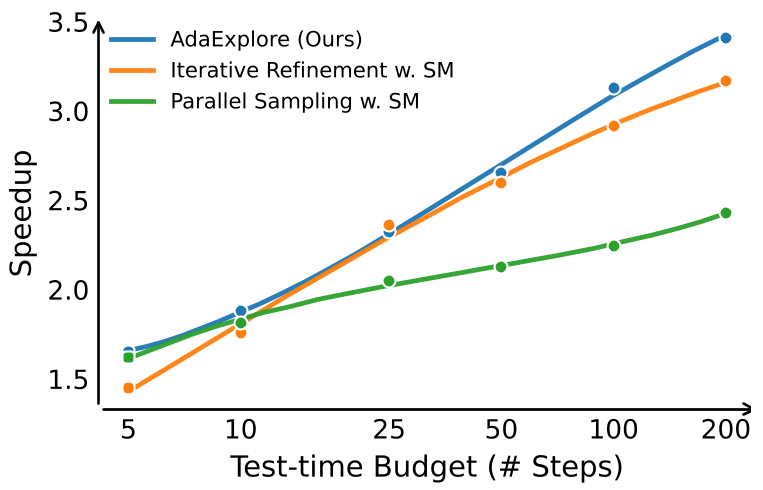
- Speedup: Consistently outperforms simple iterative refinement because it maintains "diverse" candidate paths.
In a shocking case study on RMSNorm, AdaExplore generated a kernel that beat the expert-written FlashInfer CUDA implementation by 1.75×. It discovered that by loading the entire hidden dimension into a single tile, it could keep everything in registers—a strategy an expert might overlook for specific shapes.
Critical Insight: Why Tree Search Matters
As shown in the scaling graphs, AdaExplore's performance widens the gap over baselines as you give it more "test-time compute" (steps). While simple refinement (IR) plateaus, the Tree Search keeps finding new structural breakthroughs. This confirms a growing trend in AI: the future of elite performance isn't just bigger models, but better search at inference time.
Conclusion & Future Look
AdaExplore proves that even "small" models (GPT-5-mini) can achieve superhuman performance in niche, expert-heavy domains if equipped with a memory of past failures and a structured way to explore possibilities.
Limitations: The framework still struggles with "Blackwell-specific" instructions or heavy vendor-optimized math like GEMM (cuBLAS). The next frontier? Incorporating hardware-specific architecture manuals into the "Adapt" stage.
Disclaimer: This analysis is based on the AdaExplore paper.