
Adam Kilgarriff’s Legacy: Moving Beyond the "Bank Model" of Language
Adam Kilgarriff’s Legacy to Computational Linguistics and Beyond
This paper provides a comprehensive retrospective on the scientific legacy of Adam Kilgarriff, a seminal figure in computational linguistics and lexicography. It synthesizes his contributions to word sense disambiguation (WSD), the creation of specific evaluation frameworks like Senseval, and the development of the widely used Sketch Engine software.
TL;DR
This article serves as a deep-dive retrospective into the work of Adam Kilgarriff, the man who fundamentally changed how computational linguistics views "meaning." By rejecting the idea of word senses as static dictionary entries and building the Sketch Engine, he provided the tools and the philosophical framework for modern empirical linguistics and the "Web as Corpus" movement.
Problem & Motivation: The Fallacy of the "Bank Model"
In the early 1990s, the NLP community treated word sense disambiguation (WSD) as a simple classification task. If a dictionary listed three senses for a word, the goal was simply to tag a text with "Sense 1, 2, or 3."
Kilgarriff challenged this in his DPhil thesis, arguing that the "Bank Model" (where senses are distinct, easy to enumerate, and matchable to text) was fatally flawed. He noticed that:
- Dictionary senses often overlap.
- Senses are not "natural kinds" but are often task-dependent.
- Arbitrary dictionary lists don't reflect how words are actually used in massive corpora.
His provocative claim, "I don't believe in word senses," wasn't a denial of meaning, but a critique of the atomic, static way we categorized it.
Methodology: Word Sketches and Semantic Profiling
To bridge the gap between messy corpus data and the needs of lexicographers, Kilgarriff developed the concept of Word Sketches.
1. The Core Intuition
Instead of asking what a word means, we should ask how it behaves. A Word Sketch is an automatic, one-page summary of a word's collocational and syntactic behavior. It captures:
- Modifier relations: What adjectives typically describe this noun?
- Object/Subject relations: What verbs does this noun typically interact with?
2. The Sketch Engine Architecture
Kilgarriff collaborated with Pavel Rychlý to create the Sketch Engine. Unlike purely neural approaches, it uses a robust hybrid model:
- Word Sketch Grammars: Handcrafted rules to identify grammatical relations.
- Statistical Scoring: Using the logDice measure to score the strength of associations.
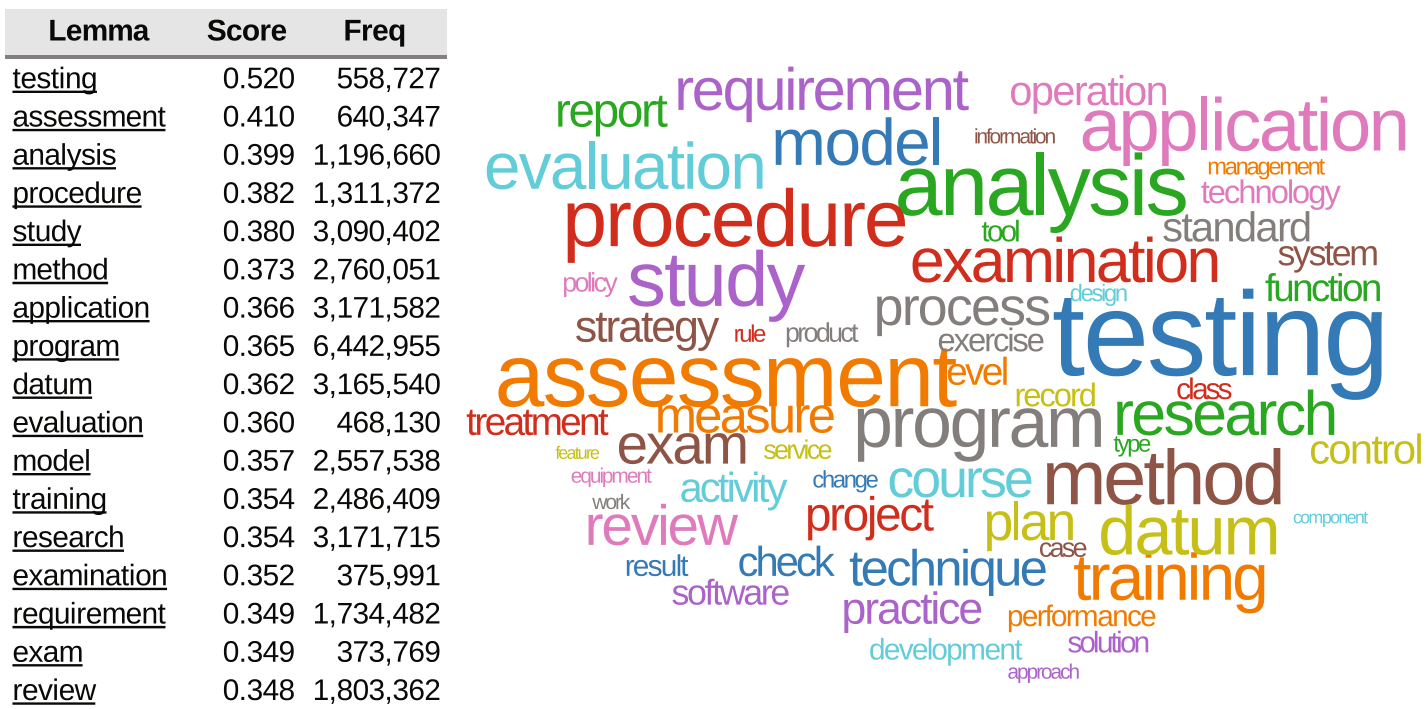 Figure 1: A visualization of a Word Sketch, summarizing grammatical relations into a human-readable table.
Experiments & Results: Standardizing the Field
Adam’s impact was quantified through two major channels: evaluation standards and industrial efficiency.
Senseval (now SemEval)
Kilgarriff was a driving force behind Senseval-1 (1998). By introducing high-quality sense inventories like Hector, he proved that WSD could achieve 95.5% replicability if the data was curated with a lexicographic eye. This moved the field from "bad science" (inconsistent tagging) to rigorous empirical evaluation.
Lexicographic Efficiency
In practical terms, his tools became the engine room for the Macmillan English Dictionary.
- GDEX (Good Dictionary Examples): An algorithm that scours corpora to find the "best" example sentences based on heuristics like sentence length and absence of rare words.
- Result: Lexicographers shifted from manual concordance scanning to a "select and edit" workflow, dramatically accelerating dictionary production.
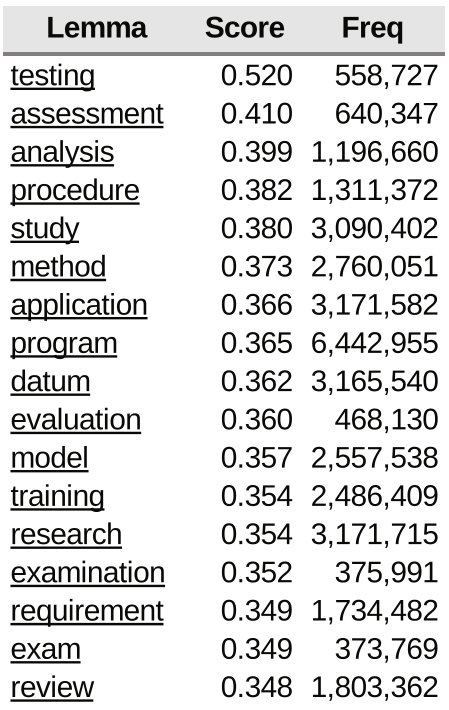 Figure 2: Example of a distributional thesaurus generated by Sketch Engine, revealing semantic relations through shared context.
Critical Analysis: The Professional Legacy
Kilgarriff’s genius lay in his inclusivity and pragmatism. While the field shifted toward "Googleology" (the belief that more data is always better), he cautioned that "Googleology is bad science" without proper corpus analysis and cleaning (e.g., CleanEval).
Limitations & Future Work
His work was deeply rooted in corpus linguistics. In the current era of Large Language Models (LLMs), the challenge remains: can neural models simulate the nuanced, task-specific sense distinctions Kilgarriff identified without relying on the very static dictionaries he critiqued?
Conclusion
Adam Kilgarriff didn't just write papers; he built ecosystems. From the SIGWAC (Web as Corpus) group to the Sketch Engine, his legacy is a reminder that language technology must always return to the data—the "corpora for all"—to truly understand the ever-shifting nature of meaning.