
Adapting Covariate Shift: Ensuring Reliability in Legal AI Systems
12368_Adapting Covariate Shift for Legal AI.
This paper presents a framework for "Adapting Covariate Shift for Legal AI," focusing on detecting and mitigating performance degradation in legal query classification systems. It introduces a binary shift model () to monitor distribution changes between historical training data and real-time monthly user queries.
TL;DR
Deploying a model is only the beginning. In the legal sector, language and user intent are constantly shifting. This paper introduces a specialized framework to detect Covariate Shift—the change in input data distribution—by training a "Shift Model" to distinguish between old and new data, providing a scientific trigger for model retraining.
Background & Motivation: The Silent Accuracy Killer
In Legal AI, a model trained on 2023 case law might fail on 2026 queries not because the logic is wrong, but because the distribution of the language has changed. This is known as Covariate Shift.
Most production systems suffer from "silent failure": the model continues to provide predictions, but its internal mapping no longer aligns with the external reality. The authors argue that we need a proactive way to detect when the training set () and the current month's queries () have diverged enough to require human-in-the-loop intervention or automated retraining.
Methodology: The Shift Model ()
The core innovation is the use of a Shift Model () as a diagnostic tool. Instead of waiting for accuracy to drop (which requires expensive ground-truth labels for new data), we treat the detection of shift as a binary classification problem:
- Labeling: Take historical training data and label it "Class 0". Take new production data and label it "Class 1".
- Training: Train a classifier () to distinguish between these two sets.
- Analysis:
- If the classifier performs poorly (Low and ), the sets are indistinguishable, meaning no significant shift has occurred.
- If the classifier performs well (High ), it means the new data is distinct from the old, signaling a Covariate Shift.

The framework uses the Matthews Correlation Coefficient () to validate the shift model. Unlike simple accuracy, is robust even if the number of new queries is much smaller than the historical set.
Experimental Setup and Mathematical Foundation
The authors define the process using a formal set of variables (see table below). When , it indicates that the model's feature space has been compromised by new patterns.
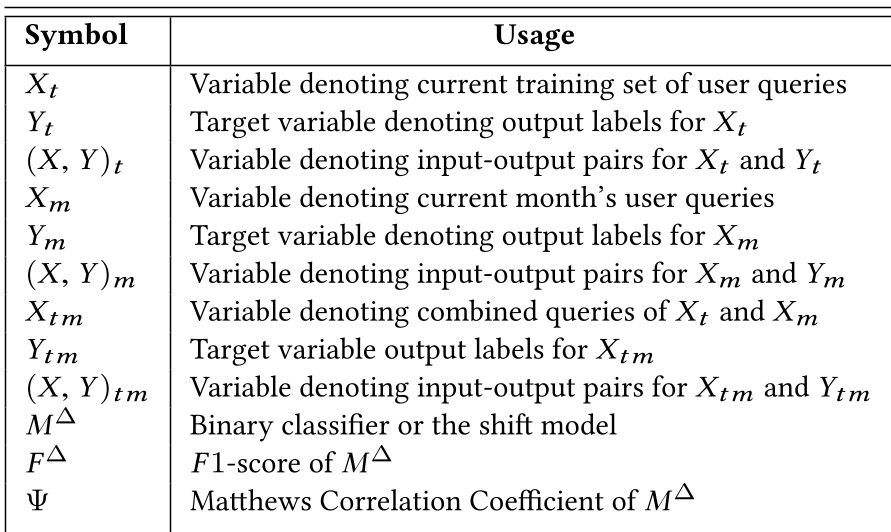
The solution is to merge the sets () and update the target labels (), effectively "adapting" the model's knowledge base to the current temporal context.
Deep Insight: Why This Matters for Legal Tech
Legal language is semi-structured but highly sensitive to context. A shift might represent a new legislative act or a change in how lawyers search for electronic discovery (e-discovery).
The beauty of this method is its unsupervised nature for detection. You don't need the correct "answers" for the new queries to know that the model is drifting; you only need to know that the questions look different than they used to.
Conclusion & Future Look
The paper demonstrates that Covariate Shift adaptation is essential for "Legal AI-as-a-Service." While this work focuses on binary shift detection, the next frontier is Concept Drift detection—where not only the inputs change, but the very definition of a "correct" legal answer evolves.
For practitioners, the takeaway is clear: Monitor your distributions, not just your accuracies.