
EvoAutoLeaders: Solving the Dynamic Community Detection Puzzle via Node Leadership
Adapting the TopLeaders algorithm for dynamic social networks
The paper introduces EvoAutoLeaders, a framework for evolutionary community discovery in dynamic social networks. It builds upon the TopLeaders paradigm, treating communities as groups centered around influential "leader" nodes, and achieves SOTA results on dynamic modularity by balancing snapshot quality with temporal smoothness.
TL;DR
Detection of communities in evolving social networks is notoriously difficult because the "ground truth" is a moving target. In this paper, Gao et al. present EvoAutoLeaders, an algorithm that (1) automatically finds the number of communities and (2) ensures that the detected communities evolve smoothly over time. By shifting the focus from global optimization to tracking "leader nodes," the method achieves superior performance on real-world datasets like Enron emails.
Problem & Motivation: The Static Trap
Social networks are rarely static. Employees join and leave, friendships form and dissolve. Most traditional algorithms aggregate all data into a single "snapshot," which erases the temporal narrative.
The technical challenge lies in Temporal Smoothness. If you cluster each time step independently, the communities might jump drastically between and even if the network changed only slightly. Previous attempts to fix this, like the original TopLeaders algorithm, were limited because they required the user to manually input the number of communities ()—an impossible task for dynamic, large-scale systems.
Methodology: The Core Innovations
1. AutoLeaders: Eliminating the "K" Parameter
The first breakthrough is AutoLeaders. Instead of asking "how many communities are there?", the algorithm identifies "leaders"—nodes that are the most central within their local neighborhood ().
- Rule: A node becomes a leader if its intersection with existing leaders is below a threshold (), ensuring leaders are sufficiently spread out.
- Effect: This mimics social intuition; a leader manages their local tribe, and tribes are defined by how many common friends a member has with their leader.
2. Evolutionary Smoothness via Historical Memory
To prevent communities from "flickering" between snapshots, EvoAutoLeaders introduces a memory mechanism.
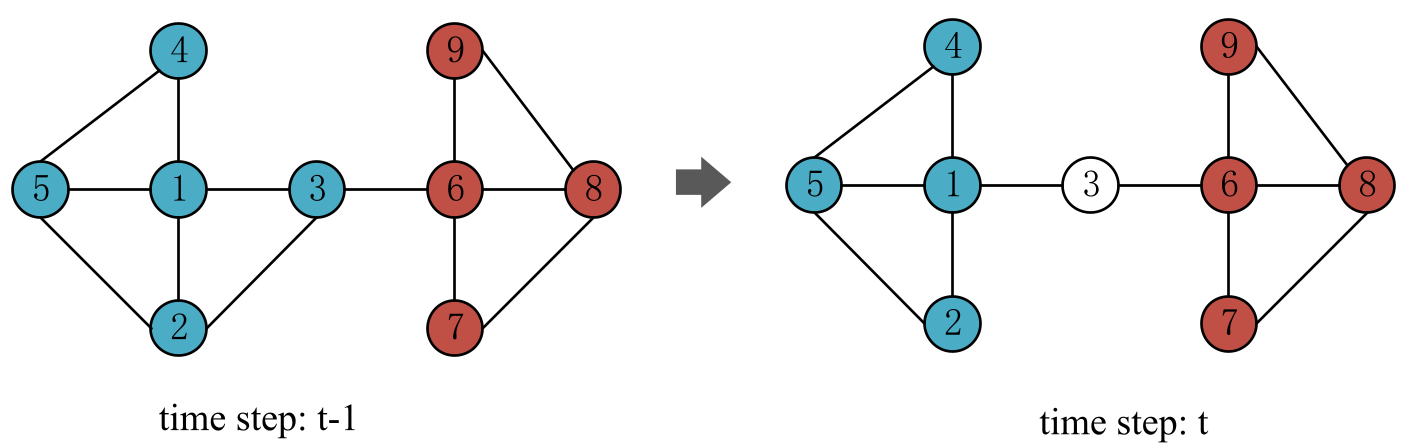
The algorithm calculates the "closeness" of a node to a leader using a weighted formula:
By including the term , nodes are "pulled" toward the leaders they belonged to in the previous step, preventing unnecessary community reassignment.
Experiments & Results: Real-World Superiority
The authors tested the algorithm on several benchmarks, including the famous Zachary's Karate Club and the Enron Email dataset.
- Parameter-Free Success: On static benchmarks like Karate and Strike, AutoLeaders correctly identified the precise number of communities and assigned nodes with perfect accuracy (Purity = 1.0).
- Dynamic Performance: On the Enron dataset (tracking staff communication throughout 2001), EvoAutoLeaders consistently achieved higher Dynamic Modularity (DQ) than its predecessors.
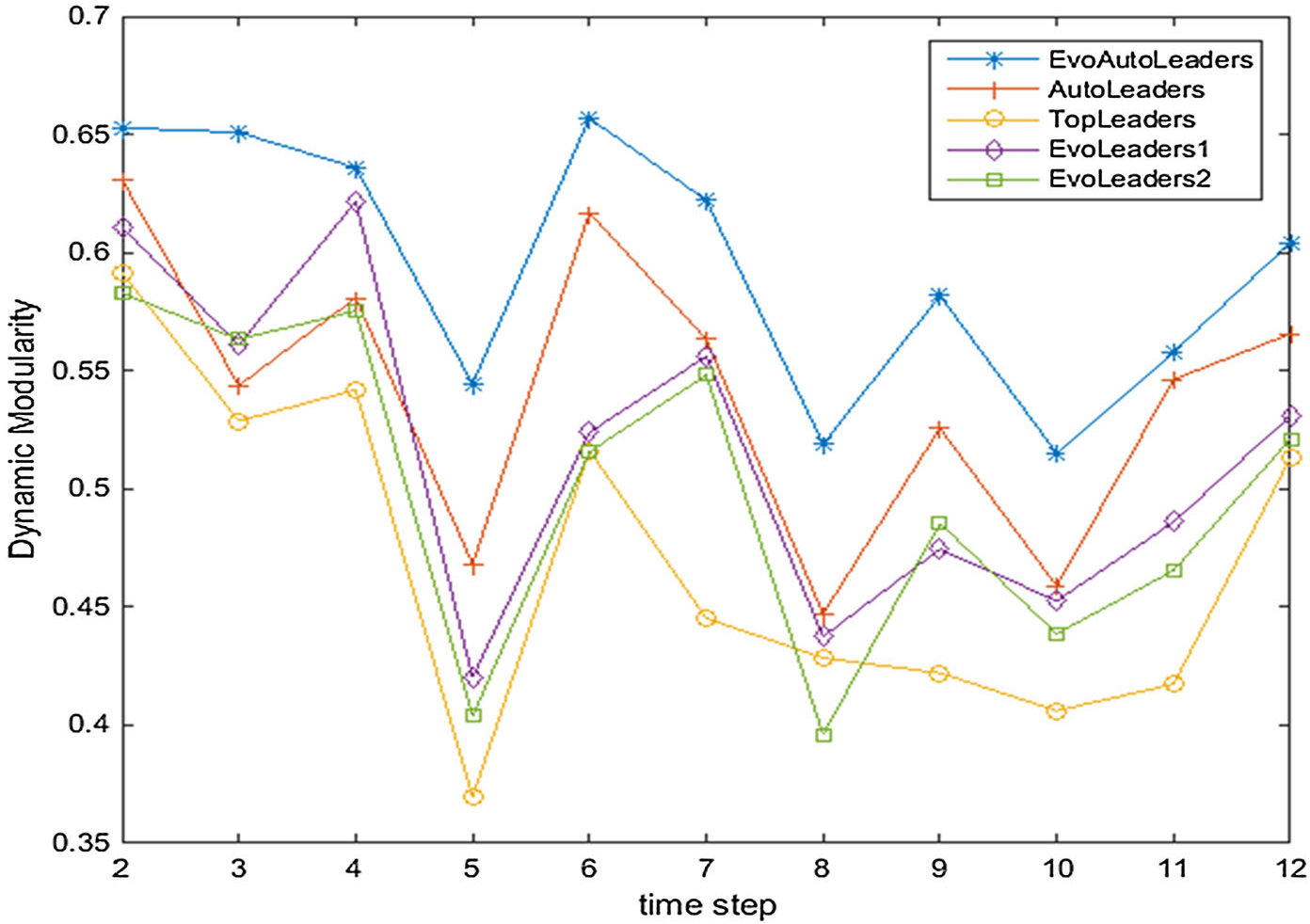
As shown in the charts, while standard TopLeaders and AutoLeaders fluctuate wildly, EvoAutoLeaders maintains high structural quality by effectively bridging the gap between historical and current connectivity.
Critical Analysis & Conclusion
Takeaway: The "Leader-Follower" paradigm is more robust than traditional Spectral Clustering for dynamic networks because leaders serve as stable "anchors" across time steps.
Limitations:
- Metric Sensitivity: The algorithm relies on parameters like (leader intersection) and (outlier threshold). While the authors suggest ranges, these may vary drastically for non-social graphs (e.g., biological networks).
- Sudden Shifts: In cases of "drastic" network changes (e.g., a corporate merger), the temporal smoothness constraint might actually hinder the detection of legitimate structural breaks.
Future Work: Integrating this leader-based approach with Deep Graph Learning (GNNs) could allow the model to learn the association weights () automatically, rather than relying on manual tuning.