
[MIT HAN Lab] IF4: Adaptive Int/Float 4-Bit Quantization for High-Fidelity LLMs
Adaptive Block-Scaled Data Types
The paper introduces Adaptive Block-Scaled Data Types, specifically IF4 (Int/Float 4), a novel 4-bit quantization format that switches between FP4 and INT4 representations for groups of 16 values. It achieves SOTA results in W4A4 settings, outperforming NVFP4 across various LLM benchmarks while maintaining hardware efficiency.
TL;DR
Researchers from MIT HAN Lab have unveiled IF4 (Int/Float 4), a next-generation 4-bit data type that dynamically chooses between Floating-Point (FP4) and Integer (INT4) representations for every 16-element block. By repurposing an unused bit in the scale factor, IF4 reduces quantization error without any memory overhead, achieving SOTA performance in both training (W4A4G4) and inference (PTQ) across massive models like Qwen3.5 and Nemotron 3.
Problem & Motivation: The 4-Bit Bottleneck
As Large Language Models (LLMs) scale, the industry is racing toward 4-bit precision (W4A4) to slash memory bandwidth costs. However, current standards like NVFP4 (NVIDIA's 4-bit Float) have a rigid error distribution.
The core insight of this paper is that data distributions aren't uniform across a model:
- FP4 is great for heavy-tailed distributions with outliers.
- INT4 is superior for more uniform distributions (often seen after Hadamard transforms).
Previous attempts to fix this, such as the Four Over Six (4/6) method, forced a trade-off: they improved precision but shrank the Dynamic Range of the model. The community needed a way to get the "best of both worlds" without losing representational power.
Methodology: The "Eye-Eff-Four" (IF4) Innovation
IF4 introduces the Adaptive Block-Scaled approach. Here is how it works under the hood:
- Repurposing Unused Bits: In standard NVFP4, every block of 16 values has an FP8 scale factor. Since individual values already have sign bits, the scale factor's sign bit is usually wasted. IF4 uses this bit as a flag:
0for FP4,1for INT4. - Range Alignment (The 6/7 Method): FP4 maxes out at 6.0, while INT4 maxes at 7.0. To prevent one format from "overpowering" the other, the authors scale INT4 values by 6/7 before quantization. This aligns both formats to the same [0, 6] range, preserving the global dynamic range.
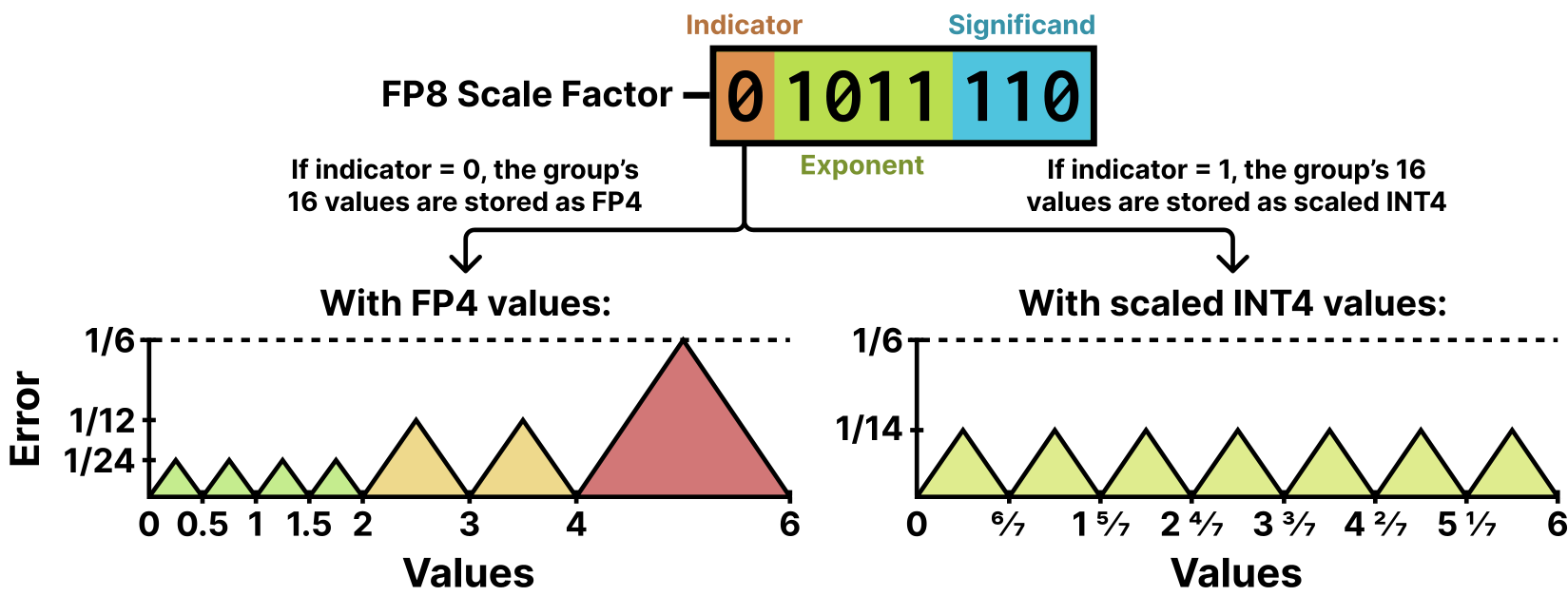 Figure 1: IF4 switches formats per block, picking the representation that minimizes Mean Squared Error (MSE).
Hardware-Friendly Design
To prove this isn't just a theoretical win, the team implemented an IF4 Multiply-Accumulate (MAC) unit in 28nm CMOS.
- Latency: Only a 4.7% increase compared to a "dumb" NVFP4 unit.
- Scalability: The logic overhead is minimal because the scale factors are handled in a separate parallel path.
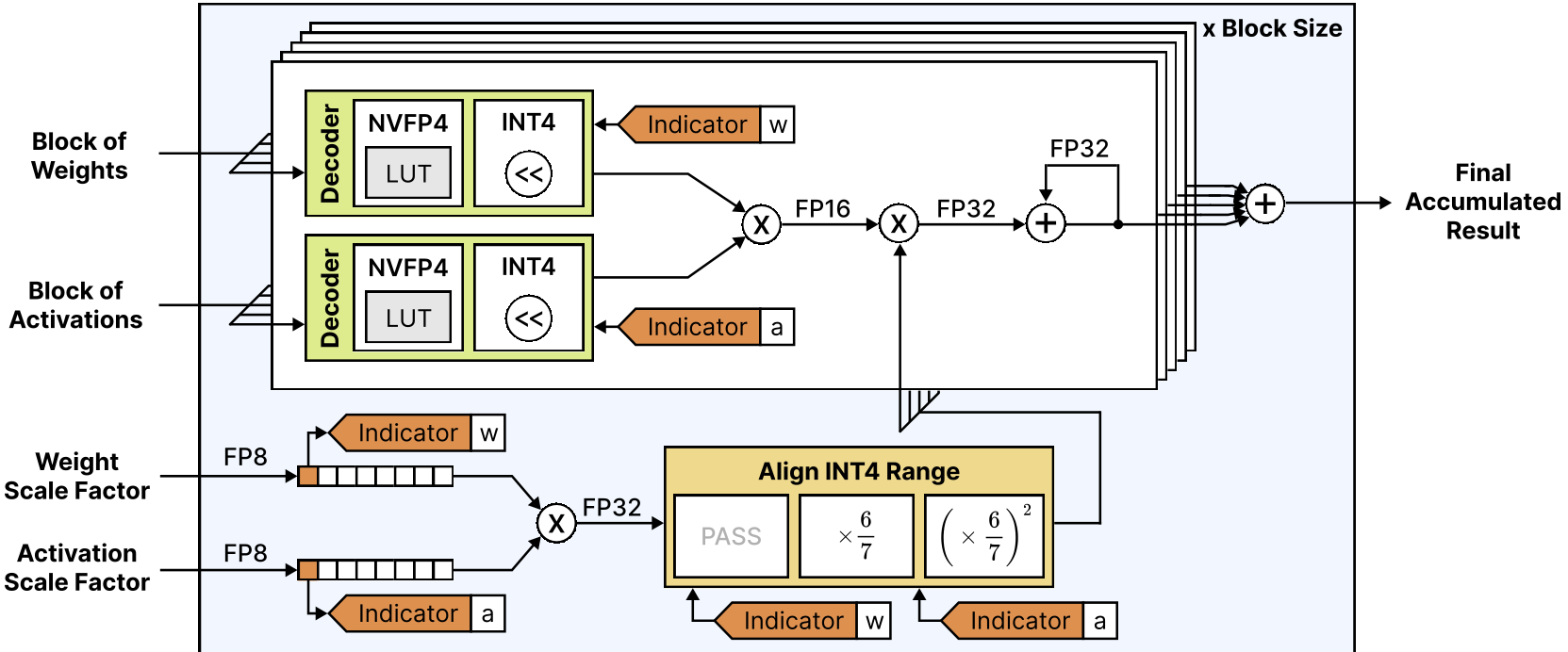 Figure 2: The hardware architecture demonstrates that IF4 decoding can be done with simple shifters and small LUTs.
Experiments & Results: Bridging the Precision Gap
1. Post-Training Quantization (PTQ)
The researchers tested IF4 across several Qwen3.5 model sizes (up to 397B parameters).
- Result: IF4 consistently delivered lower perplexity than NVFP4 and MXFP4.
- Performance: On the 122B-A10B model, IF4 achieved a WikiText-2 perplexity of 6.10, significantly closer to the BF16 baseline (5.72) than any other 4-bit format.
2. Full Quantized Training (W4A4G4)
Training with 4-bit weights, activations, and gradients is the "Holy Grail" of efficiency. IF4 shines here because it adapts to the shifting distributions of gradients during the backward pass.
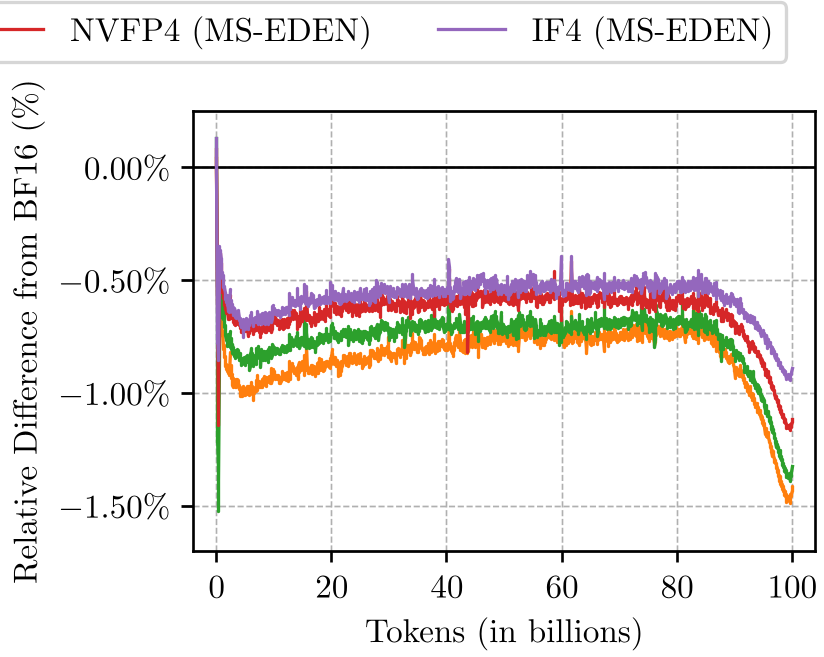 Figure 3: IF4 vs. NVFP4 training curves. IF4 shows a clear advantage, especially when paired with error-reduction techniques like MS-EDEN.
Critical Analysis & Conclusion
Takeaway
IF4 is a rare "free lunch" in AI research. By intelligently using a single indicator bit that was already being transmitted, it provides a significantly more flexible numerical grid. This flexibility is what allows it to handle the "outlier vs. uniform" tension that plagues 4-bit quantization.
Limitations
- Software Ecosystem: While the hardware logic is simple, existing CUDA kernels or Triton implementations would need updates to support the per-block switching logic.
- Hardware Deployment: While simulated on 28nm, it requires next-gen silicon (e.g., successors to Blackwell or MI355X) to see the full speed-up in real-world clusters.
Future Outlook
The authors also hinted at IF3 and IF6. This suggests that as we push toward even lower precision (3-bit), adaptive formats will become the standard, potentially allowing us to run 100B+ parameter models on consumer-grade hardware with nearly zero loss in "intelligence."