
MAC: Blind Socialbot Infiltration via Adaptive Matrix Factorization
Adaptive Crawling in Online Social Networks: a Matrix Factorization Based Approach
The paper introduces the Adaptive Crawling in Online Social Networks (ACOSN) problem and proposes the Matrix factorization-based Adaptive Crawling (MAC) algorithm. It focuses on a practical scenario where socialbots must harvest private user data without prior knowledge of network topology or friend request acceptance rates, achieving approximately 80% of the optimal crawling benefit on real Facebook datasets.
TL;DR
Most research on socialbot "friending" strategies assumes the attacker already knows who is likely to accept a request. This paper tackles a more realistic—and dangerous—scenario: The "Cold-Start" Attack. The authors propose MAC (Matrix factorization-based Adaptive Crawling), a method that allows a socialbot to enter a network with zero connections and progressively map out hidden relationships and harvest private data by predicting friendships purely from observed interactions.
The Realistic Vulnerability: Learning While Crawling
Prior studies often treat social network reconnaissance as an optimization problem over a known graph. However, a real attacker doesn't have the Facebook master graph. They start with a blank profile.
The ACOSN (Adaptive Crawling in Online Social Networks) problem identifies three major hurdles:
- Visibility Constraints: Attackers only see the full profiles of friends. "Friends-of-friends" and "Strangers" remain largely opaque.
- The Exploration-Exploitation Dilemma: Should the bot friend a "Hub" user to see more of the network (Exploration), or a user likely to have valuable private data (Exploitation)?
- Heterogeneous Acceptance: Different users have vastly different criteria for accepting stranger requests.
Methodology: High-Dimensional Inference
The core of the solution is Matrix Factorization (MF). Instead of relying on hard-coded heuristics, the attacker treats the social network as a matrix of latent features.
1. Link Prediction via MF
The bot minimizes a loss function comparing observed edges () against a link function : As the bot gains friends, it fills in the gaps of the matrix, allowing it to predict not just who is friends with whom, but who is likely to accept the bot's request.
2. The MAC Algorithm Flow
The process follows a feedback loop of Predict -> Select -> Request -> Update.

3. Balancing Potential and Profit
The decision function for selecting the next target is defined by a marginal gain , which weighs the immediate "Benefit" (access to private info) against the "Expansion Potential" (how many new nodes are revealed). The authors use a dynamic weight:
- Early phase: Focus on expansion ( is high).
- Late phase: Focus on harvesting data ( is high).
Experimental Insights: Does it work?
Using the Facebook dataset (4,039 nodes, ~88k edges), the researchers simulated the attack.
Performance Curve
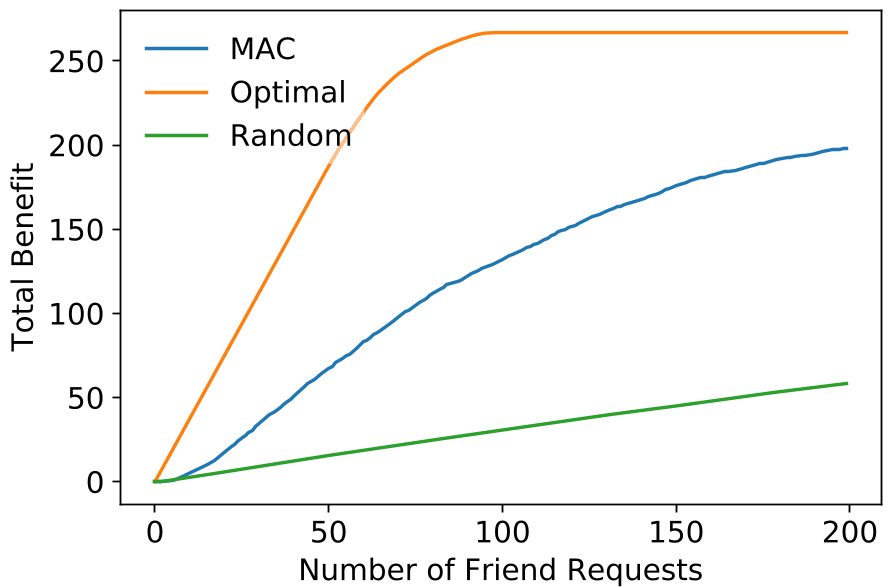
The MAC algorithm experiences a "slow start" while it collects enough data to make the Matrix Factorization meaningful. However, after approximately 50 requests, the performance explodes, far outpacing random selection.
Key Findings:
- Bootstrapping: Targeting "Popular Users" (high-degree nodes with public profiles) is essential to jumpstart the matrix factorization.
- Efficiency: MAC achieved 80% of the benefit of an "Optimal" attacker who has full knowledge of the network.
- Attacker Type: Interestingly, "High-degree" attackers (those who would have had 100-200 friends) were often more successful than "Very High-degree" (200+) ones. The authors hypothesize that extremely high-degree nodes have less "consistent" friendship patterns, making their latent features harder to model.
Critical Analysis & Conclusion
The MAC algorithm demonstrates that privacy in social networks cannot rely on the "hidden" nature of the topology. Latent factor models like Matrix Factorization are powerful enough to reconstruct a user's social context with very few samples.
Limitations:
- The model assumes a static network during the attack duration.
- It does not account for modern OSN defenses like "shadow banning" or rate-limiting friend requests based on low acceptance rates.
Future Outlook: As social networks implement more sophisticated bot detection, we can expect attackers to move toward Graph Neural Networks (GNNs) which may capture non-linear relationship patterns even more effectively than standard matrix factorization.