
Adaptive Dynamics: Scaling the Path to Extinction in Complex Networks
Adaptive dynamics, control, and extinction in networked populations
The paper investigates the dynamics of disease extinction in stochastic and adaptive networks using a pair-based proxy model. It introduces a new transition rate approximation that incorporates link dynamics into Large Deviation Theory to predict the most probable paths and mean times to extinction in Erdős-Rényi networks.
TL;DR
This research moves beyond simple "well-mixed" epidemic models to examine how social networks actually die out. By treating the network as a dynamic entity where links change alongside nodes, the authors use Large Deviation Theory and a novel homotopy-based optimization (IAMM) to predict exactly how a disease collapses. The big reveal? Social adaptation (like rewiring to avoid sick friends) makes extinction much easier to achieve, especially when paired with strategic, non-regular vaccination.
Context: Why Static Networks Over-simplify Reality
In classical epidemiology, we often assume everyone has an equal chance of meeting everyone else. In the real world, we live in networks. Crucially, these networks are adaptive. If you hear a friend is sick, you "rewire" your social links to avoid them.
The problem is that mathematically modeling these "links" alongside "nodes" creates a massive computational burden—the curse of dimensionality. Previous SOTA methods either ignored the local structure or couldn't predict the rare events (like total extinction) that occur far from the steady state.
Methodology: Mapping the "Optimal Path"
The authors propose a pair-based proxy model. Instead of just tracking infected individuals (), they track the types of connections: Susceptible-Susceptible (), Susceptible-Infected (), and Infected-Infected ().
The Mathematical "Bridge"
To solve the complexity, they introduce a homotopy parameter :
- When , the system is a simple, well-mixed soup.
- When , it is a fully structured local network.
By using the WKB approximation (borrowed from quantum mechanics), they treat the probability of extinction as an "action" in a Hamiltonian system. The path to extinction is essentially the path of least resistance (minimal action) through the state space.
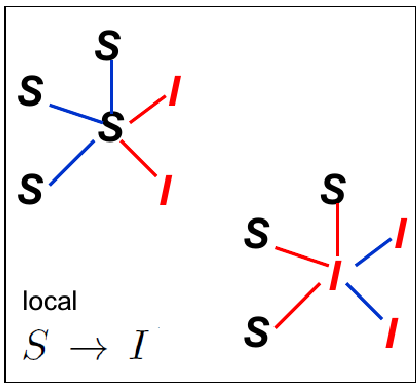 Figure 1: Demonstration of how a single node transition () forces a massive shift in link configurations, a key insight of the pair-based model.
Experiments: Adaptive Rewiring and "Shedding"
The researchers tested their model against Monte Carlo simulations on Erdős-Rényi networks. The results were striking:
- Bistability: In adaptive networks, there is a "tipping point" where both a persistent epidemic and total extinction are stable outcomes.
- Degree Oscillations: In adaptive systems, the average "degree" (number of connections) of infected nodes drops sharply as healthy nodes flee—a process called "degree shedding."
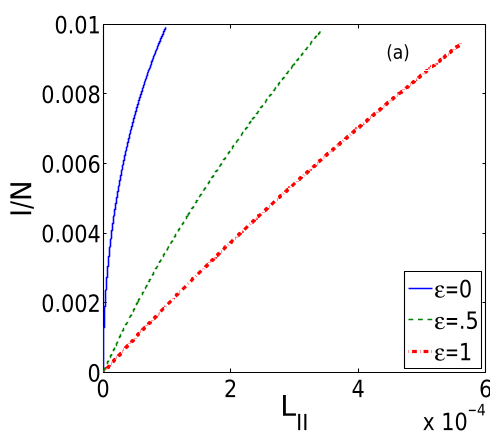 Figure 3: Contrast between the well-mixed path () and the networked path (). The networked path shows a much higher concentration of links before collapse.
Critical Insight: The Synergy of Control
Perhaps the most "actionable" finding is the synergy between Adaptivity and Control. The paper shows that if a population is already rewiring to avoid infection, applying a Poisson-distributed vaccination pulse is far more effective than a regular schedule. This combination can reduce the amount of vaccine needed by up to 1,000x because the vaccine is effectively "inherited" by the high-degree nodes that the adaptive network naturally preserves.
Conclusion & Future Outlook
This work provides a rigorous mathematical framework for predicting rare events in complex systems. It proves that link dynamics are not just a "detail"—they are a primary driver of system-wide phase transitions.
Moving forward, this "pair-based proxy method" holds immense potential for other fields, such as algorithmic trading (where links between stocks change adaptively) or cybersecurity (modeling the extinction of computer viruses in evolving server architectures). The lesson is clear: to understand the nodes, you must first master the links.